


Are you searching for up-to-date content marketing statistics for 2026? You’re in the right place.
Over the past five years, the popularity and overall Google searches for “content marketing” have grown almost threefold.
Have a look;
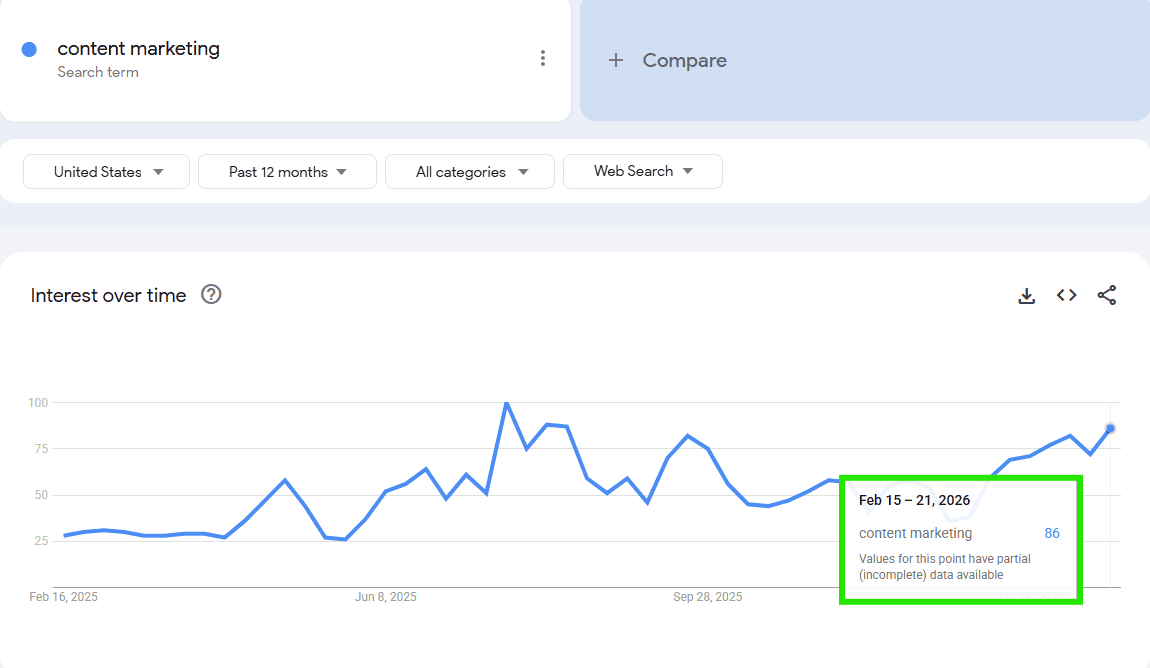
So if you want to unleash the power of content marketing to grow your sales, check out this fantastic list of content marketing ROI statistics.
In this post, you’ll discover the following;
- Important content marketing data
- The key metrics to track
- How to properly optimize your content marketing efforts
Let’s get started!
Content Marketing Statistics [2026 Updated List]
1. Does creating content regularly help with more traffic?
Yes, WordStream reports that businesses that publish blog content at least 16 times per month generate 3.5 times more website traffic and 4.5 times more leads than those that update their blogs only a few times each month.
2. How much do people spend on content marketing?
According to a Semrush survey, 27% of people spend less than $1,000, 19% spend between $1,000 and $3,000, 20% spend $3,000 to $5,000, and 6% report spending over $20,000.
Here’s a detailed breakdown of how much people spend on content marketing each month.
| Spending Range | Percentage of People |
|---|---|
| Less than $1,000 | 27% |
| $1,000 – $3,000 | 19% |
| $3,000 – $5,000 | 20% |
| Over $20,000 | 6% |
3. How do people promote their content?
71% of people use email marketing to promote their content.
Here are some of the fascinating content promotion stats for 2026;
| Marketing Channel / Activity | Percentage of People Using It |
|---|---|
| Social media (organic posting) | 89% |
| Guest blogs on corporate websites | 84% |
| In-person events | 55% |
| Webinars | 55% |
4. Do companies measure content performance?
75% of respondents said their organization measures content performance. Among those, 69% said website engagement provided the most insight into performance.
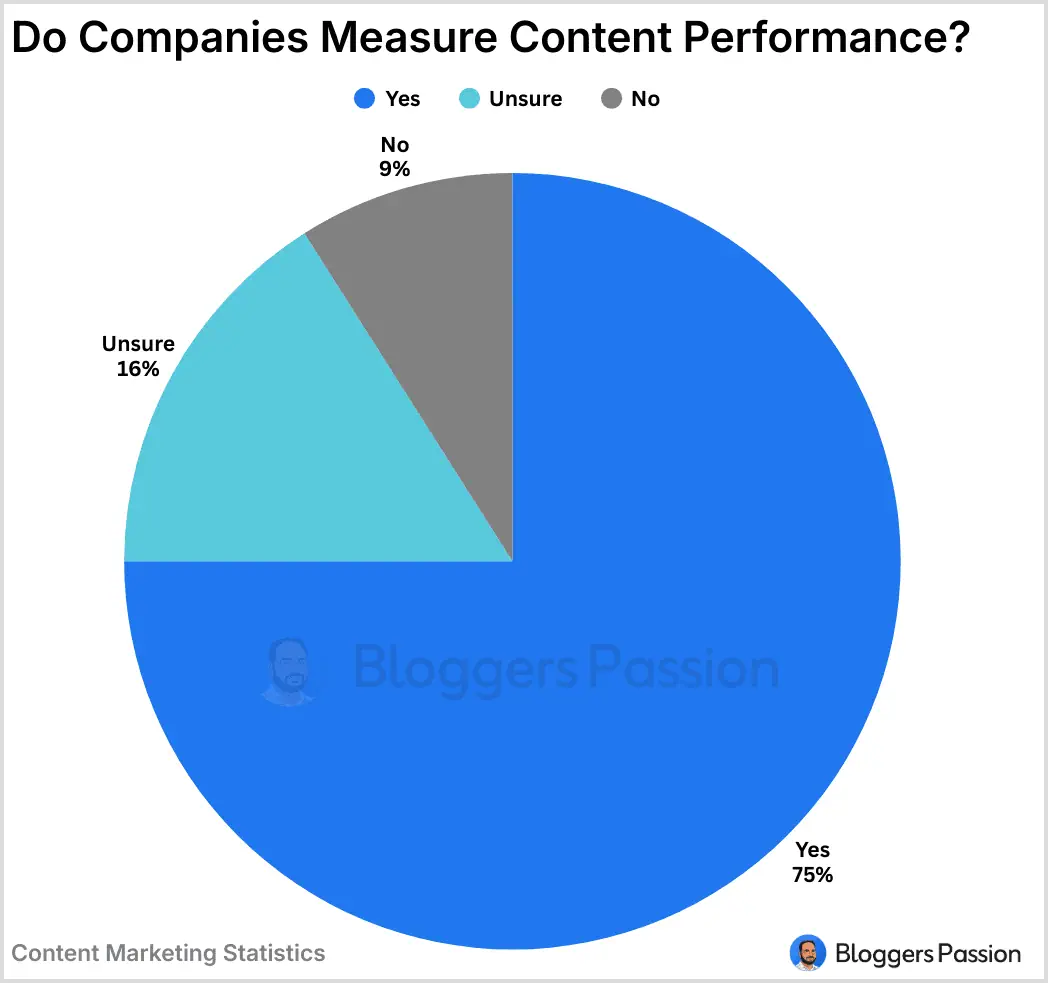
(Source: Content Marketing Institute)
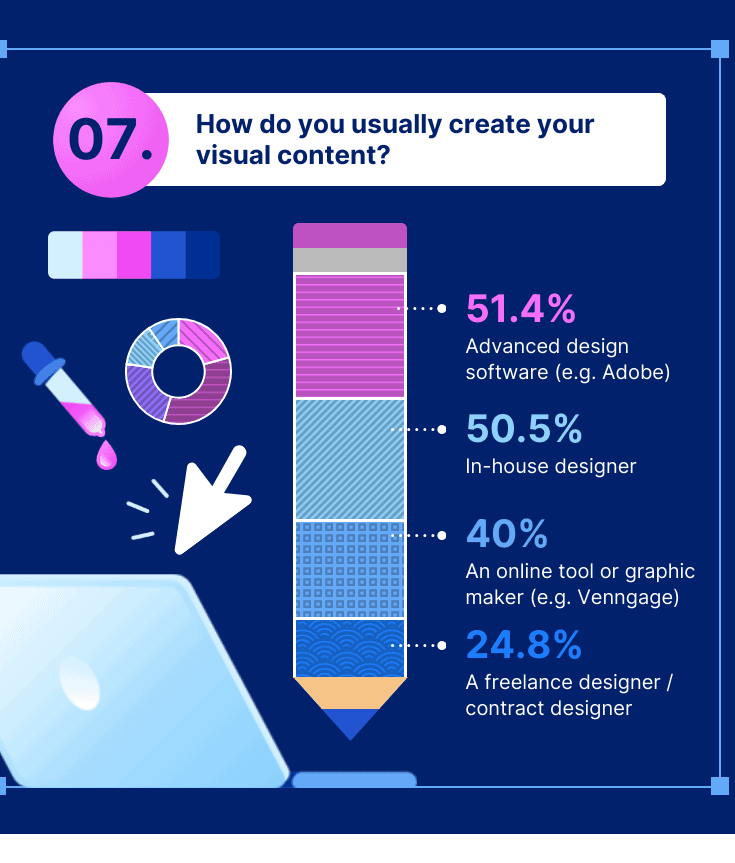
5. What do most marketers typically use for creating visual content?
Venngage reveals that 51.43% of marketers design visual content themselves using tools like Adobe, while 50.48% rely on in-house designers.
40% of them use online tools such as Canva, Venngage, etc., 24% hire a freelance designer to create their visual content.
AI Content Marketing Statistics for Creators
1. How many marketers are using AI for content strategy?
AI is used by 69 to 88% of marketers when they are creating their content marketing strategy.
2. Do businesses use AI for content ideas?
Yes, nearly 88% of businesses use AI to come up with new content and topic ideas.
3. How satisfied are businesses with their AI writing tools?
Yes, when businesses use AI writing tools, most like them. 71% report being very happy with the results.
Content Marketing Stats for Marketers
If you’re a marketer who’s looking for exclusive content marketing stats, this section is for you.
1. What is the biggest challenge for content marketers?
Orbit Media reports that 52% of bloggers are struggling to increase their blog’s traffic.
The following challenges most bloggers face when it comes to content marketing;
- Finding time to create content (49%)
- Creating quality content consistently (35%)
- Coming up with relevant topics (18%)
2. How many hours does it take to write an article?
The average time spent writing an article is 3 hours and 25 minutes. (Source: Orbit Media)
Yes, it does take more time to create high-quality content. You can cut down that time using various tactics such as;
- Taking the help of AI tools like ChatGPT, Jasper, etc
- Hiring a writer or editor
| Year | Average Time Spent per Article |
|---|---|
| 2014 | 2:24 hours |
| 2015 | 2:35 hours |
| 2016 | 3:16 hours |
| 2017 | 3:20 hours |
| 2018 | 3:28 hours |
| 2019 | 3:57 hours |
| 2020 | 3:55 hours |
| 2021 | 4:01 hours |
| 2022 | 4:10 hours |
| 2023 | 3:51 hours |
| 2024 | 3:48 hours |
| 2025 | 3:25 hours |
The bloggers who write detailed 2000+ word articles on average are far more likely to get better results.

3. Which video formats perform best?
Short-form video performs the BEST. The short-form video includes YouTube shorts, Instagram reels, TikTok videos, etc.
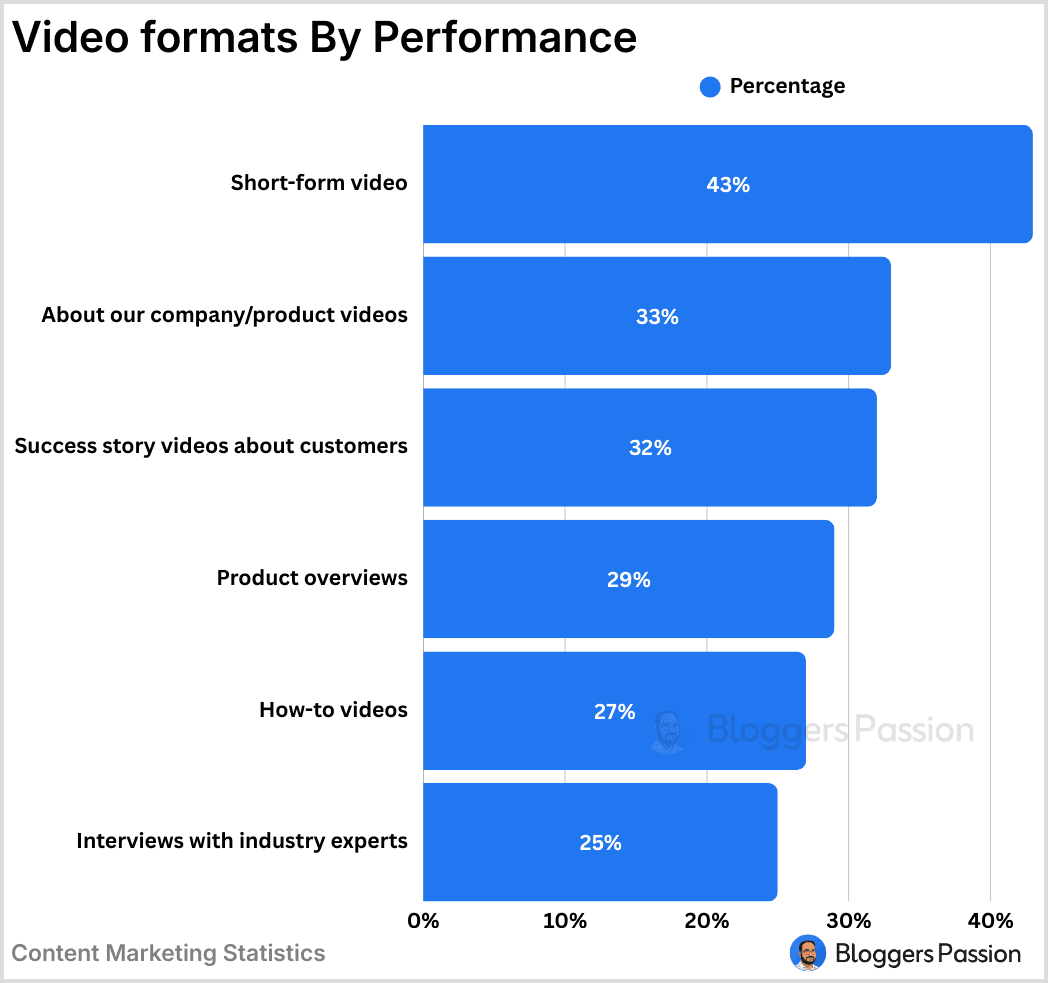
Here are some of the popular video formats that work the best (according to Semrush);
| Video Type | Percentage |
|---|---|
| Short-form video | 43% |
| About our company/product videos | 33% |
| Success story videos about customers | 32% |
| Product overviews | 29% |
| How-to videos | 27% |
| Interviews with industry experts | 25% |
4. What kinds of content are most people publishing?
76% of people are publishing How-to articles and guides.
55% publish listicles, 34% of them publish interviews, and 22% of them publish roundup posts.
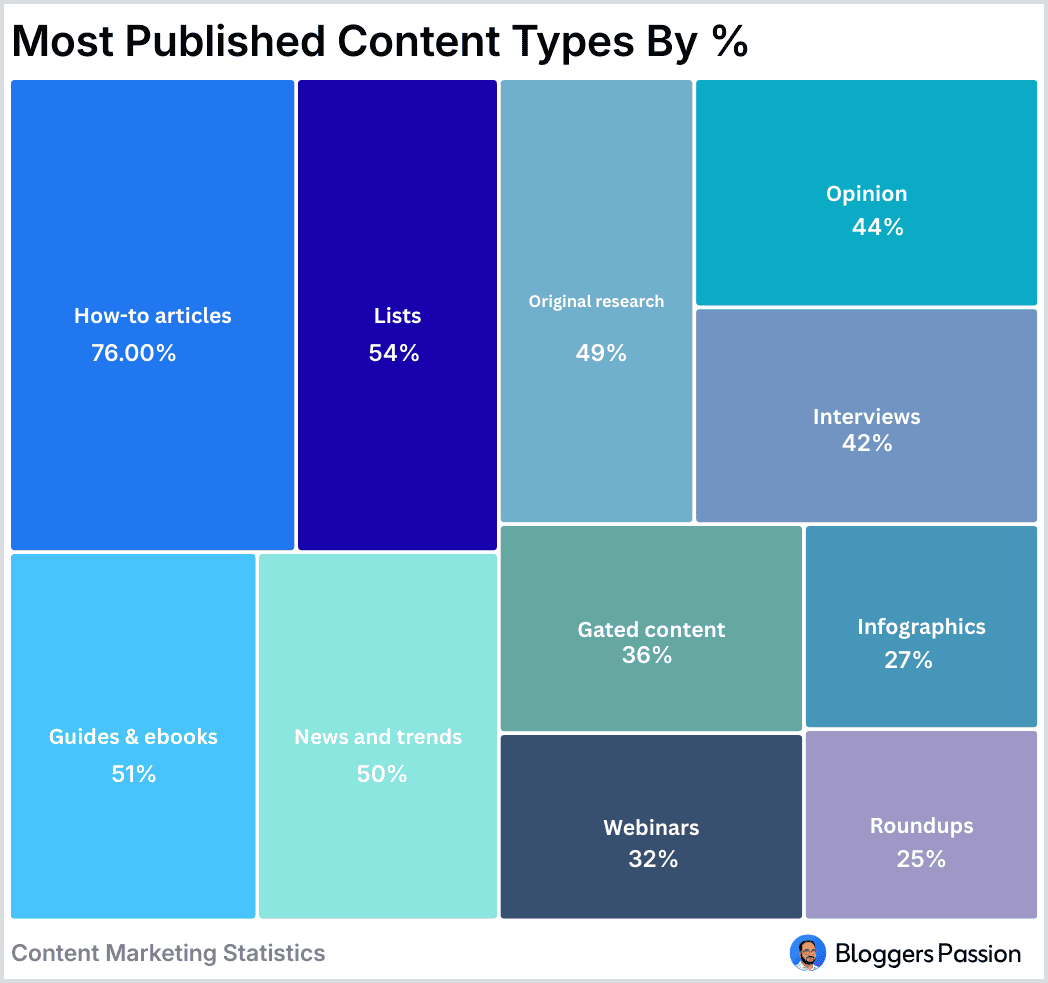
Take a look at complete types of content:
| Content Type | Percentage |
|---|---|
| How-to articles | 76% |
| Lists | 54% |
| Guides & ebooks | 51% |
| News and trends | 50% |
| Original research | 49% |
| Opinion | 44% |
| Interviews | 42% |
| Gated content | 36% |
| Webinars | 32% |
| Infographics | 27% |
| Roundups | 25% |
(Source: Orbit Media)
Fact check: WordPress holds a 61.4% market share in the Content management system.
5. What is the average cost of an article?
The average cost of an article typically ranges from $80 to $2,200, depending on the writer’s experience and the article length (usually 800–2,200 words).
A well-researched piece of content costs $100 for 500 words, whereas high-quality content written by experts will cost $250 per 500 words. (Source: Media Shower)
Here’s a quick breakdown;
| Per Word Rate Range | Cost (800 words) | Cost (2,200 words) |
|---|---|---|
| $0.01 – $0.10 | $8 – $80 | $22 – $220 |
| $0.11 – $0.25 | $88 – $200 | $242 – $550 |
| $0.26 – $0.50 | $208 – $400 | $572 – $1,100 |
| $0.51 – $0.75 | $408 – $600 | $1,122 – $1,650 |
| $0.76 – $1.00 | $608 – $800 | $1,672 – $2,200 |
| $1.00+ | $800+ | $2,200+ |
Source: Clearvoice
B2B Content Marketing Stats
If you’re a B2B company, here’s a curated list of content marketing stats.
Note: B2B (Business-to-Business) marketing refers to marketing products or services to other businesses and organizations.
1. Do companies outsource their content marketing?
Content Marketing Institute (CMI) reports that 75% of large company respondents said they outsourced content marketing activities such as topic research, content creation, editing, promotion, etc.
CMI also reports that 50% of all marketers, 37% of small companies, and 54% of medium companies outsource their content.
| Response | All Respondents | Small (1–99 Employees) | Medium (100–999 Employees) | Large (1,000+ Employees) |
|---|---|---|---|---|
| Yes | 50% | 37% | 54% | 75% |
| No | 50% | 63% | 46% | 25% |
2. What are the top challenges most people face in content marketing?
Semrush states that 55% of people struggle to attract quality leads with their content, 37% of people are struggling to create more content faster, 23% of people are finding it difficult to produce original and high-quality content, and 33% of people are struggling to improve their content rankings in search engines.
| Content Marketing Challenge | Percentage |
|---|---|
| Attracting quality leads with our content | 55% |
| Generating ROI and sales with our content | 42% |
| Generating enough traffic with our content | 38% |
| Creating more content faster (and finding resources for it) | 37% |
| Ranking in search engines | 33% |
| Generating content ideas | 33% |
| Creating content that resonates with our audience | 30% |
| Organizing content marketing processes in our company | 26% |
| Producing original and high-quality content | 23% |
| Hiring highly qualified content marketing talent | 20% |
3. Is content marketing helpful for B2B marketers?
According to CMI, 42% of B2B marketers say they’re effective at content marketing.
Content marketing can generate thousands of dollars if you’re using it right. You need a solid content strategy to educate your customers about your products or services.
4. Are B2B companies spending on content marketing?
Yes. According to eMarketer, the B2B digital ad spend worldwide is expected to reach $48.15 billion by 2026, up from $38.67 billion this year.
Nearly half (47.4%) of global B2B digital ad spend comes from the US. This year, US B2B firms are set to spend $18.34 billion, up 14.9% YoY.
5. Do B2B buyers consume content before buying?
47% of buyers read at least three to five pieces of content before they contact a sales representative. 96% of B2B buyers seek more information from industry thought leaders before buying.
Did you know the U.S. is home to over 30,800 SaaS companies, making it the powerhouse of the global software market? Dive into more fascinating insights in our SaaS Stats report.
B2C Content Marketing Statistics
Here are some of the fantastic B2C content marketing stats for 2026. Businesses target personal consumers.
Note: B2C (Business to Consumers) companies MOSTLY operate on the Internet and sell products to customers online. Traditional B2C examples include major online businesses like Netflix or Spotify.
1. Do B2C companies measure their traffic?
Semrush reports that 51% of B2C companies reported measuring their organic traffic. 19% reported calculating revenue from non-paid channels, such as word-of-mouth marketing.
2. Do B2C companies measure where their leads are coming from?
64% of B2C companies calculate the revenue that their content marketing generates, according to a Semrush survey.
3. Where do most B2C companies invest in content marketing?
57% of B2C companies invest in social media, 45% in improving content quality, 36% in customer research, 35% in creating video content, 28% in search engine optimization, and 7% in AI content marketing tools such as Jasper, ChatGPT, etc.
Here’s a detailed illustration of the main areas of content marketing investment for most B2C companies. (Source: Semrush)
| Content Marketing Investment Area | Percentage |
|---|---|
| Social media/community building | 57% |
| Improving content quality | 45% |
| Customer and audience research | 36% |
| Video content | 35% |
| SEO | 28% |
| Better content analytics | 26% |
| Product marketing content | 25% |
| Content promotion and distribution | 22% |
| Growing the content team | 22% |
| Content design/User Experience (UX) | 16% |
| Events (in-person/hybrid/digital) | 14% |
| Other advanced visual content | 13% |
| Audio content | 12% |
| Thought leadership content | 10% |
| AI content marketing tools | 7% |
4. How many B2C organizations outsource content marketing activities?
50% of B2C respondents said their organization outsources at least one content marketing activity. (CMI)
5. What are most B2C companies’ top challenges while outsourcing content?
48% of B2C companies have budget issues. 47% struggle to find expert content creators, and 31% struggle to find partners who can provide strategic advice. (Content Marketing Institute)

6. What types of content do most B2C companies use?
Among the marketers surveyed, 52% reported high ROI and 47% saw average ROI from their video content. (HubSpot)
7. What B2C video formats produced the best results?
According to HubSpot, 83% of marketers use short-form videos like TikTok, Reels, and Shorts. Most report the highest ROI (71%), engagement (66%), and lead generation (60%) from this format.
| Video Format | Percentage (Highest ROI) |
|---|---|
| Short-form video | 71% |
| Long-form video | 22% |
| Live video | 6% |
8. What content areas will be most important to B2C companies?
Changes to search algorithms (64%), changes to social media algorithms (53%), and data management/analytics (48%) are top considerations for B2C marketers.
Content Marketing ROI Statistics
Here’s a handpicked list of content marketing ROI stats for you.
1. Does creating a short form of content help?
According to the Semrush survey, short content (between 300 to 900 words) attracts 21% less traffic and 75% fewer backlinks than articles of average length (900–1200 words).
Long blog post (3000–7000 words) get twice as many pageviews and 24% more shares than articles of average length (900–1200 words).
So if you’re planning to increase traffic and attract backlinks, create detailed and informative content.
2. Do images in blog posts help with backlinks?
Yes. Semrush reports that 55% more backlinks were generated by blog posts with 7+ images compared to those without.
The U.S. leads in web hosting with about 92 million providers. To learn more, check out web hosting stats.
3. Does interactive content help with better conversions?
Yes. According to MediaFly, interactive content gets 53% more engagement than static content, with buyers spending an average of 8.5 minutes consuming static content and 13 minutes on interactive content.
Some of the examples of interactive content include;
- Quizzes
- Interactive Infographics
- Image Sliders
- Games
- Interactive Maps
- Webinars
4. How much do content marketers earn?
On average, US-based content marketers make over $112,000 a year.
In the US, the most common content marketing job titles are Content Marketing Manager (50%) and Content Marketing Specialist (26%).
| Job Title | Percentage |
|---|---|
| Content Marketing Manager | 50% |
| Content Marketing Specialist | 26% |
| Content Marketing Director | 8% |
| Content Strategist | 5% |
| Content Creator | 4% |
| Copywriter | 4% |
| Content Producer | 1% |
| VP of Content | 1% |
| Head of Content Marketing | 1% |
(Source: Semrush)
67% of shoppers buy just because they see a coupon on a blog post. See more in the coupon usage statistics.
5. Which content formats perform best?
Semrush data reveals that “videos” work the BEST for 45% of respondents.
It is followed by;
- Short-form articles (31%)
- Success stories (28%)
- Long-form blog posts (24%)
- Case studies (19%)
- Webinars and online events (18%)
So, if you plan to create content that attracts a larger audience, you should try creating videos for YouTube. Not only does it have billions of users, but it often sends targeted traffic if you have high-quality videos.
6. What are the top 3 types of content?
HubSpot reported that the top three types of content created by marketing teams in the last year included videos, blogs, and images.
7. Do businesses see an improvement in their content with AI?
Yes. Semrush states that 79% of businesses report an increase in content quality because of AI.

8. What is a good ROI for content marketing?
Most content marketers strive for an average ROI of 5:1. It means $5 of profit gained for every $1 spent on a content marketing campaign.
Content Marketing Facts 2026
Here are some of the interesting facts about content marketing that you should know in 2026.
1. What is the most powerful content marketing tactic?
Email marketing is a powerful content marketing tactic, with an average ROI of $36 for every $1 spent.
2. What percentage of marketers create one piece of content each day?
60% of marketers create at least one piece of content per day.
It can be any content, including blog posts, videos, podcasts, webinars, infographics, newsletters, etc.
Did you know? Every day, 7.5 million blog posts are published online. Explore the blogging statistics for 2026.
3. What is the content marketing market size?
The global digital content creation market was valued at USD 32.28 billion in 2024 and is projected to grow at a 13.9% CAGR from 2025 to 2030.
(Source: Grand View Research)
4. What is the content marketing industry revenue worldwide?
In the last year, the global content marketing industry revenue was estimated at 82 billion dollars. It is projected to reach 107.5 billion dollars by 2026.
(Source: Statista)
Final Thoughts
Content marketing is one of the most affordable ways to increase engagement, website traffic, and sales.
The audience is everywhere, from social media to YouTube to blogs and websites. You need a content strategy to reach out to them effectively. Using a proper content marketing strategy, we built a profitable blog generating $15K monthly.
The above stats on content marketing can help you craft a solid strategy to boost your sales. Have any questions? Let us know in the comments.
FAQs
Here are some frequently asked questions about content marketing facts, stats, and trends.
Content marketing is a strategy that involves creating and promoting content, such as blog posts, videos, podcasts, social media posts, etc., to promote a product, brand, or service.
Compared to regular advertising, such as traditional ads, content marketing gets you 3x the leads for your money and costs 62% less.
Content marketing has a bright future. According to Adobe, nearly 95% of consumers are more loyal to transparent and genuine brands. By creating informative content, you can build trust and awareness.
A good intermediate rate is $0.01 to $1+ per word. The cost of the article depends on the writer’s experience, skills, and more.
Some of the top benefits of content marketing include the following;
– Boost your search traffic
– Increase your sales
– Help with brand awareness
– Increase your social media followers






Leave a Comment
Your email address will not be published. Required fields are marked *