

We all use Google every day as a go-to place for our queries. We search for answers, watch YouTube videos, check maps, store files, and even run businesses using Google tools.
And yet its services are mostly free. Then how does Google actually make money when so many of its services are free?
Well, Google (Alphabet Inc.) has the smartest business model in the world. You would wonder, but as of Sep 2025, Google has generated around $288.9 billion in revenue with 16% Y-O-Y growth.
Most of Google’s revenue comes from advertising, contributing more than half of the total revenue. YouTube subscriptions and Cloud Services also account for a considerable part of Alphabet’s (Google’s) revenue.
In this article, we will break everything down in a simple way. You will see where Google’s money comes from, how much each part contributes, and why some smaller revenue sources matter more than they look.
Let us get straight into it!
Table of Contents
How Does Google Make Money?
Google primarily generates its revenue through advertising. In fact, 60% of Google’s total revenue comes from Google Ads, including ads shown on Search, websites, and apps through AdSense.
As of September 2025, Google has generated yearly revenue of $288.9 billion, with Q3 alone bringing in $102.3 billion. This is a solid 16% increase over the last year, same quarter.
YouTube is one of Google’s strongest contributors outside Search ads. Revenue comes not only from ads, but also from YouTube Premium and YouTube TV subscriptions.
Moreover, Google Cloud is also one of the key sources that brings healthy income. Since more and more businesses are increasingly moving to cloud-based infrastructure and AI tools, Google Cloud contributes roughly 15% of Google’s revenue.
Besides these three major income sources, Google also earns a healthy share through:
- Hardware like Pixel phones and Nest devices.
- Google Play Store and Google Network services
- Google Maps API
- Google Pay
- Gemini and other AI-based services
| Google Revenue Sources | % Share of total Google Revenue |
| Google Ads & AdSense | 60% |
| YouTube (Ads, Premium, TV) | 10% |
| Google Cloud | 12% |
| Hardware (Pixel, Nest) | 3% |
| Google Play & Network | 9% |
| Others (Maps, Pay, Bets) | 5% |
| Google Gemini | <1% |
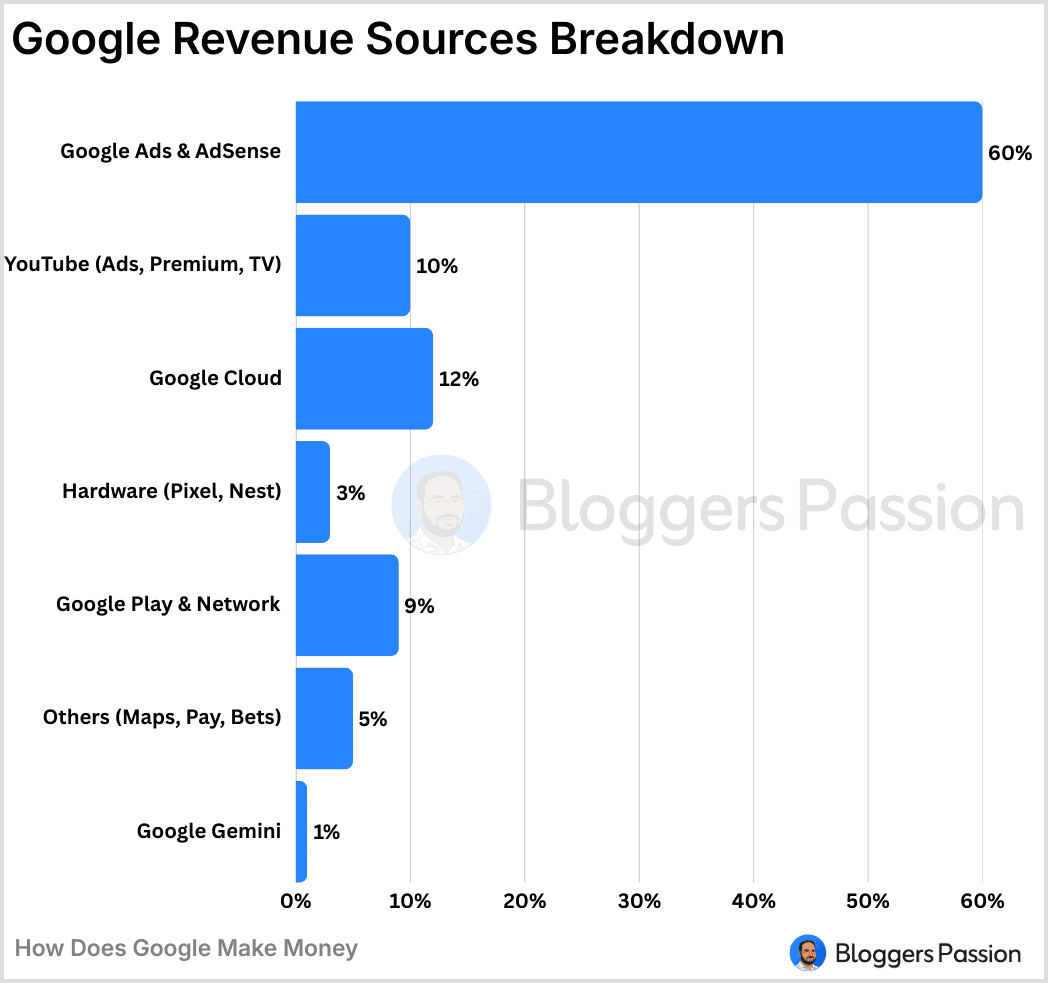
Detailed Breakdown of Google Makes Money
Let’s now take a closer look at Google’s financials. This will provide insight into how much each source contributes to overall Google revenue.
Before we go into the details, here is the revenue generated by Google (Alphabet) in 2025.
| Quarter | Total Revenue as of 2025 | Total Revenue as of 2024 |
| Q1 | $90.23 billion | $80.53 billion |
| Q2 | $96.42 billion | $84.74 billion |
| Q3 | $102.34 billion | $88.26 billion |
| Q4 | – | $96.46 billion |
| Total | $288.99 billion (as of Q3 2025) | $349.99 billion |
(Source: Google Annual Reports 2025: Q1, Q2, Q3)
Google Advertising Revenue
Advertising seems to take the bigger slice when it comes to Google’s earnings. Google comes across these ads directly on Google search or while watching YouTube videos.
Clicking on such ads generates anywhere from a few cents to $50 per click, depending on the niche and competition.
Almost over 60% of Google’s revenue is through advertisements.
This breaks down into three core streams:
- Google Search & Display Ads (the biggest driver)
- YouTube Ads
- Google Network Ads (AdSense and partners)
Combined, all three, Google’s advertising revenue as of Sep 2025 reached $212.37 billion.
| Google Advertising Streams | Revenue in Q3 2025 | Yearly Revenue (as of Sep 2025) |
| Google Search Ads | $56.56 billion | $161.45 billion |
| YouTube Ads | $10.261 billion | $28.97 billion |
| Google Network Ads | $7.354 billion | $21.95 billion |
| Total | $74.182 billion | $212.37 billion |
For 2024, the total revenue generated through advertisements was $257.62 billion.
(Source: Google)
1. Google Search Ads
No doubt, Google search Ads are the most dependable revenue driver in Google’s entire business.
In Q3 2025, Search Ads alone generated $56.567 billion. This accounts for most of Google’s advertising revenue and has dominated over the years, with the largest share.
As of Sep 2025, the collective revenue of Google Search Ads accounts for $161.36 billion of the total advertising revenue.
This is an increase of 12.04% from 2024, the same quarter when the collective yearly revenue was $144.03 billion. The total earnings through Google search ads in 2024 were $198.07 billion.
Here is a breakdown of earnings through Google Search ads as of 2025:
| Quarter | Google Search Advertising revenue 2024 | Google Search Advertising revenue 2025 | % Growth |
| Q1 | $46.15 billion | $50.70 billion | 9.8% |
| Q2 | $48.50 billion | $54.10 billion | 11.5% |
| Q3 | $49.38 billion | $56.567 billion | 14.6% |
| Q4 | $54.04 billion | – | – |
(Source: Google Annual Reports 2025: Q1, Q2, Q3)
2. YouTube Ads
YouTube Advertising is the second major revenue source when it comes to Google’s advertising revenue share. Though growth here has been more gradual than Google Search ads, they are far more diversified.
Talking about the numbers, within just three months of Q3 2025, YouTube ads have generated around $10.26 billion in revenue. The total earnings as of Sep 2025 accounted for $28.97 billion.
| Quarter | YouTube Ads Revenue 2025 | YouTube Ads Revenue 2024 |
| Q1 | $8.92 billion | $8.09 billion |
| Q2 | $9.79 billion | $8.66 billion |
| Q3 | $10.26 billion | $8.92 billion |
| Q4 | – | $10.47 billion |
(Source: Google)
In 2024, Google generated almost $36.14 billion (in a full year) through YouTube Ads and brand campaigns.
Plus, compared to the earlier years, YouTube Ads now benefit from Shorts ads and live stream ads, which makes it less dependent on traditional video formats.
No wonder that YouTube ads are the core part of Google’s long-term advertising strategy.
3. Google Network Ads
Google Network Ads are often the least talked-about part of Google’s advertising, yet they remain a crucial contributor to overall revenue.
For Q3 2025, this segment generated around $7.354 billion through Google’s partner network.
| Quarter | Google Network Ads Revenue 2025 |
| Q1 | $7.25 billion |
| Q2 | $7.35 billion |
| Q3 | $7.35 billion |
| Q4 | – |
(Source: Google)
Google Network Ads monetize third-party websites and mobile apps. Here, publishers allow Google to place ads on their platforms, and Google takes a share of the revenue.
This model once drove explosive growth, but lately, Network Ads have faced increasing pressure from privacy regulations, cookie deprecation, and competition from alternative ad platforms.
So, as you can see, growth here has been a bit slower than search and YouTube ads. But Google Display Network still spans millions of websites and apps globally.
Google Services Revenue
Other than advertising, Google also generates a healthy amount of revenue by offering services.
These services include Google Play Store, hardware sales, and other subscription services.
Including all the Google Services, the Q3 2025 revenue collected was $12.870 billion.
In 2024, total Google Services revenue was reported to be $40.32 billion.
Here is the quarterly revenue of Google Services generated in 2025 and 2024:
| Quarter | Google Services Revenue 2025 | Google Services Revenue 2024 |
| Q1 | $10.37 billion | $8.73 billion |
| Q2 | $11.20 billion | $9.31 billion |
| Q3 | $12.87 billion | $10.65 billion |
| Q4 | – | $11.63 billion |
Plus, one thing about this segment is that most of the income here is recurring. People buy apps, pay for subscription services, upgrade stores, or use Google devices. This makes it small yet considered a revenue contributor to Google.
Let’s know about these services one by one:
1. Google Play Store
Well, the Google Play Store is one of the consistent earners within Google services. The revenue here is earned through the paid apps, in-app purchases, and even the subscription across Android devices worldwide.
Earnings from the Play Store have been steady over the years. Mostly, the subscriptions, especially in gaming, live streaming, and productivity apps, are the key drivers of revenue.
2. Hardware Sales
Google offers some exclusive devices that include Pixel phones, Nest smart devices, and Fitbit products. This is a smaller part of Service revenue, and sales tend to rise and fall depending on product launches.
Hardware sales account for almost 3% of Google’s total revenue.
Well, Google doesn’t treat hardware income as a pure money maker. But rather, it is a strategic revenue segment to keep users inside the Google ecosystem.
So when people use Google devices, they are more likely to use Google’s Search, Assistant, Maps, and subscription.
That means, even though the hardware margins are thin, the long-term value is much higher.
3. Subscription Services
Here comes the most reliable income source of Google services. This includes subscriptions from YouTube Premium, YouTube Music, Google One, and other paid services.
The reason behind it is most likely that it has grown steadily as more users are willing to pay for ad-free subscriptions, premium features, and extra storage.
Once users subscribe, they tend to stay for months or even years. So, this makes it a recurring revenue income for Google.
4. Chrome And Search-Related Licensing
Chrome and Search-related licensing are also the most profitable revenue streams of Google.
It mainly includes payments Google receives from partners for search placement and browser-related agreements.
Google Cloud Revenue
Most of the Google Cloud revenue comes from its platform. It includes services like computing power, storage, databases, analytics, and AI tools used by businesses of all sizes.
Google Cloud brings in around 12% of the overall revenue.
In fact, it has generated around $41.05 billion as of Sep 2025, contributing to strong outside advertising.
In the third quarter of 2025 alone, Google Cloud contributed around $15.15 billion to Google’s revenue.
| Quarter | Google Cloud Revenue 2025 |
| Q1 | $12.26 billion |
| Q2 | $13.64 billion |
| Q3 | $15.15 billion |
This is because Google Cloud income is mostly contract-based and recurring, which offers better visibility of future earnings to Google.
Google Pay Revenue
Compared to the other revenue sources, Google Pay is still relatively small when it comes to revenue generation. Around 3% of the revenue of Google’s revenue comes from Google Pay.
Most of Google Pay’s income comes from merchant services, transaction fees (in some markets), and partnerships with banks and payment providers.
Google does not charge users directly for making payments, which limits short-term revenue but helps increase adoption.
Google Maps API
Google Maps API contributes around 2% to Google’s total revenue.
Companies pay Google to use Maps, location data, routing, and place information inside their own apps and websites. This includes ride-hailing apps, food delivery services, travel platforms, and local business tools.
Businesses are charged based on usage, which means as their apps grow, Google’s revenue grows with them.
Gemini
Gemini is the newest revenue stream of Google, and it is still in the early stages. Currently, Gemini revenue mainly comes from its premium subscriptions and integrations inside Google’s existing products.
Gemini brings up less than 1% to Google’s overall revenue.
This is because Google is not rushing to turn it into a massive money maker for now.
Instead of selling Gemini as a standalone product, Google is using it to improve services people already pay for. These include cloud tools, productivity apps, and developer platforms.
YouTube Non-Ad Revenue
Other than advertising income, YouTube also contributes to the revenue through its non-ad sources like YouTube Premium, YouTube Music, and YouTube TV.
This segment brings in almost 55% of YouTube’s total revenue to Google.
YouTube Premium and Music bring in money through monthly subscriptions. YouTube TV earns money through live TV subscriptions, mainly in the US. Even though this business has higher costs, it helps YouTube compete in the streaming space.
Other Bets
“Other Bets” is where Google places its long-term experiments. These are projects that are not meant to make big money right away, but could turn into major businesses in the future.
In Q3 2025, Other Bets generated $344 million in revenue, which is small compared to Google’s core businesses.
Waymo
Waymo focuses on self-driving technology. It already runs paid robotaxi services in select cities, which is where most of the revenue in Other Bets comes from.
Well, Waymo has moved from testing to real-world use, still it is far from being widely profitable.
Waymo might not be a big money-maker yet, but it is very important for Google’s long-term bets on transportation and AI. Even though it brings in only a small amount of revenue right now, it helps Google test real-world use cases for autonomous driving
How Much is Google Worth in 2026?
When people talk about how valuable Google is, they are really talking about its parent company, Alphabet Inc.
As of early 2026, Alphabet’s market capitalization is the total value of all its shares. So the overall Alphabet’s worth sits around $3.8 trillion.
Alphabet’s total assets were reported at roughly $536 billion as of the third quarter of 2025, up about 25% compared with the same time a year earlier.
Total assets have been increasing steadily year after year. This is giving Google a very strong financial cushion to keep investing in AI, cloud infrastructure, YouTube, and Bets like Waymo and Gemini.
This deep asset base is one big reason why the company can handle heavy R&D spend without worrying too much about short-term shocks.
Google Revenue Breakdown Over The Years
Google’s revenue has grown steadily over the years. It went from $6 billion in 2005 to almost over $385 billion* in 2025.
That’s nearly 63 times more money in 20 years, with an average yearly growth of about 16.7% from 2015 onward.
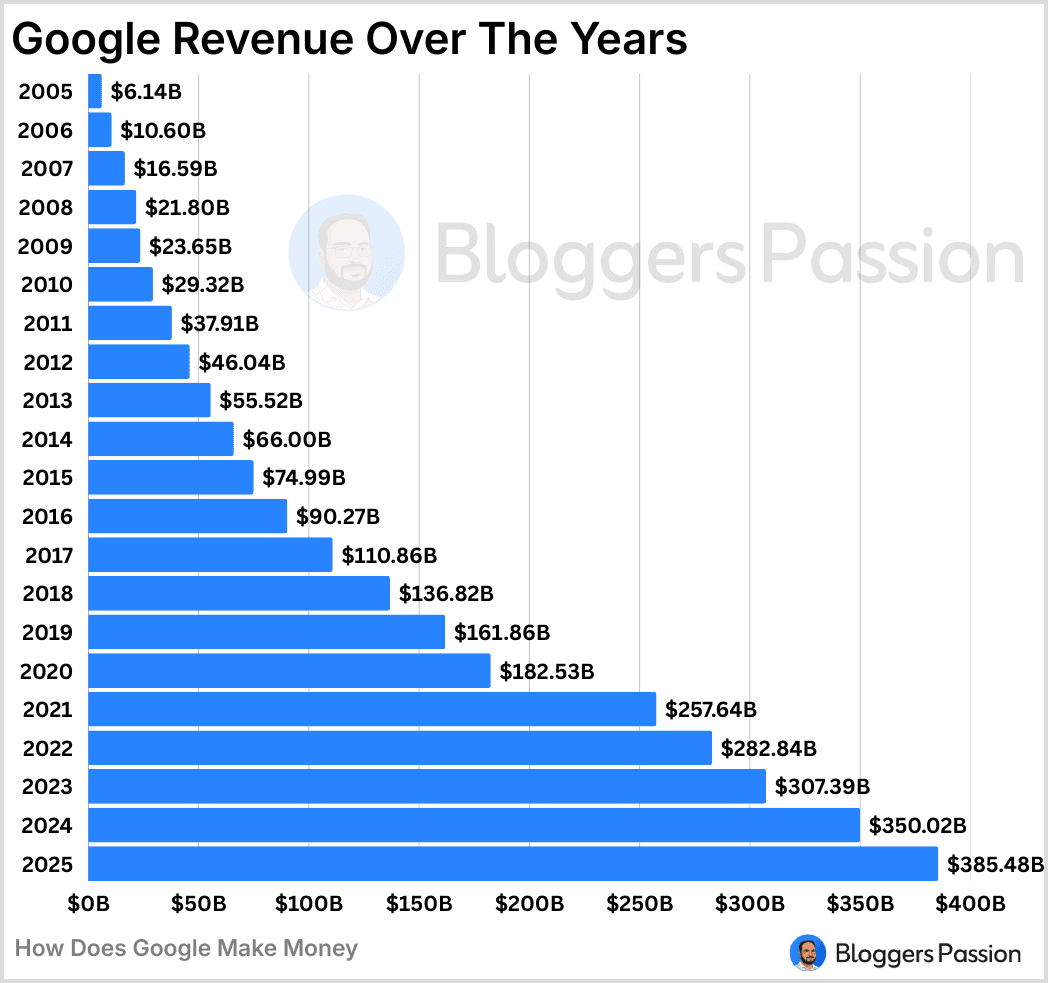
Here’s the full breakdown year by year, with revenue in billions and growth from the year before:
| Year | Revenue | Growth |
|---|---|---|
| 2005 | $6.14 billion | — |
| 2006 | $10.60 billion | 72.76% |
| 2007 | $16.59 billion | 56.47% |
| 2008 | $21.80 billion | 31.35% |
| 2009 | $23.65 billion | 8.51% |
| 2010 | $29.32 billion | 23.97% |
| 2011 | $37.91 billion | 29.28% |
| 2012 | $46.04 billion | 21.46% |
| 2013 | $55.52 billion | 20.59% |
| 2014 | $66.00 billion | 18.88% |
| 2015 | $74.99 billion | 13.62% |
| 2016 | $90.27 billion | 20.38% |
| 2017 | $110.86 billion | 22.80% |
| 2018 | $136.82 billion | 23.42% |
| 2019 | $161.86 billion | 18.30% |
| 2020 | $182.53 billion | 12.77% |
| 2021 | $257.64 billion | 41.15% |
| 2022 | $282.84 billion | 9.78% |
| 2023 | $307.39 billion | 8.68% |
| 2024 | $350.02 billion | 13.87% |
| 2025 | $385.48 billion | 13.42% |
Source: Google
Conclusion: Google’s 10 Major Revenue Sources
To sum up, indeed, advertising is the biggest source of revenue for Google. But Google’s other ventures, like subscriptions, cloud services, and app sales, play an important role in revenue too.
Plus, with Google’s emerging AI tools, Google might have a few more streams added to its revenue model in the future. Perhaps, with a bigger share of contribution.
All in all, Google does not make money in one way, but rather earns from many connected services. And that is why Google continues to grow and stay at the top over the years.
What are your thoughts on this? Do share with us in the comments section below.
FAQs:
Q1: What percentage of Google’s revenue comes from ads?
Around 60% of Google’s total revenue comes from advertising. These include ads from Google Search, YouTube Ads, and AdSense on partner sites.
Q2: Is YouTube profitable for Google?
Yes, YouTube is profitable for Google through ads (~$29B as of Sep 2025), Premium/TV subscriptions, and non-ad revenue. YouTube contributes overall 10% to Google’s revenue.
Q3: How much does Google Cloud earn annually?
Google Cloud earns roughly 12% of total revenue. As of 2025, Google Cloud brought in around $41.05 billion into Google’s revenue.
Q4: Does Google make money from free services?
Yes, Google monetizes free services indirectly via ads on Search/YouTube (~60% total revenue), Maps API, Play Store fees, and ecosystem lock-in from hardware like Pixel.


![21 Best Google Apps You Should Be Using In 2026 [Must-Have]](https://bloggerspassion.com/wp-content/uploads/2019/02/top-impressive-google-apps.webp)




Hi Rahul,
It’s interesting to see how Google’s revenue model continues to evolve beyond just search ads. What really stands out is how data, AI-driven advertising, and diversified services keep strengthening its ecosystem while adapting to changing user behavior and privacy expectations.