

White hat SEO is the only sustainable way to grow your website’s organic traffic in 2026.
Websites that rely on shortcuts and spammy SEO tactics lose rankings quickly, while those that follow ethical SEO techniques continue to grow steadily.
Did you know that 93% of online experiences start with a search engine, making SEO the most powerful way to drive traffic.
In 2026, Google is getting smarter, especially after AI and shortcuts don’t work anymore. What still works is creating helpful content, real experience, and building trust over time.
Table of Contents
What is white hat SEO?
White hat optimization involves using safe and long-term SEO methods that follow search engine guidelines. These techniques focus on real users, not shortcuts or tricks.
On the other hand, black hat SEO uses risky tactics that may work temporarily but can get your site penalized or removed from search results.
Simple example:
- White hat SEO: Writing an in-depth blog post based on real experience and earning backlinks naturally.
- Black hat SEO: Buying backlinks or stuffing keywords just to rank faster.
In short, white-hat optimization helps your site achieve better rankings over time. In this guide, you’ll learn the most effective white hat search techniques for 2026 that actually work and keep your site safe.
5 White-Hat Optimization Methods that Work Like A Charm In 2026
1. Create Content from Real Experience (That People Trust & Link To)
Google now prefers content written by people who actually have the experience on the topic, not content written just to hit a word count.
Instead of writing generic posts like “How to Lose 10 kg”, create content based on your own journey, results, or hands-on experience.
Example:
- Instead of “How to Lose 10 kg”
- Pick an angle like “How I Lost 10 kg in 4 Months (My Diet, Gym Routine & Mistakes)”
This type of content works better in Google because it feels REAL and HELPFUL.
Why real-experience content works better in 2026
- People trust personal stories more than theory
- Google values experience-based content (E-E-A-T)
- Bloggers naturally link to REAL case studies
How to create experience-based SEO content?
The key to writing experience-based content is this: Start with a real problem.
Example: “Why did my weight loss stop after 2 months?”
Share what you actually did, something like;
- Diet changes
- Workout routine
- Tools or apps used
Explain results in simple words
- What helped you the most
- What failed
- What would you do differently
Content types that work best with real experience
- Case studies (How I grew organic traffic from 0 to 100K in 6 months)
- Personal guides (My exact SEO strategies for ranking a new blog in 2026)
- Step-by-step tutorials (Step-by-step on-page SEO checklist I use for every post)
- Comparison posts (what worked vs what didn’t) (3 SEO tactics that worked for me vs ones that failed)
2. Use the Skyscraper Technique
The Skyscraper Technique is about finding popular content, improving it, and getting links.
Step 1: Find Link-Worthy Content
Use tools like Semrush or BuzzSumo to find pages in your niche with many backlinks. If people are linking to it, the topic works.
Using Semrush Backlink Analytics → Indexed Pages, you can easily find which pages on a competitor’s site attract the most backlinks.
Just enter the domain, go to the Indexed Pages tab, and sort by Referring Domains.
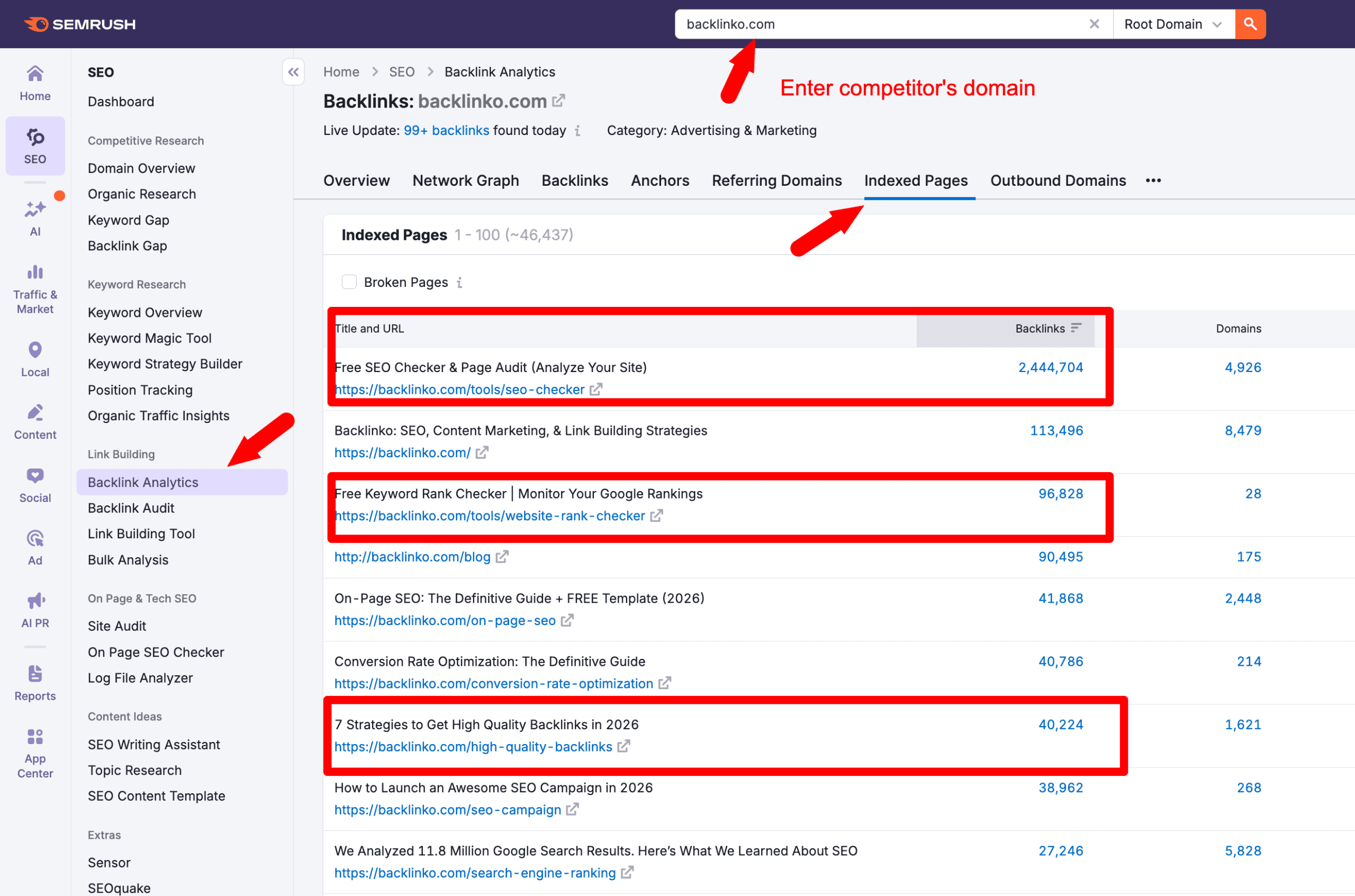
Pages with a high number of linking domains clearly show what type of content people love to link to. These pages become perfect targets for the Skyscraper Technique.
Step 2: Make It Better
Create a better version by:
- Adding updated info (2026 data)
- Making it more detailed
- Using visuals (images, charts)
- Writing in simple and clear points
Step 3: Reach Out
Contact websites that link to similar content and tell them you’ve published a better, updated guide. Use tools like Hunter to find the right email addresses of website owners.

3. Refresh & Update Old Content
Want to increase your search traffic without publishing new content? Update your existing posts. It’s the best white-hat strategy. Old blog posts often stop ranking because they become outdated. After all, nobody wants to read outdated information, not even Google.
Why does updating old content work?
- Google prefers fresh and accurate information
- A few of the old posts already have links, authority, and traffic
- Updating EXISTING content saves time compared to writing new posts from scratch
- It increases the chances of ranking in AI Overviews
Simple example
Old title: SEO Tips for 2023
Updated title: SEO Tips That Work in 2026
What changed?
- New stats
- New Google updates
- New tools
- Better examples
What to update in old content?
- Update facts and statistics. Remove old numbers and add the latest data.
- Delete tools or strategies that no longer work. Add new ones that people actually use now.
- Improve the examples with real use cases rather than theory
- Add missing sections. You can check the top-ranking pages and see what topics you missed.
- Improve readability by using shorter paragraphs, clear headings, and simple language
- Add a short summary at the top
- Answer common questions clearly (use the FAQ section)
- Improve internal links
- Update the publish date
How often should you refresh content?
It depends.
- High-traffic posts, update every 6–12 months
- Important guides, update every 3–6 months
- Evergreen posts, update whenever something changes
4. Broken Link Building
Broken link building means helping websites fix dead links and suggesting your content as a useful replacement.
It still works in 2026, but only when done smartly.
Why broken link building still works
- Website owners don’t like broken pages (even search engines hate broken 404 pages)
- You help them fix an issue
- You earn a relevant backlink
- It’s 100% white-hat and safe
Here are some of the best ways to use broken link building to your advantage in 2026.
Step 1: Find good websites in your niche
Target high-quality sites, not random blogs.
Example: If your site is about fitness:
- Health blogs
- Gym websites
- Nutrition resources
Avoid sites with spammy content or unrelated topics.
Step 2: Look for broken links on useful pages
Focus on:
- Resource pages
- Guides
- Blog posts with many external links
SEO tools like Screaming Frog SEO Spider or Semrush can show pages with 404 (dead) links.
Step 3: Check if you have (or can create) matching content
Don’t try to force someone to link to your content. Do it naturally.
Example: If a page links to a dead article about “Beginner Home Workout Plan”, your replacement content should cover the same topic or better.
If you don’t have it yet, create it first.
Step 4: Reach out with a helpful email
Keep it short and simple.
Instead of asking for a backlink, simply:
- Point out the broken link
- Share your relevant page as an option
Here’s a simple email template you can use while reaching out;
Hi [Name],
I was reading your page on [Page Topic] and noticed one of the links isn’t working anymore.
The link to [Old Page / Topic] seems to be broken.
I recently published a similar, updated resource here:
[Your URL]If you think it’s useful, you can replace the broken link with this one.
Just wanted to let you know, great content, by the way!
Thanks,
Your name
5. Steal your Competitor’s Backlinks
Everyone wants more search traffic. And for that, backlinks still matter.
Instead of guessing where to get links from, the smartest move is to learn from competitors who are already ranking.
Here are some of the best ways to use competition to get backlinks.
Step 1: Find your real competitors
List 5 websites that rank on Google for the same keywords as you.
Example: If you write about fitness or weight loss, your competitors are blogs ranking for:
- “weight loss plan”
- “fat loss diet”
- “home workout plan”
Tools like Ahrefs or Semrush help you find them quickly.
Step 2: See who is linking to your competitors
Use a backlink tool to check which websites link to them.
Why this works: If a site already links to similar content, it may also link to your better or updated content.
Step 3: Find sites linking to multiple competitors
Look for websites that link to 2 or more competitors.
Example: If a fitness blog links to:
- Competitor A’s diet guide
- Competitor B’s workout plan
That means the site is already interested in your topic, which is a perfect backlink opportunity.
Reach out and show them your relevant or improved content.
Step 4: Turn competitor guest posts into your opportunities
Many competitors get links by writing guest posts. Here’s a huge list of free guest posting sites.
You can:
- Search Google for their author name + “guest post”
- See where they’ve written before
- Pitch your own article to those same websites
Example: If a site accepted your competitor’s article on fat loss, it may also accept your updated or experience-based version.
FAQs
SEO stands for Search Engine Optimization, a process of optimizing site content so that they can rank better in search engines like Google.
A blog or any business website is dead without traffic. And SEO plays the key role to boost traffic to a website.
There are three main SEO techniques: White-Hat SEO (safe and ethical), Black Hat SEO (risky), and Grey Hat SEO (in-between with some risk).
Black hat SEO is a set of SEO techniques that may help your site to reach on the top of Google faster but they are against the Google guidelines. While, White-hat SEO techniques follow Google’s Guidelines but generally take longer time.
The best white-hat techniques in 2026 include creating high-quality content, improving on-page SEO and earning natural backlinks.
Final Thoughts
If you want steady and long-term search traffic in 2026, White Hat optimization is the way to go. Don’t rush for quick links or fast rankings, as SEO takes time. Start small, focus on one proven tactic at a time, and stay consistent.
The key is to optimize your content for AI overviews by answering questions clearly (at the beginning) and focusing on real user intent.
Have any White-Hat SEO tips to add? If this guide helped you, share it with others and drop your thoughts in the comments.



Hey Anil Agarwal!
I read your blog, and this is very informative for me. Also, I have something to tell you. after reading this, I realized that white-hat SEO is very important to get organic traffic. I was looking such kind of information it really help me. Even I read many blogs about this but your blog and one more platform that I have found on google, Ennoble Infotech much better.