


Alternative search engines are the easiest way to stop being tracked every time you search online. If you’re tired of Google collecting your search history, IP address, and browsing behavior, you’re not alone.
Most mainstream search engines are built around tracking and profiling users for ads. Privacy-focused search engines work differently. They don’t log searches, don’t store personal data, and don’t follow you across the web.
In this guide, I’ll show you the best private search engines that don’t track users, explain how they protect your data, and help you choose the right Google alternative for privacy.
If you want a safer, cleaner, and more private way to search the web, let’s get started. But before getting into the list, you should understand the differences between the search engines that are closely related.
Conservative vs Private vs Privacy-focused Search Engines

Conservative Search Engines
Conservative search engines are built around ideology, aiming to counter what their creators see as liberal or progressive bias in mainstream platforms. Their main purpose is to prioritize content according to conservative values, not necessarily to protect user data.
Privacy protection is optional and inconsistent in this search engine category. The key point is that these engines focus on the results you see, not on the data collected about you.
Private Search Engines
Private search engines focus on not storing your personal data or search history. They do not create user profiles, do not track searches over time, and usually avoid logging IP addresses beyond short technical needs. They may show Ads based on your current search rather than your past behavior.
Private search engines protect you from being profiled, but they do not automatically make you anonymous online. These engines are designed to reduce data collection.
Privacy-Focused Search Engines
Privacy-focused search engines go a step further by being designed to resist tracking, surveillance, and third-party data leaks. In addition to not storing searches, they actively minimize IP exposure, avoid third-party trackers, use encrypted connections, and often publish transparent or open-source components.
Some engines allow self-hosting or routing through privacy networks. These focus on defensive privacy by design, though full anonymity still depends on tools like Tor or a VPN.
Let me explain to you briefly!
| Feature | Conservative | Private | Privacy-Focused |
| Main purpose | Ideology | Data minimization | Anti-tracking & surveillance |
| Tracks searches | Possibly | No | No |
| Builds user profiles | Possibly | No | No |
| Third-party trackers | Possibly | Sometimes | Actively avoided |
| Ad personalization | Possibly | Contextual | Contextual/None |
| Privacy by design | No | Yes | Strongly yes |
Summary
- Conservative = ideology-driven results
- Private = minimal data storage
- Privacy-focused = strong anti-tracking design
I hope you are clear about the different types of search engines and their privacy strategies. Let’s get into the list!
10 Google Alternatives that Don’t Track Your Data
DuckDuckGo
DuckDuckGo is regarded as one of the best-known private-focused engines and a good privacy substitute to Google. The engine does not maintain any search request logs, record any IP addresses, or create personal profiles on its users; therefore, DuckDuckGo is categorized as a non-tracking engine.
Over time, this data privacy search engine has extended its function past search into a more extensive ecosystem centered on private browsing, tracker blocking, encrypted communications, and a browser focusing on user privacy.
Advantages of DuckDuckGo:
- Unlike Google, your search history is not stored and you will not have IP tracking created.
- Your IP is automatically identified, and your search is automatically encrypted.
- The interface is simple to understand and has advertisements based on keywords.
- Available as a search engine, a browser, and a browser extension.
Throughout the years, I have used DuckDuckGo as my primary search engine intermittently. I typically use this tool when researching sensitive topics or working on client-based projects where data privacy is important.
For someone who is new to using secure search engines, DuckDuckGo is usually where I direct them to start because it is the most straightforward switch due to being easy to use, operating quickly, and providing reliable results while maintaining privacy.
BraveSearch
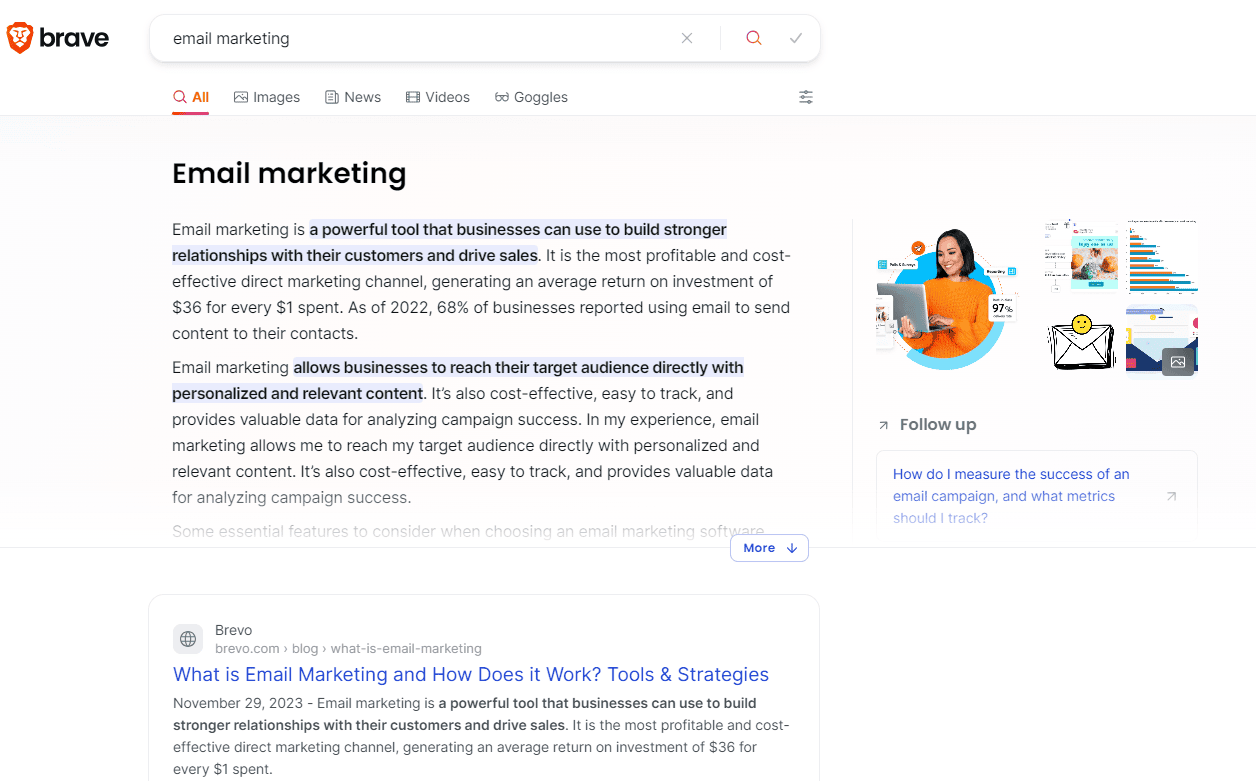
Brave Search offers users a distinct advantage in that it operates using its own independent index for search results, rather than depending on existing services like Google or Bing to provide those results.
As such, Brave Search can be described as an independent and completely private search engine, as it does not log anything that you do with it. Brave Search is also designed to work seamlessly with the Brave Browser, however it functions just as well as a completely separate search engine.
Advantages of Brave Search:
- You won’t be tracked, profiled or logged in any way.
- Operates independently, has a complete search index of its own, and there is not a single proxy from another search engine used to gather results.
- Privacy-oriented users will appreciate the option for an ad-free experience.
- Centred on secure search engines with no ads.
I use Brave Search regularly for researching technology, SEO and competitors, as I prefer to view results that are not impacted in any way by what I’ve previously searched for. Based on my experience, this internet search tool has improved accuracy, compared to how I remember it from its early days.
Today, I believe that it has excellent coverage of most search queries. Therefore, when asked for a search engine that has a focus on privacy and does not use Google at all, I’d recommend you look at Brave Search.
Qwant
Qwant, which is a European-based privacy search engine, offers a secure browsing experience that protects users’ privacy and complies with European data protection laws.
Unlike many other search engines, Qwant does not track any information about users (e.g., search history), store personal data, or create ad profiles for the user, therefore offering a highly secure search experience for those users who want their searches to be kept private and secure.
Advantages of Qwant:
- No tracking or cookies are used.
- Protected by European privacy regulations.
- Contains a minimalist design that provides access to three main tabs of news, social and images.
- Suitable for people in areas looking for search engines that follow more conservative principles in other countries.
I have used this excellent resource while working with clients in Europe who take privacy compliance seriously. While the overall depth of results is not as deep as those provided by Google, I feel that Qwant is a suitable option for everyday searching and news discovery.
If you value privacy and are interested in finding a viable alternative to Google, I recommend Qwant as a highly reliable conservative search option. At present, it is not available in India.
Privacy Engines with Advanced Features
MetaGer
MetaGer is a Germany-based search engine that is designed to keep your privacy safe by allowing you to search the internet anonymously. Most of the popular search engines do not let you open the search results anonymously, which means that when you click on a link, your IP address is sent to the website, which allows the site to track your activity.
This Google substitute uses a proxy server to let you view search results anonymously. The proxy server will mask your IP address from the destination website and reduce the number of times the destination website can track your activity. In addition, MetaGer has partially open-source code and operates in compliance with German and European Union privacy laws.
Advantages of MetaGer:
- Optional proxy access for IP anonymization while visiting result links
- No user profiling or persistent tracking
- Operates under German/EU data protection regulations
- Suitable for users who want an added anonymity layer beyond search
MetaGer is ideal for users who need to search for sensitive information, such as competitors, topics, and so on, without the destination websites tracking their IP addresses or referrer data.
While speed is not the most important consideration for me, it is an important feature for users who want secure web searching and additional privacy controls.
Swisscows

Swisscows is a private search engine developed in Switzerland, with an emphasis on user privacy, data protection and ensuring safe search results. It does not record your search queries or IP address; it does not store any personal information about its users, and it uses semantic search technology to provide search results, rather than relying on profiling users based on their past activity.
This amazing search source has a family-friendly filter that automatically blocks access to any content that may contain adult or explicit material.
Advantages of Swisscows:
- No tracking, storage or profiling of user activity
- All data is kept secure within the Swiss data centers.
- Searches are based on semantics and not behavioral targeting.
- A great choice for families, schools and work.
I have used Swisscows while creating educational and family-friendly resources, and I have always found it to provide safe and relevant search results. I wouldn’t typically use it for technical research but it is one of the best non-tracking search engines that prioritizes content safety and privacy.
Mojeek
Mojeek is among a handful of independent search services that have developed their own search crawlers and indexes, unlike many services that depend upon either Google or Bing.
Unlike many other services, Mojeek’s search results do not track user activity; they do not store user searches and they do not create a user profile nor link user searches to each other or to any other form of identification. The only personal information that Mojeek stores is what is needed for an account to run its search engine (e.g. your email address). The number of indexed web pages has steadily increased from 9 million in 2012 to over 5 billion today.
Advantages of Mojeek:
- The only service using a completely independent crawling and indexing system
- No tracking; no cookies; no behavioural advertising
- Search results are completely impartial with no personal bias
- Ideal for individuals who are looking for a search alternative to “Big Tech.”
I typically turn to Mojeek when I need search results without any form of personalized results coming from another search engine. I find it especially helpful during my research, exploration of new things online, and comparing search results from different services to see how they differ on the web.
For example, if someone were to ask me for a conservative independent search engine alternative to Google, without any links to “Big Tech,” I would almost immediately provide him/her with Mojeek.
Advanced / Technical / Decentralized Privacy Search Engines
SearX/SearXNG
Searx is an alternative search engine that aggregates searches based on user-provided input via the Internet without ever tracking users. As an open-source project, Searx is being continually developed by its community. It’s very popular among developers and those interested in privacy because of the ability to run Searx on their own server.
Advantages of SearX:
- Non-tracking of users, nor log/search history.
- Ability to anonymize your IP address using proxies or via Tor.
- Completely open-source and can be customized by anyone.
- Can be self-hosted for maximum data privacy search
I used public instances of SearxNG when I wanted an unbiased, neutral search result without the influence of Big Tech. A few times, I have installed a self-hosted version of SearxNG on a VPS (Virtual Private Server) out of curiosity. This is not child-friendly, though, as it is a very complex installation that allows for complete transparency regarding the search results.
This is why SearxNG is one of the strongest tools available if you are an advanced user and very concerned about the security of web searches.
Presearch
Presearch is a decentralized search engine built on a blockchain-backed infrastructure, designed to reduce reliance on centralized search monopolies. Instead of tracking users, it distributes search activity across nodes and rewards participants with tokens, positioning itself as a conservative search engine alternative to Google with a community-driven model.
Advantages of Presearch:
- Decentralised Search System
- No Records of Users’ Searches, or Search Profiles
- Users are rewarded for their search activity (token systems)
- Community-operated nodes instead of centralized control
I personally tested Presearch to learn how a decentralised search system operates. Although I occasionally found the results somewhat ‘rougher’ than those from Google, I clearly saw the privacy-first ethos of the Presearch model.
It is attractive for anyone who wants to keep their search activity and results private, or who wishes to support an alternative to ad-supported search models.
YaCy
YaCy is an entirely decentralized, peer-to-peer search engine. Users are responsible for creating and hosting the indexing of distributed search queries. With no single point of control for all searches, there is no tracking of search activity and no collection or retention of search history on the server side.
Advantages of YaCy:
- Fully decentralized, peer-to-peer architecture
- No central authority, no data collection
- Can be run locally or contribute to the global index
- Strong resistance to censorship and tracking
My experience with YaCy is more research and experimentation than daily use. I wouldn’t recommend this Google replacement search engine to the average user; however, it is intriguing to observe how search engines that operate in a decentralized manner without being tracked and without ads still function.
I find that for those who are extremely privacy conscious and for technologists who prioritize data privacy over convenience, YaCy is the extreme end of the scale regarding data privacy for search engines.
Premium Approach
Kagi
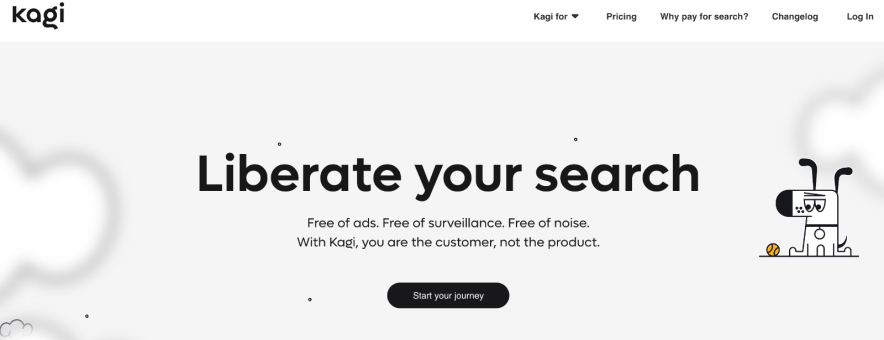
Kagi takes a very different approach compared to most privacy-focused search engines by removing advertising entirely and operating on a paid subscription model. Instead of monetizing user data, this search tool is funded directly by its users, which allows it to deliver high-quality results without tracking, profiling, or behavioral ads.
It combines results from multiple sources with its own ranking system, while actively blocking SEO spam and low-quality content, making it a strong Google alternative for privacy.
Advantages of Kagi:
- No ads, no tracking, no data resale — true subscription-based privacy
- No search logging or user profiling (supports anonymous usage)
- Strong spam filtering and customizable result ranking
- Focus on secure web search and long-form, high-quality results
I started using Kagi out of curiosity when I felt Google’s results were becoming too cluttered with ads and SEO-driven content. What stood out immediately was how clean and relevant the results felt, especially for research-heavy queries.
Paying for search felt odd at first, but over time, I realized the trade-off was worth it. It feels closer to how search used to work, just without surveillance. For anyone serious about data privacy search and willing to pay for a better experience, Kagi is genuinely refreshing.
FAQs
A private search engine does not track searches, store IP addresses, or build user profiles. Most non-tracking search engines avoid logging altogether or anonymize data so searches cannot be linked back to individuals.
“Safest” depends on what you value most. DuckDuckGo is the easiest and most beginner-friendly. Startpage is ideal if you want Google results without tracking, Swisscows focuses on privacy plus family safety, while Brave Search and Mojeek stand out for independence.
Most privacy-focused search engines avoid logging and tracking, but true anonymity depends on how you use them. Combining a private search engine with a conservative web browser, VPN, or Tor offers much stronger IP anonymization.
Some do, but in a privacy-safe way. DuckDuckGo and Brave Search may show keyword-based ads without tracking users, while engines like Mojeek, Swisscows, and Kagi focus on secure search engines without ads or minimal advertising.
You can change your default search engine from your browser settings under “Search” or “Default Search Engine.” Most conservative search engines also offer browser extensions or mobile apps to make switching easier.
For everyday searches, many Google alternatives for privacy perform extremely well. Independent engines like Brave Search and Mojeek avoid personalization, so results may feel different, but often more neutral and less biased.
Independent search engines (like Mojeek or Brave Search) crawl and index the web themselves. Metasearch engines (like Startpage or SearXNG) act as proxies, pulling results from other engines while protecting user privacy.
Yes. Startpage (Netherlands), Swisscows (Switzerland), Qwant (France), and MetaGer (Germany) are well-known European privacy search engines that operate under strict GDPR and data protection laws.
Yes, tools like SearXNG and YaCy allow advanced users to run a self-hosted search engine, giving full control over privacy, logging, and data flow. This option is best suited for technical users.
Final Thoughts
Private and conservative search engines are BEST for online browsing as they’re safer, faster, and offer 100% privacy. If you don’t want major search engines like Google to track your digital footprints, use DuckDuckGo, Qwant, or Brave Search.
So, what do you think about the conservative search engine alternatives to Google? Did I miss any of your favorite private search engines that don’t track like Google? Let me know your thoughts in the comments.








Hmmm...I actually found this site because I was looking for a particular Trump campaign ad and wasn't able to find it past all the anti-Trump nonsense.
I've used DuckDuckGo for years. I think they've bowed to the pressure in recent years. If they're only going to show one side of the story, it's useless.
Bing, of all sites, brings up the ad with the same search terms.