Search is constantly changing.
Though Google is taking a bigger slice of the search engine market, it is not the only one that is delivering useful and real results.
In fact, many other search engines share a good portion of global users and offer unique features that cater to different needs.
With the latest advancements in AI and search technology, people are now shifting how they expect their search results. Obviously, they are seeking faster, secure, and more personalised answers than ever before.
So in this article, we will look at the top search engines people use worldwide and discover information online.
Let’s dive into the search engines working behind your queries every day.
Table of Contents
Top 10 Search Engines Worldwide in 2026 (Quick Insight)
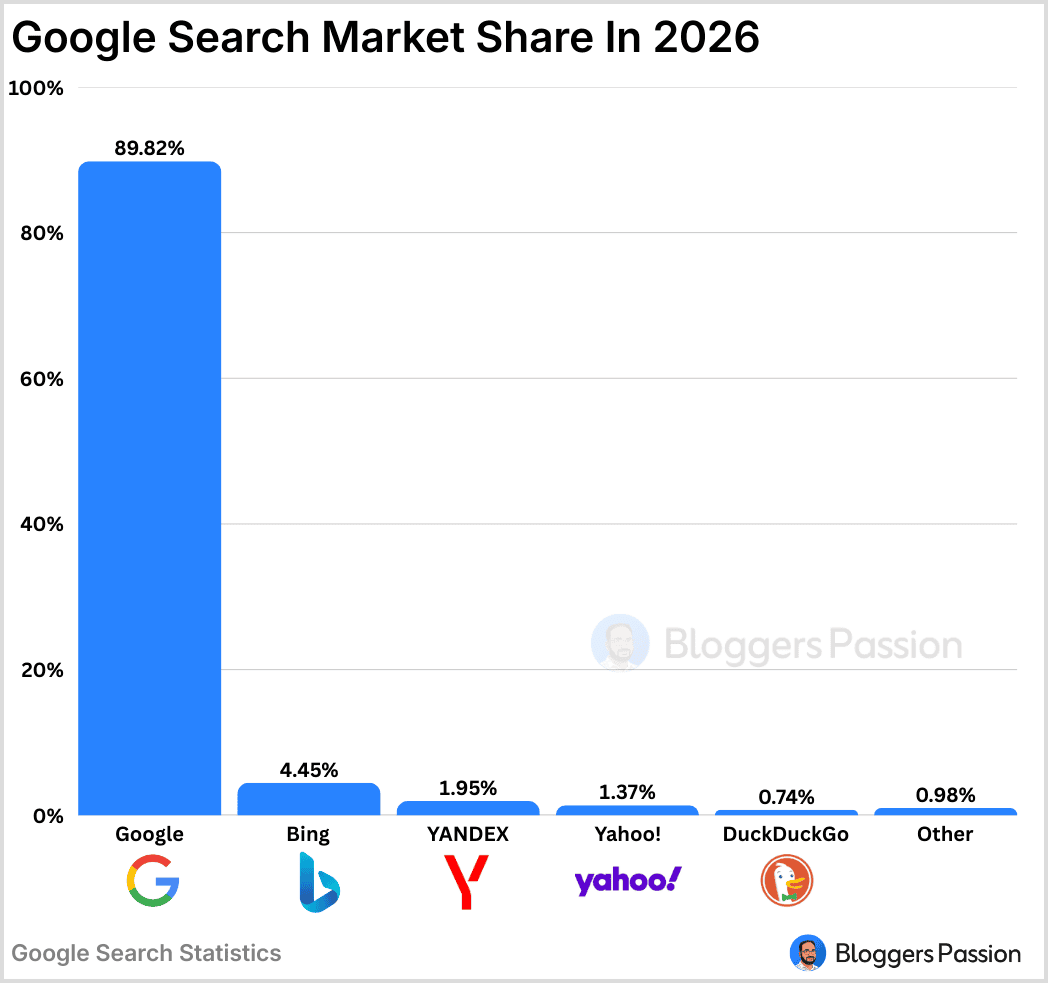
| Ranking | Search Engine Name | Market Share |
|---|---|---|
| 1 | 89.82% | |
| 2 | Bing | 4.45% |
| 3 | YANDEX | 1.95% |
| 4 | Yahoo! | 1.37% |
| 5 | DuckDuckGo | 0.74% |
| 6 | Baidu | 0.69% |
| 7 | Brave | 0.53% |
Here are the top search engines that have changed the way we search.
Google simply rules the search engine world! No doubt, it is holding 89.82% of the global market share in 2026.
So if you have ever wondered why “searching” is basically “Googling”, it is because almost the whole world is doing exactly that. (I mean I have seen people say, “Google it”, just instead of “Search it”!)
Well, to put that into perspective, Google literally receives more than 14 billion searches each day! But obviously, it is because of its excellent search results. Plus, the new AI features make it more seamless for users to satisfy their search journey, even without typing anything.
Google has always been focused on a better search experience. It always came up with new features to make sure users find answers to any of their queries. For example, if there is a query like “best time to post on Instagram”, Google will provide you with direct answers right at the top, so you don’t have to jump between a bunch of links to find what you need.
For marketers, Google has always been an essential tool for driving traffic, generating leads, and increasing sales. In fact, 63% of users click on a Google Ad during their search journey. Thus, Google Ads provides an ROI (return on investment) of 700%. The average conversion rate for PPC is around 2.35%.
Google’s market share in 2022 was 92.58%, when there was no strong competition. It has now fallen to 90% since many users are now experimenting with new search experiences.
Take a look at how the search engine market share looks worldwide.
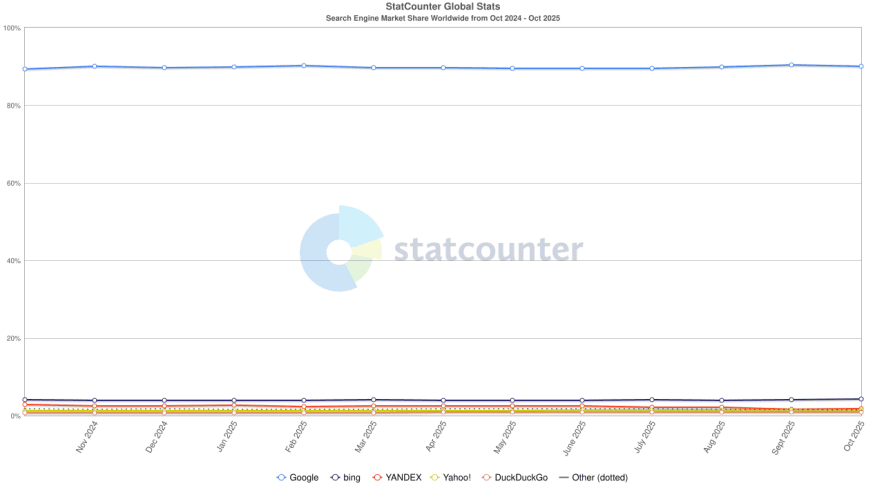
At first, a drop of 2% seems really small. But when a company as big as Google starts to lose even a little ground, it can actually mean something important, especially if this keeps happening over time.
And with such an increasing shift in the search engines, marketers are now optimizing their businesses for other search engines as well.
Key Features of Google Search
- Uses AI-powered search mode for deeper and nuanced answers.
- Offers filters for images, videos, news, and shopping results.
- Displays local place cards with reviews and business details.
- Integrates personalized results based on your search history and connected apps.
- Delivers AI-generated overviews and summaries on top of traditional links.
- Supports multi-modal search, including voice and image inputs.
2. Bing
Being a long-time competitor of Google, Bing has always been the second most trusted search engine. Since 2020, Bing has started carving out its own space, and it’s easy to see why.
Bing handles over 100 million searches daily and attracts over 1.4 billion monthly visitors.
In 2026, Bing holds about 4.45% of the global search market, still a distant second to Google, but that gap has shrunk a bit over the last couple of years. Back in 2016, this market share was 2.79%, and since then, it has been steadily increasing year over year.
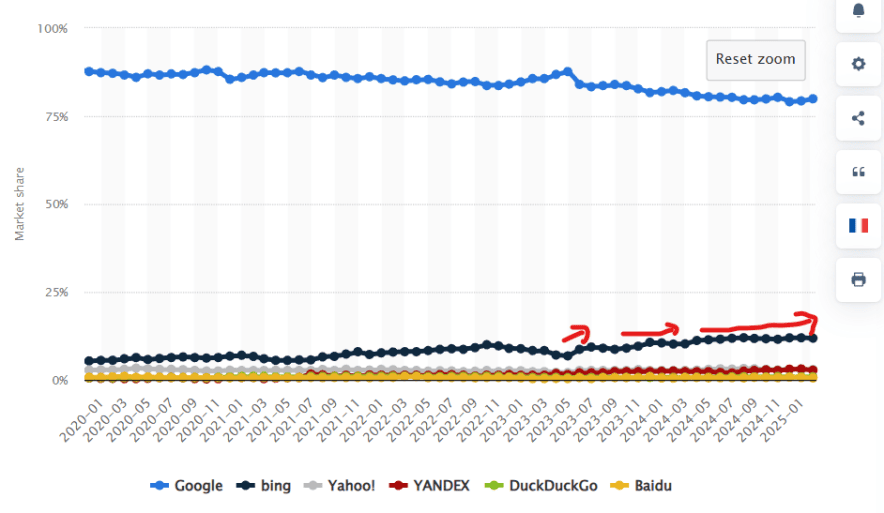
What is interesting is that Bing does even better on desktop computers, with close to 12% of desktop searches, which means it’s a real player for anyone using a PC.
Bing was the first big search engine to bring in AI-powered search with features like Copilot and Bing Chat. With Microsoft’s continued integration of AI through its partnership with OpenAI, Bing has gained a competitive edge in how it presents information and saves time for users.
Bing is not just less crowded and easier to use than other search engines; it also uses AI and Microsoft Copilot to change how people interact with content and ads. This gives new ways for businesses to reach their audiences.
Key Features of Bing Search
- AI-powered search summaries provide concise, relevant information.
- Integrated Bing Copilot offers conversational, chat-based search assistance.
- Visual search lets you upload images to find similar products or places.
- Personalized search results based on your history and preferences.
- Deep integration with Microsoft products like Windows, Edge, and Office.
- Rich local search results with maps, reviews, and images.
- AI-generated overviews with citations for credible information.
3. YANDEX

Yandex is not just Russia’s biggest search engine; it’s a full-fledged tech giant that is focused on the needs of millions of users.
Globally, Yandex has a market share of 1.95% and most of its users are in Russia and several neighboring countries. Yandex is popular because of its deep understanding of the Russian language, culture, and user habits.
It is optimized for complex Russian morphology and regional dialects. This lets it deliver highly relevant results not just for precise queries, but for casual, conversational, and local searches too.
Plus, its “fast” search robot updates indexed pages every 1-2 hours, which keeps results fresh. For marketers, Yandex. Direct is the main advertising platform that is designed to help businesses attract the right customers, boost sales, and keep users coming back.
Key Features of Yandex Search:
- Excels in understanding the Russian language and regional nuances.
- Offers extensive search filters by date, type, and region.
- Provides localized search results tuned for CIS countries.
- Includes features like spell check, autocomplete, and synonym recognition.
- Uses AI and machine learning for relevant and context-aware results.
- Supports search by text, voice, and images.
4. Yahoo!
We all know Yahoo is one of the oldest and most familiar names in the search engine game, and even in 2026, it is still widely used by a fair share of the population (300 million MAU).
While many people know it for its long-running service and news portal, its search engine still has millions of users worldwide. Today, Yahoo has a market share of around 1.45% and is considered one of the top search engines worldwide.
In some countries, like Japan, it’s even more popular, with almost 9–10% of the search engine market there. In the U.S., its market share hovers around 2–3%, indicating it remains a player, albeit not a dominant one.
Yahoo’s search results are powered by Bing, so users see similar search listings. However, Yahoo provides its own extra touches, like news headlines, weather, and a highly personalized home page.
From a marketing perspective, Yahoo offers seamless advertising solutions that integrate search, native ads, and video campaigns.
Compared to Google, Yahoo ads often come with lower competition and cost-per-click rates, which is a big advantage for small to medium businesses or brands with tighter ad budgets.
Key Features of Yahoo Search:
- Powered by Microsoft Bing’s search algorithm since 2009.
- Offers categorical browsing for more leisurely topic exploration.
- Provides autocomplete search suggestions based on trending queries.
- Includes advanced filters for images, videos, news, and shopping.
- Delivers local search results tailored to the user’s location.
- Integrates with Yahoo services like Mail, Finance, and News.
- Features AI-enhanced search with Microsoft Copilot integration.
- Provides real-time query suggestions and contextual search shortcuts.
5. DuckDuckGo
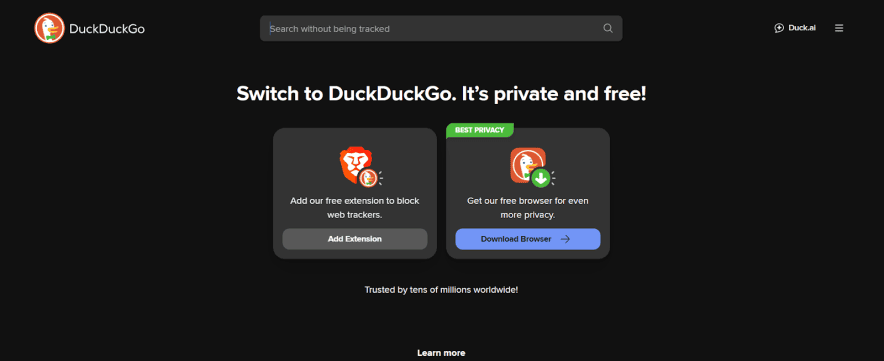
DuckDuckGo is known for its strong focus on privacy and user security. It is used by users who want to search the web without being tracked or having their data collected.
DuckDuckGo has grown steadily over the years, with around 0.74% global search engine market share in 2026. Its growth increased during the COVID-19 pandemic and around key events such as elections, because of privacy awareness.
To further classify, in the US, it is more popular with nearly 2% market share and also ranks as the second most used mobile search engine, just after Google. This means that roughly 80 million people use the DuckDuckGo search engine.
From what I have observed, DuckDuckGo offers a no-nonsense search experience without personalized ads or clutter. It is straightforward and appeals to users who want direct, unbiased results.
It pulls data from many sources like Bing, Google, and its own crawler, and mixes them to offer diverse and useful search results without giving any preference to a particular platform.
Key Features of DuckDuckGo Search
- Does not track your searches or browsing history.
- Blocks hidden third-party trackers on websites.
- Provides private search results without personalized profiling.
- Offers instant answers, images, videos, and news features.
- Support! Bang shortcuts for quick site-specific searches.
- Includes built-in encryption and privacy protections.
- Integrates AI-powered DuckAssist for answering questions.
6. Baidu
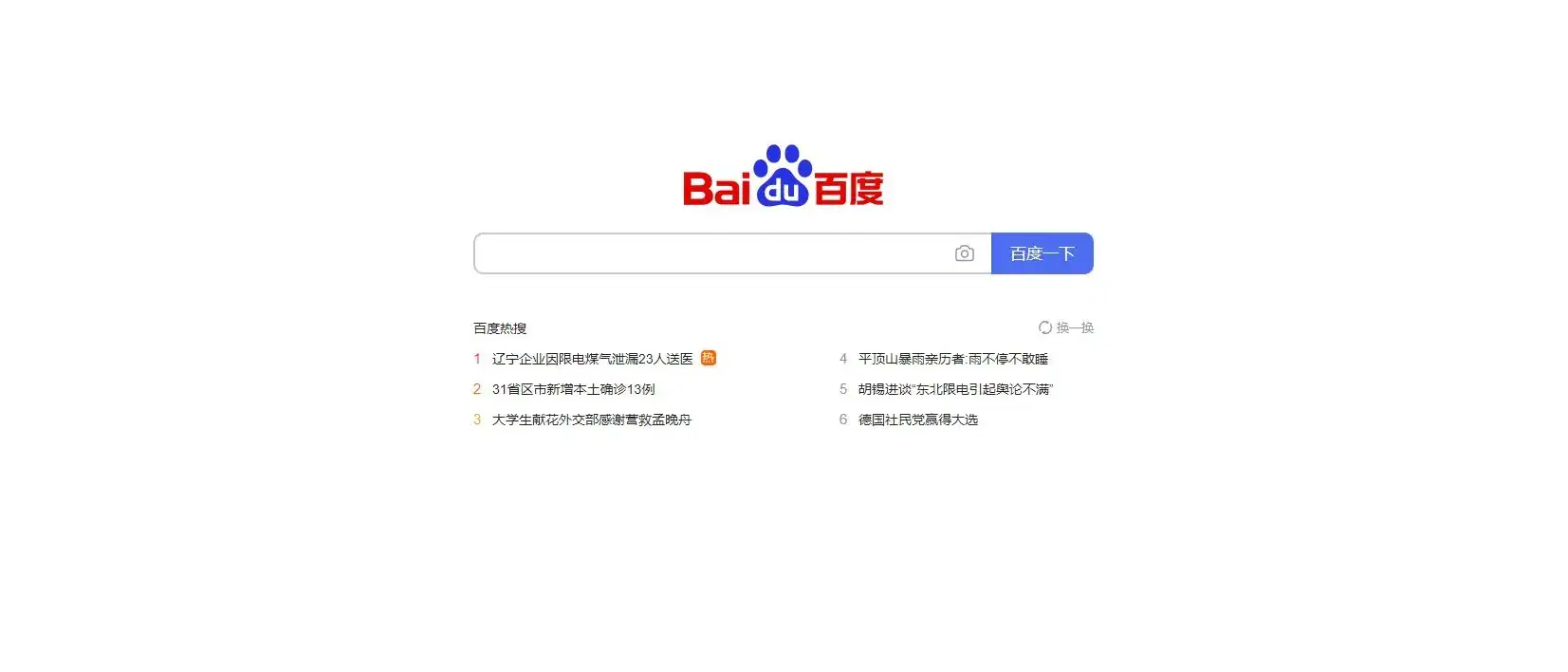
Baidu is the dominant search engine in China and is often referred to as “the Google of China” because of its huge influence in the Chinese market.
While its global market share (0.73%) might seem small, Baidu’s impact inside China is vast, and it offers marketers unique opportunities in one of the world’s largest internet populations.
Today in China, Baidu holds around 56% of the search engine market across all platforms. On mobile devices, its market share leaps even higher to over 70%, showing that Baidu is the go-to for Chinese users on smartphones.
For brands and marketers targeting China, Baidu is indispensable. Unlike Google, which is mostly blocked or limited in China, Baidu is the primary gateway for search traffic.
It offers search ads, display ads, video ads, and AI-enhanced marketing tools. This allows advertisers to reach highly segmented audiences based on location, device, and user behavior.
So yes, for global brands that are looking to invade the Chinese market, Baidu can be an essential partner for search visibility.
Key Features of Baidu Search:
- Strongly optimized for Simplified Chinese language and local idioms.
- Combines traditional keyword matching with AI to understand user intent.
- Integrates deep ecosystem services like Baidu Baike (encyclopedia), Baidu Maps, and Baidu Tieba (forums).
- Prioritizes static content and struggles with heavy JavaScript sites.
- Offers advanced advertising tools, including PPC, display, and native ads.
- Displays branded content zones with logos, social proof, and videos.
- Continuously enhancing AI features, including an AI chatbot called Ernie Bot.
7. Brave Search

Well, Brave Search is a relatively new entry in the search engine space that’s been gaining traction, especially among users who prioritize privacy and want to avoid any advertisements.
Brave started as a browser focused on blocking trackers and ads to give people more control over their browsing experience. Brave Search naturally extends that mission into search. It is built to deliver real privacy. So no user tracking, no profiling, and no personalized ads based on your searches.
Brave has developed its own independent search index. That means you are getting fresh and unbiased results from Brave’s own crawl of the web, not just recycled listings pulled from elsewhere.
I have been using Brave search for my research part, and I am so satisfied with the direct answers, clear facts, and fresh perspective, unlike other search engines.
Well, even though it has the smallest market share, its user base has been steadily growing, especially among privacy-conscious users, tech enthusiasts, and anyone looking for a trustworthy alternative.
Key Features of Brave Search:
- Uses its own independent index for unbiased search results.
- Provides AI-powered answers and detailed reports via Ask Brave.
- Ensures private search with no user tracking or profiling.
- Includes community-driven ranking options and social discussions.
- Offers transparent and spam-free search result rankings.
- Supports search filters for images, videos, news, and maps.
- Provides Search Goggles to customize and re-rank results.
- Delivers real-time snippets and schema-enriched data.
Other Search Engines
Now, other than these traditional search engines, there are new, latest AI search engines that are in demand, which not only solve the user search intent but also transform the entire search experience with advanced AI capabilities.
AI search engines currently hold between 5% to 10% of overall search traffic globally, and this share is expected to grow rapidly as users.
More and more people are getting used to these AI search engines, and their adoption is rapidly changing how we search and interact with information online.
Here is how people are adopting AI search engines and YouTube for video-based search intents.
8. ChatGPT Search
ChatGPT search is now common everywhere. Today, ChatGPT is used by over 850 million users worldwide. And each one of them uses ChatGPT for anything from quick answers to complex research, creative writing, coding help, language translation, and even daily tasks.
So yes, ChatGPT is almost changing the way that we search on search engines. Due to its easy search journey and the way it gets your tasks done, ChatGPT has become a habit for even minor tasks.
It is also widely adopted by professionals, with 92% of Fortune 500 companies using ChatGPT for various work-related applications.
According to the studies, users spend at least 14 minutes on ChatGPT per session. So yes, ChatGPT might become the future of search engines in the upcoming years.
9. Perplexity Search
Another AI search engine, Perplexity, is also widely used for daily searches and mostly for research purposes.
Over 22 million users worldwide use Perplexity monthly, and it receives over 70 million queries each day. So now you can imagine how people enjoy seamless search results with direct answers.
Perplexity offers AI chat with traditional search that provides trusted, cited, and real-time answers that are especially valuable for researchers, professionals, and students.
And people are more inclined toward Perplexity’s search experience, with about a 200% increase in users since 2024. Users tend to spend a significant amount of time per session, with an average of more than 20 minutes on Perplexity.
So, as of 2026, Perplexity is the second most used AI search engine worldwide, with reliable and fast answers for any search queries.
10. YouTube
Yes! YouTube is a video search engine.
Here you will find a bit of a different approach than any other traditional or AI search engines. Instead of primarily relying on text-based results, YouTube serves up videos to answer queries.
YouTube has videos for literally any query. It is the place people turn to when they want to learn how to do something, watch product reviews, get entertained, or dive into hobbies with visual and audio content.
It actually ranks as the second most popular search engine globally after Google, with over 2.8 billion monthly active users. These users generate billions of daily searches and views.
YouTube’s search experience is also different because it leans heavily on recommendation algorithms. Instead of just showing static results, it suggests related videos, personalized playlists, and trending content.
For marketers and creators, YouTube is a goldmine. Video content is 50 times more likely to rank organically on Google’s first page compared to text-based content, and it offers a unique way to build brand awareness and engage with audiences intimately.
Wrap Up
So now you know, there is more to the story than just Google.
People these days not only value an excellent search experience but also want secure, privacy-focused options.
And with the rise of AI-powered search results, users are increasingly inclined towards explanatory answers.
So next time you look something up, remember, there is a whole world of search engines behind the scenes, making sure you get the right answers, your way.
FAQs
What are top search engines other than Google?
Besides Google, the big names include Bing, Yahoo, Baidu (popular in China), Yandex (used a lot in Russia), and DuckDuckGo, which is known for privacy.
Which is the safest search engine in 2026?
DuckDuckGo is one of the safest because it doesn’t track you or store your data. Brave Search is another solid privacy-focused option gaining traction.
What is the market share of Google?
Google holds around 90% of the global search engine market, making it the dominant search engine by a wide margin.
Is YouTube considered a search engine?
Yes, YouTube is often considered a search engine. In fact, it is the second-most-popular search engine after Google.
What is the market share of Bing?
Bing is the second-most-used search engine worldwide, with around 4.45% market share, doing especially well on desktop searches.
What are the top AI search engines in 2026?
The top AI search engines in 2026 include ChatGPT Search, Perplexity AI, Microsoft Bing Copilot, and Brave Search.