


Most ecommerce founders pick a domain in a few minutes based on whatever happens to be available.
That’s often a mistake.
When we analyzed 20 successful ecommerce domain names, Not a single company relied on an exact-match keyword domain.
By the end of this guide, you’ll know:
- What makes a great ecommerce domain name
- Which domain extension is best for ecommerce websites
- How long your domain should be
- Common mistakes that cost ecommerce brands money
- How to generate memorable domain names using proven naming frameworks
Let’s start by looking at what successful ecommerce brands are actually doing.
The Ecommerce Domain Naming Study (20 Top Brands Analyzed)
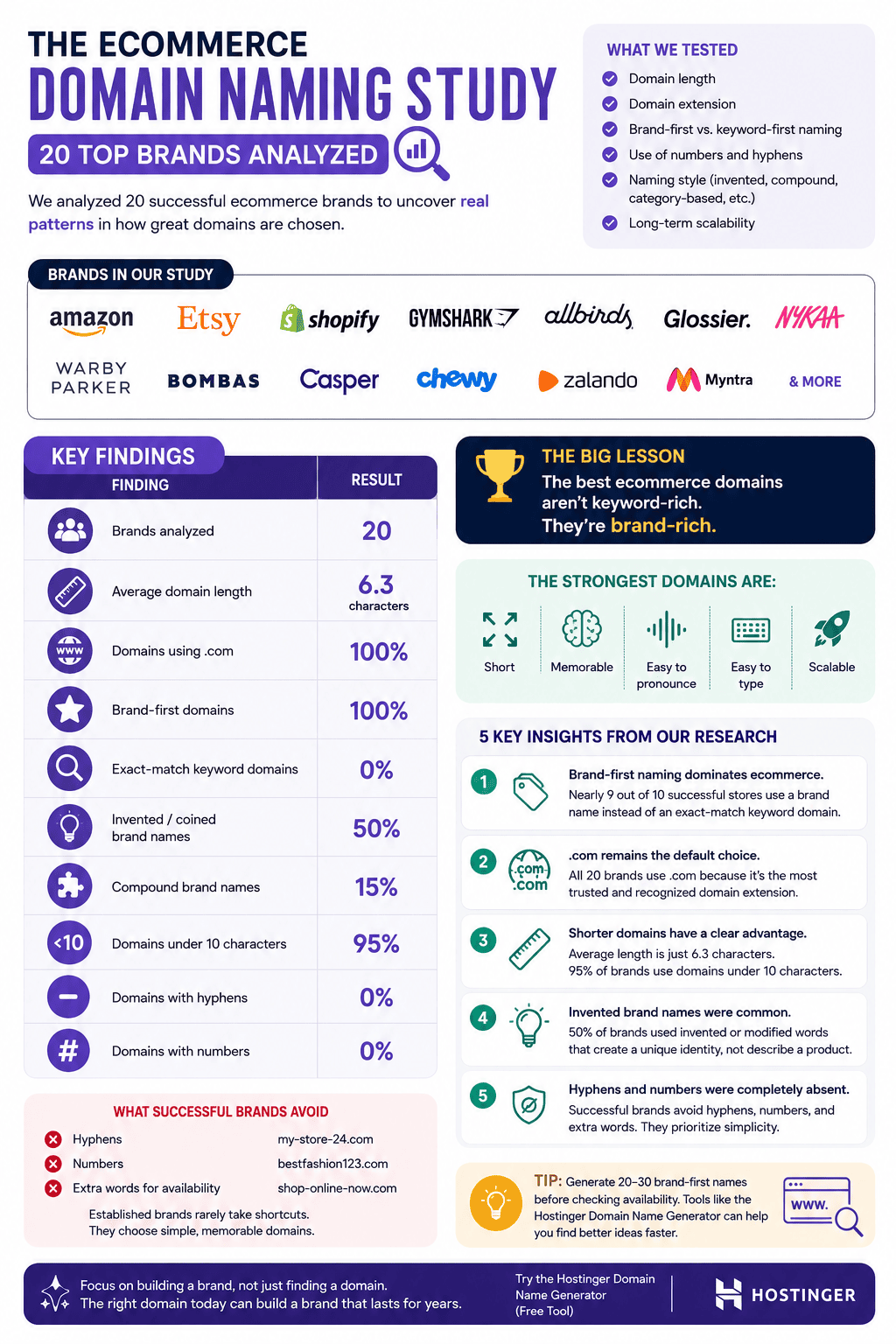
What do successful ecommerce brands actually do when choosing a domain name?
Let’s find out.
Most articles about ecommerce domains are based on assumptions.
You’ll often hear advice like:
- Use keywords in your domain
- Make it SEO-friendly
- Add your product name
- Try to rank with an exact-match domain
But when we looked at some of the biggest ecommerce brands in the world, we found a completely different pattern.
For this study, we analyzed 20 well-known ecommerce brands. The names include Amazon, Etsy, Shopify, Gymshark, Allbirds, Glossier, Nykaa, Warby Parker, Bombas, Casper, Chewy, and others.
For each brand, we checked:
- Domain length
- Domain extension
- Brand-first vs keyword-first naming
- Use of numbers and hyphens
- Naming style (invented, compound, category-based, etc.)
- Long-term scalability
Quick Note: Research from major domain studies shows that brands overwhelmingly favor exact brand-match domains, usually on .com, while shorter domains tend to be easier to brand and remember.
Key Findings:
| Finding | Result |
| Brands analyzed | 20 |
| Average domain length | 6.3 characters |
| Domains using .com | 100% |
| Brand-first domains | 100% |
| Exact-match keyword domains | 0% |
| Invented/coined brand names | 50% |
| Compound brand names | 15% |
| Domains under 10 characters | 95% |
| Domains with hyphens | 0% |
| Domains with numbers | 0% |
If there’s one lesson from this study, it’s this:
The best ecommerce domains aren’t keyword-rich. They’re brand-rich.
The strongest domains tend to be:
- Short
- Memorable
- Easy to pronounce
- Easy to type
- Flexible enough to grow into new categories
Quick Note: One interesting exercise is to generate 20–30 brand-first names before checking domain availability. AI Tools like the Hostinger Domain Name Generator can make this process much faster than brainstorming everything manually.
Data identified during the research:
1. Brand-first naming dominates ecommerce:
Nearly 9 out of 10 successful stores use a brand name instead of an exact-match keyword domain. See Amazon, Etsy, Shopify, Chewy, and Nykaa and not BuyPetFoodOnline.com or BestShoesStore.com.
2. .com remains the default choice.
All 20 companies in our study used a .com domain.
That’s not because other extensions can’t work.
It’s because .com remains the most trusted domain extension on the internet.
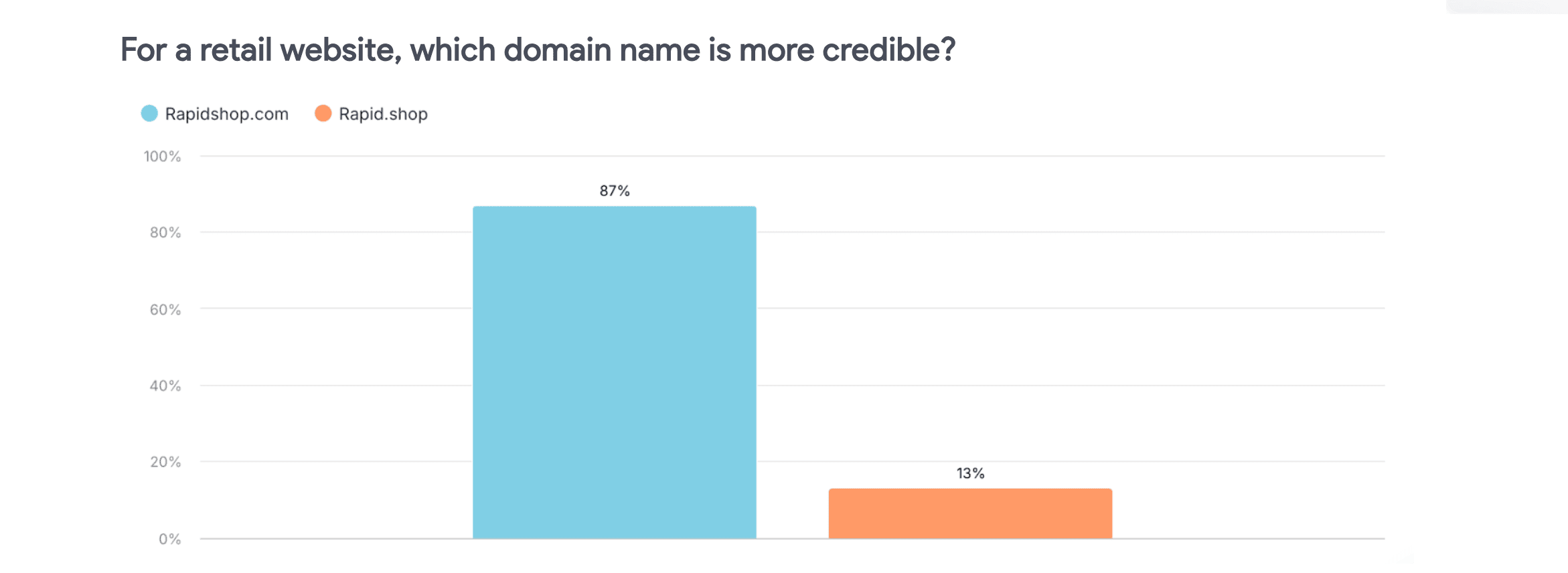
Despite hundreds of new domain extensions, .com continues to dominate. Industry-wide data also shows that .com remains the preferred extension for big companies.
3. Shorter domains have a clear advantage.
Across all 20 brands, the average domain length was just 6.3 characters.
That’s much shorter than most ecommerce domains being registered today.
In fact, 95% of the brands we analyzed used domains with fewer than 10 characters.
Think about it:
- Etsy (4)
- Temu (4)
- ASOS (4)
- Nykaa (5)
- Chewy (5)
- Amazon (6)
Short domains are more memorable faster to type and better suited for long-term branding.
4. Invented brand names were common.
Half of the brands in our study used completely invented or modified words.
Examples include:
- Etsy
- Shopify
- Nykaa
- Myntra
- Zalando
- Boohoo
- Temu
These names don’t describe a product.
They create a brand.
And that’s often far more valuable in the long run.
5. Hyphens and numbers were completely absent.
Not one brand in our study used:
- Hyphens
- Numbers
- Extra words added for availability
That’s an important observation because many new store owners end up registering domains like:
- my-store-24.com
- bestfashion123.com
- shop-online-now.com
Established brands rarely take that route. They prioritize simplicity.
Which Domain is Best for eCommerce Website?
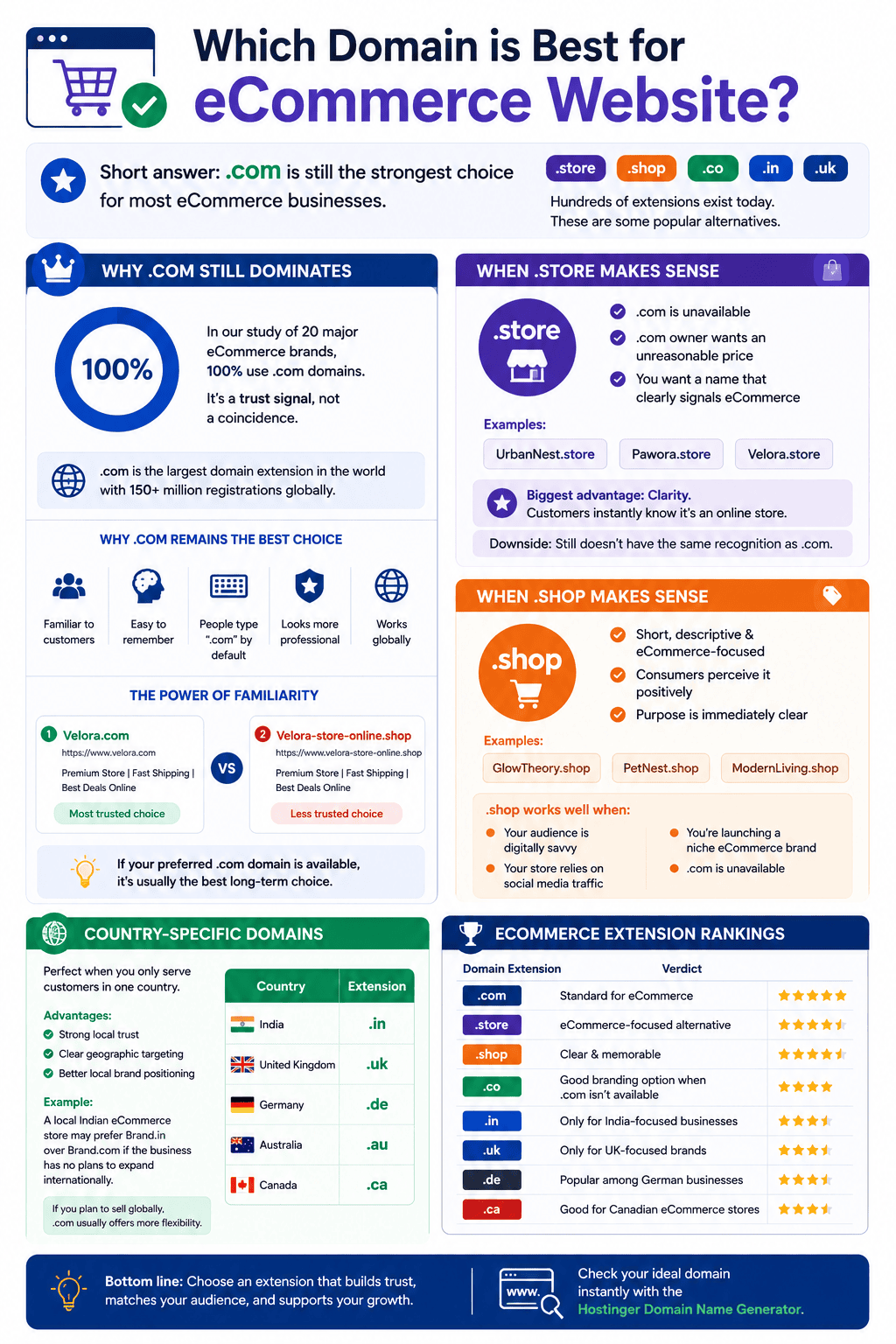
One of the most common questions new store owners ask is:
Which domain is best for an ecommerce website?
The short answer?
.com is still the strongest choice for most ecommerce businesses.
However, that doesn’t mean other extensions are bad.
Today, there are hundreds of domain extensions available. I am talking about .store, .shop, .co, and country-specific domains like .in and .uk.
Why .com Still Dominates:
After analyzing 20 major ecommerce brands in our study, we found that 100% of them use a .com domain.
That’s not a coincidence.
It’s a trust signal.
In fact, industry reports show that .com continues to be the largest domain extension in the world, with over 150 million registrations globally.
There are several reasons why .com remains the best domain extension for ecommerce:
- It’s familiar to customers
- It’s easier to remember
- People often type “.com” by default
- It looks more professional
- It works globally
Suppose you see these two domains in a Google search result:
- Velora.com
- Velora-store-online.shop
Most shoppers will trust the first option. That’s the power of familiarity.
If your preferred .com domain is available, it’s usually the best long-term choice.
When .store Makes Sense:
The .store extension was created specifically for online stores.
And in some situations, it can be a smart alternative.
For example, let’s say:
- The .com version is unavailable
- The .com owner wants an unreasonable price
- You want a name that immediately signals ecommerce
In those cases, a .store domain can work well.
Examples:
- UrbanNest.store
- Pawora.store
- Velora.store
The biggest advantage of .store is clarity.
Customers instantly understand that they’re visiting an online store.
The downside?
It still doesn’t have the same level of recognition as .com.
When .shop Makes Sense:
The .shop extension serves a similar purpose.
It’s short, descriptive, and ecommerce-focused.
In fact, some branding studies have found that consumers often perceive .shop more favorably than many newer domain extensions because the purpose is immediately clear.
Examples:
- GlowTheory.shop
- PetNest.shop
- ModernLiving.shop
A .shop domain TLD work in following situations:
- Your audience is digitally savvy
- Your store relies on social media traffic
- You’re launching a niche ecommerce brand
- .com is unavailable
Country-Specific Domains:
What if you only serve customers in one country?
That’s where country-code domains can become interesting.
Examples include:
| Country | Extension |
| India | .in |
| United Kingdom | .uk |
| Germany | .de |
| Australia | .au |
| Canada | .ca |
Country-specific domains can offer a few advantages:
- Strong local trust
- Clear geographic targeting
- Better local brand positioning
For example:
A local Indian ecommerce store may prefer:
- Brand.in
over
- Brand.com
if the business has no plans to expand internationally.
However, if you expect to sell globally in the future, .com usually offers more flexibility.
Ecommerce Extension Rankings:
| Domain Extension | Verdict |
| .com | Standard for eCommerce |
| .store | eCommerce-focused alternative |
| .shop | Clear & memorable |
| .co | Good branding option when .com isn’t available for you |
| .in | Only for India-focused businesses |
| .uk | Only for UK-focused brands |
| .de | Popular among German businesses |
| .ca | Good for Canadian eCommerce stores. |
What Is the Ideal Ecommerce Domain Name Length?
People focus on finding available words during a domain name brainstorming process.
Very few stop to ask: How long should my domain actually be?
Because domain length has a direct impact on:
- Memorability
- Brand recall
- Typing accuracy
- Word-of-mouth marketing
- Overall brand perception
In our study above, one pattern appeared almost immediately:
The biggest brands tend to use short domains.
Let’s see why.
Why Domain Length Matters:
Imagine someone hears about your store on the internet.
A few hours later, they try to remember the domain.
Which of these is easier to recall?
- Etsy.com
- Temu.com
- Shopify.com
Or:
- BestWirelessEarbudsStore.com
- AffordablePetSuppliesOnline.com
- DiscountFashionDealsForWomen.com
The answer is obvious.
Shorter domains create less friction.
They’re easier to:
- Remember
- Type
- Pronounce
- Share verbally
- Fit into marketing materials
They also look professional.
That’s one reason why some of the world’s most valuable companies have invested millions of dollars acquiring shorter domains over the years.
Of course, shorter isn’t always better.
A random four-letter domain with no meaning isn’t automatically superior to a strong ten-letter brand.
But all else being equal, shorter domains usually have an advantage.
Average Length of Top Ecommerce Brands:
Across all 20 brands in our study, the average domain length was just 6.3 characters.
Even more interesting:
- 95% of domains were under 10 characters
- 100% were under 15 characters
- None exceeded 12 characters by much
This doesn’t mean your ecommerce domain must be six characters long.
But it does suggest that successful brands generally prefer simplicity over description.
Recommended Length Guidelines:
Based on our research and broader branding trends, here’s a practical framework you can follow.
| Domain Length | Recommendation |
| 1–5 Characters | Exceptional but extremely rare |
| 6–8 Characters | Ideal for most ecommerce brands |
| 9–12 Characters | Very good balance of branding and flexibility |
| 13–15 Characters | Acceptable if highly brandable |
| 16–20 Characters | Risk of becoming difficult to remember |
| 20+ Characters | Usually too long for a modern ecommerce brand |
If you’re unsure, aim for:
6 to 12 characters whenever possible.
That’s where many of today’s strongest ecommerce brands sit.
I know it is very hard to generate short domains manually.
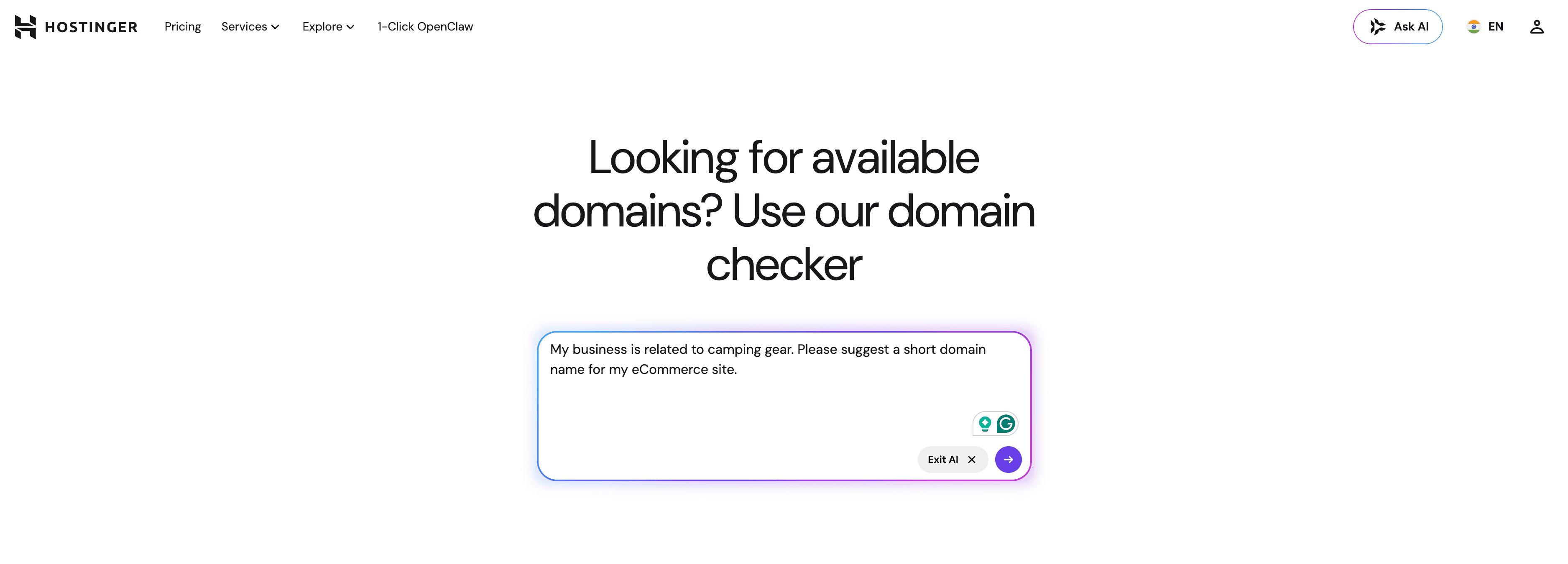
You can always use a Domain generator which is AI Powered.
One example is Hostinger.
I tried to generate some domain names for a camping based eCommerce site. It gives me a few recommendations that seem good. You can skip the weird ones though.
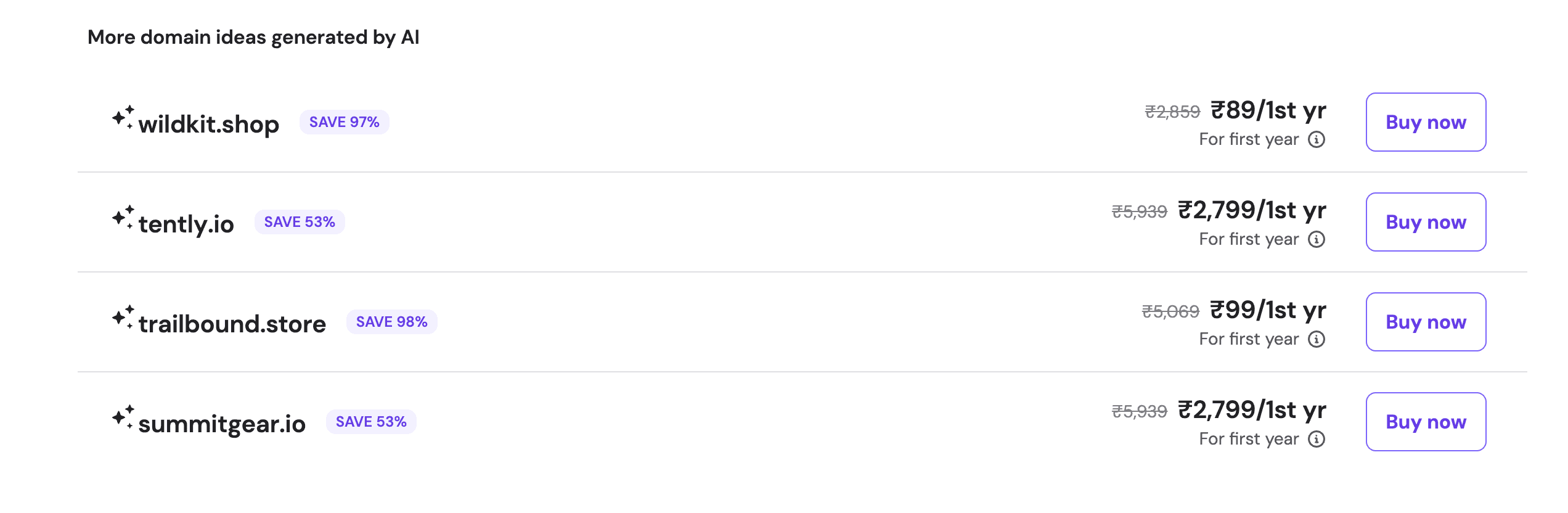
They are also giving discounts on most of the eCommerce oriented TLDs. Get extra 10% OFF using our special code: BPDOMAIN
Ecommerce Domain Name Ideas (50 Examples by Store Type)
What if you’re still stuck at the brainstorming stage?
To help, we generated dozens of ecommerce domain ideas and filtered them using the same principles discussed throughout this guide.
The following examples were inspired using the Hostinger Domain Name Generator and then filtered using the data we found in the study.
That means we prioritized names that are:
- Brandable
- Easy to remember
- Easy to pronounce
- Flexible enough to scale
- Suitable for long-term ecommerce growth
You can use them as an inspiration rather than direct recommendations, as domain availability changes daily.
| Store Type | Best Domain Name Ideas |
| Fashion | Styleora, Modique, Trendivo, Veloura, Chicnest, Urbanelle, Vestrio, Modeva, Luxora, Threadly |
| Beauty | Glowora, Lumiva, Beautiqueo, Radielle, Pureluxe, Glowvera, Skinora, Velisse, Eloria, Bloomique |
| Electronics | Sonexa, Audivo, Nexora, Voltivo, Techora, Electrax, Circuitly, Nexivo, Gearonic, Devixa |
| Pet Store | Pawora, Furvana, Petivo, Tailora, Barkly, Pawnest, Furioo, Petluxe, Woofio, HappyPaws |
| Home Decor | Nestora, Havenlyx, Decorva, Homivo, Casaora, Livoria, Roomique, Nestique, VeloraHome, UrbanNest |
| General Ecommerce | Velora, Nexora, Lumivo, Zentro, Movexa, Elvora, Novexa, Brandora, Venturo, Alvora |
Ecommerce Domain Name Selection Checklist
But before you register any domain, there’s one final step.
Run it through this checklist.
Think of this as your last quality-control process.
If several of them fail, keep searching.
- ✅ Is It Under 15 Characters?
- ✅ Is It Easy to Pronounce?
- ✅ Does It Avoid Numbers?
- ✅ Does It Avoid Hyphens?
- ✅ Can It Survive Product Expansion?
- ✅ Can It Survive Category Expansion?
- ✅ Is It Trademark-Safe?
- ✅ Are Social Handles Available?
Our Recommendation
Don’t evaluate just one domain.
Generate multiple options and compare them side by side.
A simple exercise is to create 20–30 domain ideas and then run each through this checklist and finally shortlist the strongest candidates.
Tools like the Hostinger Domain Name Generator can make this process much faster by helping you generate brandable alternatives.
The goal isn’t just to find an available domain. It’s to find a domain you’ll still be happy with five or ten years from now.
Explore More:
- Top Cheap Domain Registrars Out There in 2026 [Complete Price Analysis]
- Best Registrar for .AI Domain Names
- How to get a .com Domain for Free?
- Expired Domains to Buy in 2026
FAQs About Ecommerce Domain Names
Which domain extension is best for ecommerce websites?
For most businesses, .com remains the best domain TLD for ecommerce websites.
Is .store good for ecommerce?
Yes. The .store extension is one of the better alternatives to .com for ecommerce businesses. It clearly communicates that your website is an online store and is easier to understand than many newer domain extensions.
Should ecommerce domains contain keywords?
Not necessarily. In fact, our analysis of successful ecommerce brands found that none of the major brands we studied relied on exact-match keyword domains.
Which is the best ecommerce domain name generator?
We suggest the Hostinger Domain Name Generator for ecommerce websites. What we like:
– It quickly generates brandable domain ideas
– It uses AI to suggest creative variations
– It is free to use
Explore More: Helium 10 Review [Amazon Seller Software]






Leave a Comment
Your email address will not be published. Required fields are marked *