


Ecommerce refers to buying and selling products or services over the internet.
For Indian businesses, ecommerce offers a way to reach customers beyond their local area without necessarily opening a physical shop in every city. But setting up an online store is only one part of the process. Payments, delivery, customer trust, and profitability matter just as much.
In this guide, we’ll explain how ecommerce works in India, explore its different business models, and walk through the steps involved in starting an online business.
![What is ecommerce [how online shopping works in india]](https://bloggerspassion.com/wp-content/uploads/2026/10/What-is-ecommerce-how-online-shopping-works-in-india.webp)
What Is Ecommerce?
Ecommerce is the process of buying and selling goods or services through websites, mobile apps, online marketplaces, and other internet-based channels.
For example, when you order a pair of shoes from an online brand, buy groceries through an app, or purchase an online course, you’re participating in ecommerce.
The products don’t have to be physical. Ecommerce also includes digital downloads, software subscriptions, online consultations, and other services purchased over the internet.
India’s ecommerce opportunity: According to the India Brand Equity Foundation (IBEF), India’s online shopper base reached approximately 290–300 million in 2025. Tier-2 and smaller cities accounted for around 65% of new shoppers. This creates opportunities for businesses beyond major metropolitan areas to reach customers online.
However, a large online audience doesn’t automatically guarantee sales. Businesses still need products people want, competitive pricing, reliable delivery, and a way to attract customers.
How Does Ecommerce Work in India?
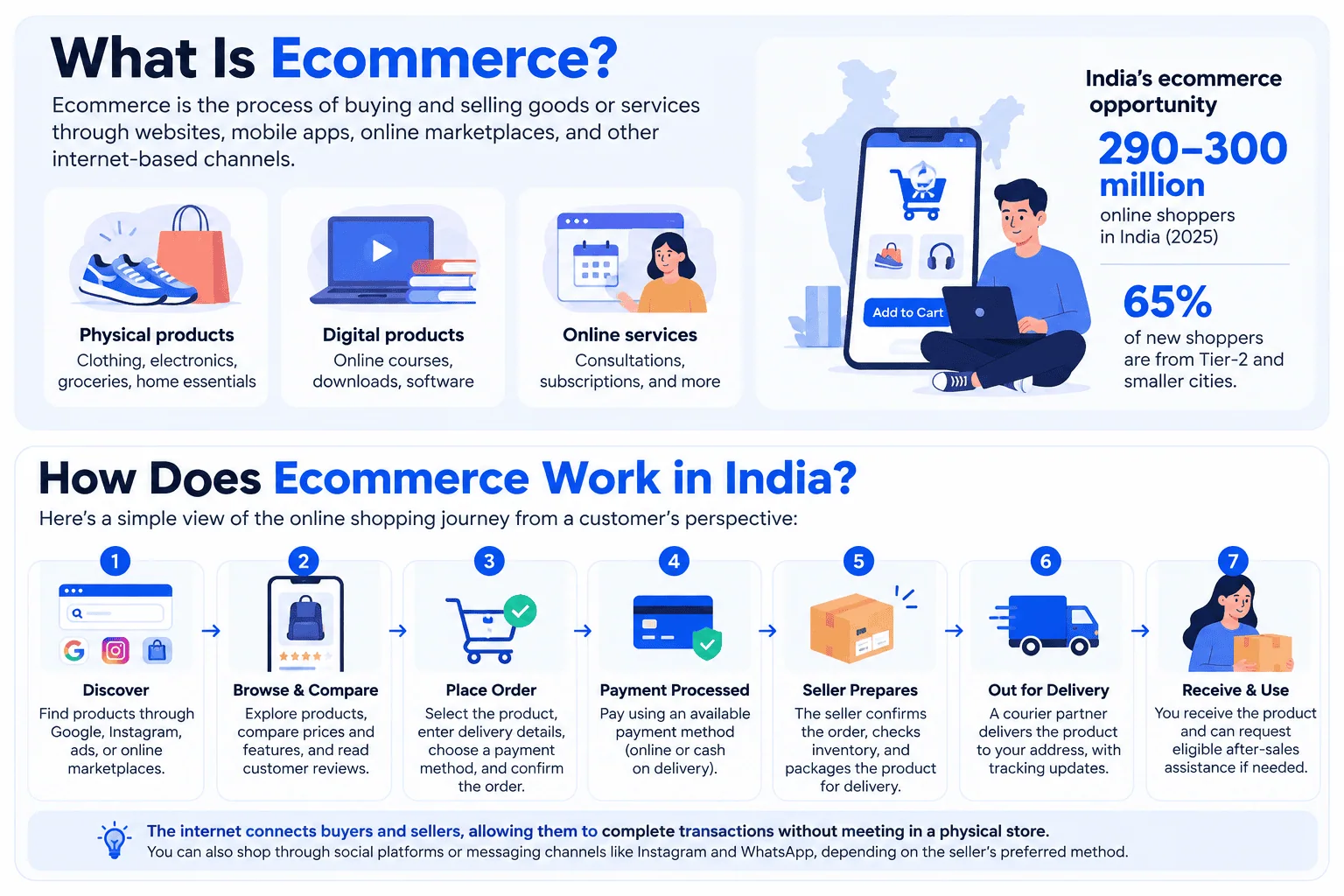
From a customer’s perspective, online shopping is relatively straightforward.
Imagine you want to buy a backpack from an Indian brand.
First, you discover the brand through Google, Instagram, an advertisement, or an online marketplace. You browse its products, compare prices and features, and read customer reviews.
Once you’ve chosen a backpack, you select the product, enter your delivery details, choose an available payment method, and place your order.
The seller then processes the purchase and arranges delivery. After receiving the product, you can decide whether it meets your expectations and whether you need any eligible after-sales assistance.
That is the basic customer journey behind ecommerce.
The business side involves additional activities, but the underlying idea is simple: the internet connects buyers and sellers, allowing them to complete transactions without meeting in a physical store.
Online shopping can also take place through social platforms or messaging channels. A customer might discover a handmade jewellery seller on Instagram, discuss a product through WhatsApp, and complete the purchase through the seller’s preferred ordering method.
The exact experience depends on the selling channel and the systems the business uses.
What Are the Main Types of Ecommerce?
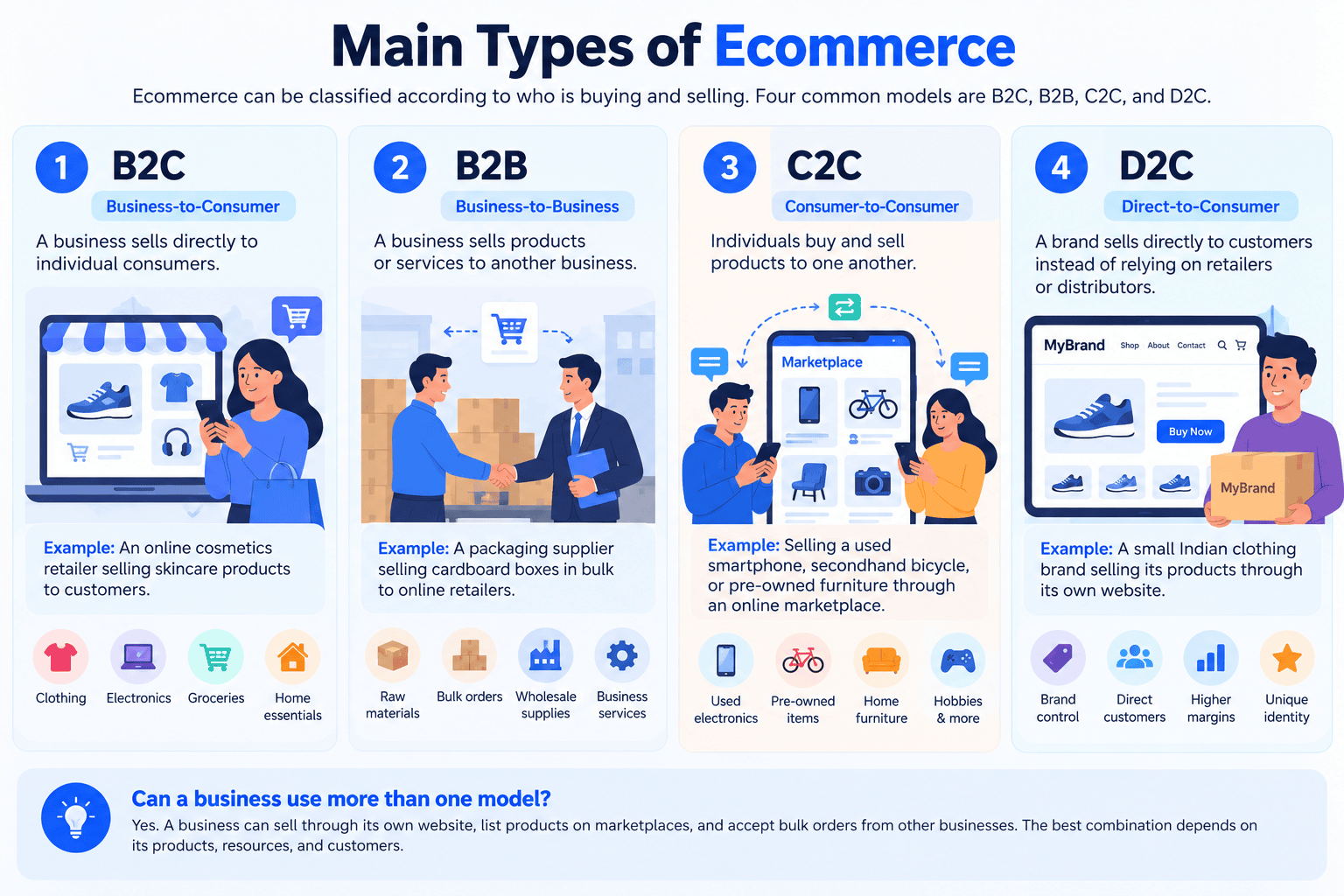
Ecommerce can be classified according to who is buying and selling. Four common models are B2C, B2B, C2C, and D2C.
1. Business-to-Consumer (B2C)
B2C ecommerce occurs when a business sells directly to individual consumers.
For example, an online cosmetics retailer selling skincare products to customers operates on a B2C model.
This is one of the most familiar ecommerce models because it covers everyday online shopping, from clothing and electronics to groceries and home furnishings.
2. Business-to-Business (B2B)
B2B ecommerce involves one business selling products or services to another business.
For example, a packaging supplier might sell cardboard boxes in bulk to online retailers through its website.
B2B transactions often involve bulk quantities, negotiated pricing, repeat orders, and different payment terms from consumer purchases.
3. Consumer-to-Consumer (C2C)
C2C ecommerce connects individuals who buy and sell products to one another.
Imagine someone selling a used smartphone, a secondhand bicycle, or pre-owned furniture through an online marketplace.
The platform may help people discover listings and communicate, although the payment and delivery arrangements depend on the service being used.
4. Direct-to-Consumer (D2C)
D2C is a business model in which a brand sells directly to customers rather than relying entirely on retailers or distributors.
For example, a small Indian clothing brand could sell its products through its own website instead of depending only on large shopping marketplaces.
D2C can give a business greater control over its branding, product presentation, and customer relationships. However, the business must also take responsibility for attracting visitors, managing orders, and providing customer support.
Can a business use more than one model? Yes. A clothing brand could sell through its own website, list products on marketplaces, and accept bulk orders from other businesses. The best combination depends on its products, resources, and customers.
Marketplace vs. Your Own Ecommerce Website: Which Is Better?
One of the first decisions for a new online seller is where to sell.
You could start on an established marketplace, build your own ecommerce website, or use both.
| Factor | Online marketplace | Your own ecommerce website |
|---|---|---|
| Getting discovered | Can provide access to existing shoppers | You generally need to attract visitors yourself |
| Setup | Often simpler to start listing products | Requires setting up and configuring a store |
| Fees | May include commissions, listing, fulfilment, or other charges | May include platform, hosting, payment processing, and marketing costs |
| Branding | Limited by marketplace rules and design | More control over the shopping experience |
| Customer relationships | Governed by marketplace policies | More direct control, subject to privacy laws and consent requirements |
| Operations | Some services may handle parts of fulfilment | You choose and manage your operational setup |
Neither option is automatically better.
A marketplace may be a practical starting point if you want to test product demand without building a complete website. The trade-off is that you operate within another company’s rules and fee structure.
An independent website can make sense if you want to establish a distinctive brand, build a direct customer relationship, or control how products are presented.
However, owning a website doesn’t automatically bring visitors or sales. You’ll still need to invest time in search engine optimization (SEO), social media, advertising, partnerships, or other marketing channels.
Some small sellers also start by taking orders through Instagram or WhatsApp. This can be a useful way to validate demand before investing in a full storefront, although manual order management can become difficult as sales increase.
Seller discussions on Reddit frequently raise practical concerns such as marketplace fees, shipping expenses, returns, and the effort required to attract customers to an independent website. These are useful issues to investigate before choosing a sales channel, rather than assuming that one option works for every business.
How Do Online Payments Work in India?
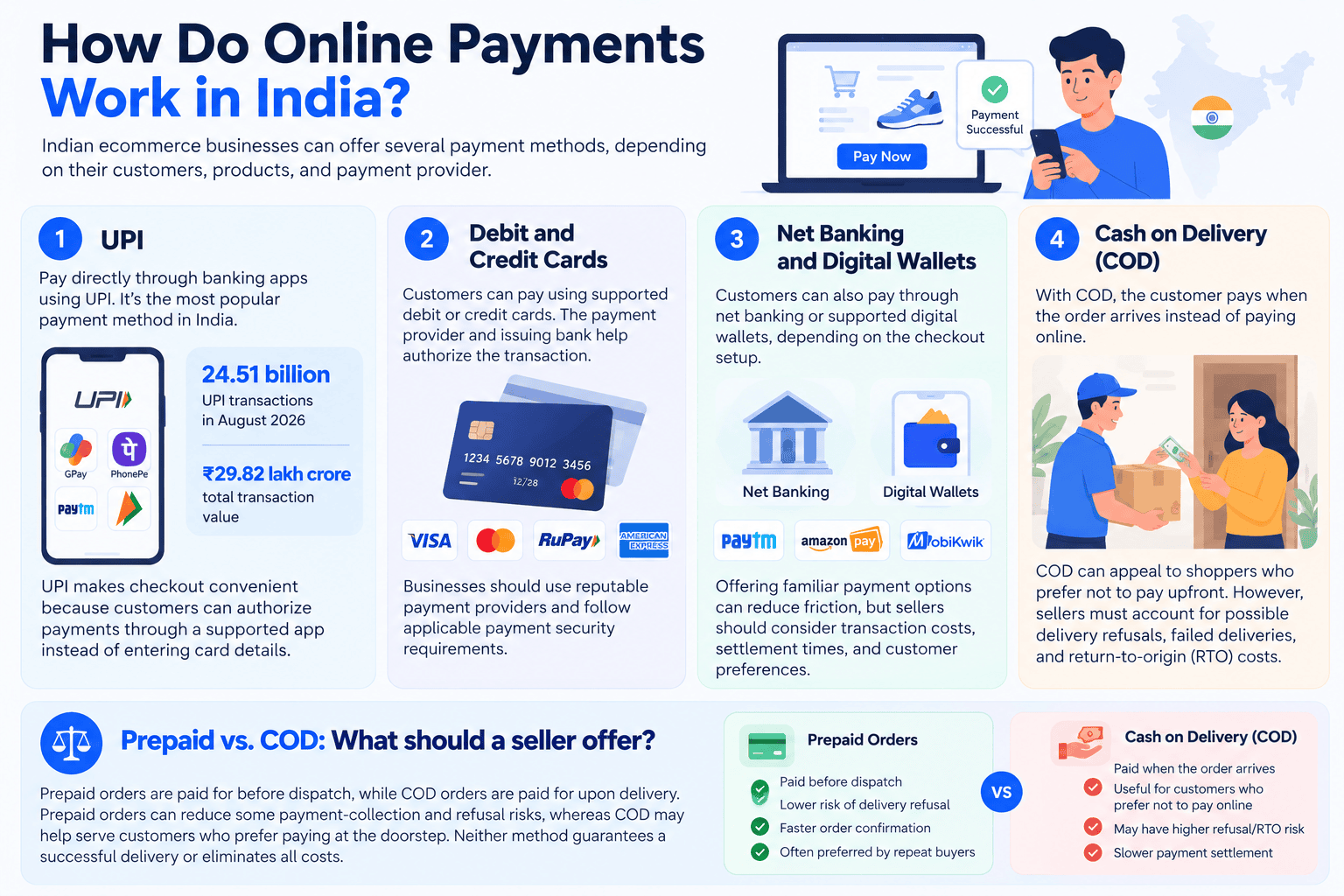
Indian ecommerce businesses can offer several payment methods, depending on their customers, products, and payment provider.
UPI
Unified Payments Interface (UPI) allows customers to pay through supported banking apps. It’s widely used in India for everyday digital transactions, including online purchases.
According to the National Payments Corporation of India (NPCI), UPI processed approximately 24.51 billion transactions in August 2026, worth about ₹29.82 lakh crore. These figures cover UPI transactions overall, not ecommerce purchases alone.
For online stores, UPI can make checkout convenient because customers can authorize payments through a supported app instead of entering card details.
Debit and credit cards
Customers can pay using supported debit or credit cards. The payment provider and issuing bank help authorize the transaction before the order proceeds.
Businesses should use reputable payment providers and follow applicable payment security requirements.
Net banking and digital wallets
Depending on the checkout setup, customers may also be able to pay through net banking or supported wallets.
Offering familiar payment options can reduce friction, but sellers should consider transaction costs, settlement times, and customer preferences when choosing a provider.
Cash on delivery (COD)
With COD, the customer pays when the order arrives rather than paying online at checkout.
COD can appeal to shoppers who prefer not to pay upfront. However, sellers must account for possible delivery refusals, failed deliveries, return-to-origin (RTO) costs, and delayed payment settlement.
Prepaid vs. COD: What should a seller offer?
Prepaid orders are paid for before dispatch, while COD orders are paid for upon delivery.
Prepaid orders can reduce some payment-collection and refusal risks, whereas COD may help serve customers who prefer paying at the doorstep. Neither method guarantees a successful delivery or eliminates all costs.
A new business should review its product margins, customer expectations, delivery performance, and payment-provider charges before deciding how to balance the two.
For payment-system background and official UPI statistics, see the NPCI UPI statistics page.
What Role Do Payment Gateways and Ecommerce Platforms Play?
These terms are related, but they serve different purposes.
What is a payment gateway?
A payment gateway helps securely transmit payment information and supports the authorization process for online transactions. Depending on the provider and integration, other payment-processing services may also be involved.
A gateway is not the same as an ecommerce website. You can have an attractive online store, but customers still need a workable way to pay if you want to accept online payments.
Before selecting a provider, compare supported payment methods, transaction fees, settlement timelines, refund handling, integration options, and support.
What is an ecommerce platform?
An ecommerce platform provides the tools needed to create and manage an online store.
Depending on the platform, these tools may include:
- Store design and product pages
- Shopping carts and checkout
- Product catalogues and inventory management
- Order management
- Payment integrations
- Shipping integrations
- Sales reporting and marketing features
Some platforms bundle many of these functions, while others rely on third-party plugins and services.
For a beginner, the practical question is not simply which platform has the most features. It’s which option can support the products you sell, the payment methods your customers use, and the operational work you’re prepared to handle.
How Do Shipping, Delivery, Returns, and Refunds Work?
Getting an order is only the beginning. The business must also deliver the correct product in good condition and resolve problems when something goes wrong.
Shipping and delivery
After receiving an order, the seller checks stock, packs the product, prepares the shipment, and arranges dispatch. Delivery may be handled by a courier company, a logistics aggregator, the seller, or another fulfilment partner.
Shipping costs depend on factors such as package weight and dimensions, delivery distance, service level, pickup arrangements, and the provider’s pricing.
Before launching, work out who will pack orders, how quickly they can be dispatched, and which areas you can serve reliably. Don’t promise next-day delivery unless your operations can support it.
Returns and refunds
Customers may request returns because a product is damaged, incorrect, defective, or eligible for return under the seller’s policy.
A clear policy should explain eligibility, return windows, the process for requesting a return, who pays return shipping where applicable, and how refunds are handled.
Indian ecommerce businesses must also understand applicable consumer protection requirements. The government maintains information on the Consumer Protection (E-Commerce) Rules. Rules and obligations can change, so sellers should check the latest official requirements rather than relying on an old policy template.
Returns aren’t just a customer-service issue. They can affect inventory, shipping expenses, margins, and the time required to resolve an order.
What Are the Benefits of Ecommerce for Indian Businesses?
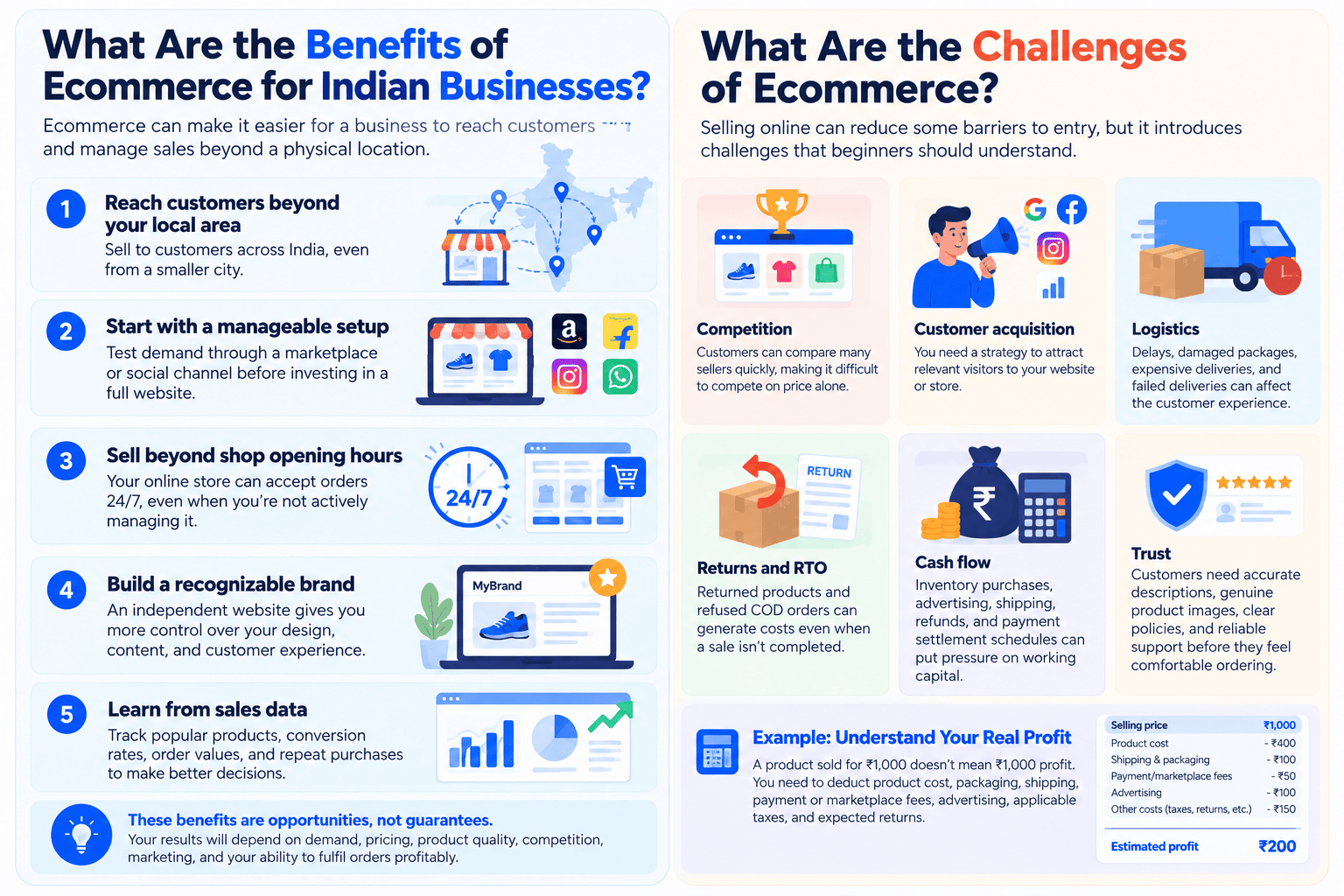
Ecommerce can make it easier for a business to reach customers and manage sales beyond a physical location.
1. Reach customers beyond your local area. A seller in a smaller Indian city can potentially serve customers across the country if the product, delivery network, and business operations support it.
2. Start with a manageable setup. Some businesses can test demand through a marketplace or social channel before investing in a more elaborate website and operational system.
3. Sell beyond shop opening hours. An online store can accept orders outside normal business hours, although customer support and fulfilment still need to be managed.
4. Build a recognizable brand. An independent website gives a business greater control over its design, product information, content, and customer experience.
5. Learn from sales data. Depending on the tools used, businesses can track popular products, conversion rates, order values, and repeat purchases to make better decisions.
These benefits are opportunities, not guarantees. Results depend on demand, pricing, product quality, competition, customer acquisition costs, and the seller’s ability to fulfil orders profitably.
What Are the Challenges of Ecommerce?
Selling online can reduce some barriers to entry, but it introduces challenges that beginners should understand.
- Competition: Customers can compare many sellers quickly, making it difficult to compete on price alone.
- Customer acquisition: An independent website needs a strategy for attracting relevant visitors.
- Logistics: Delays, damaged packages, expensive deliveries, and failed deliveries can affect the customer experience.
- Returns and RTO: Returned products and refused COD orders can generate costs even when a sale isn’t completed.
- Cash flow: Inventory purchases, advertising, shipping, refunds, and payment settlement schedules can put pressure on working capital.
- Trust: Customers need accurate descriptions, genuine product images, clear policies, and reliable support before they feel comfortable ordering.
A useful habit is to calculate the profit from an order rather than looking only at its selling price.
For example, a product sold for ₹1,000 doesn’t generate ₹1,000 in profit. You may need to deduct the product cost, packaging, shipping, payment or marketplace fees, advertising, applicable taxes, and expected returns.
Understanding these costs before scaling is much more useful than chasing a high order count without knowing whether those orders are profitable.
How to Start an Ecommerce Business in India?
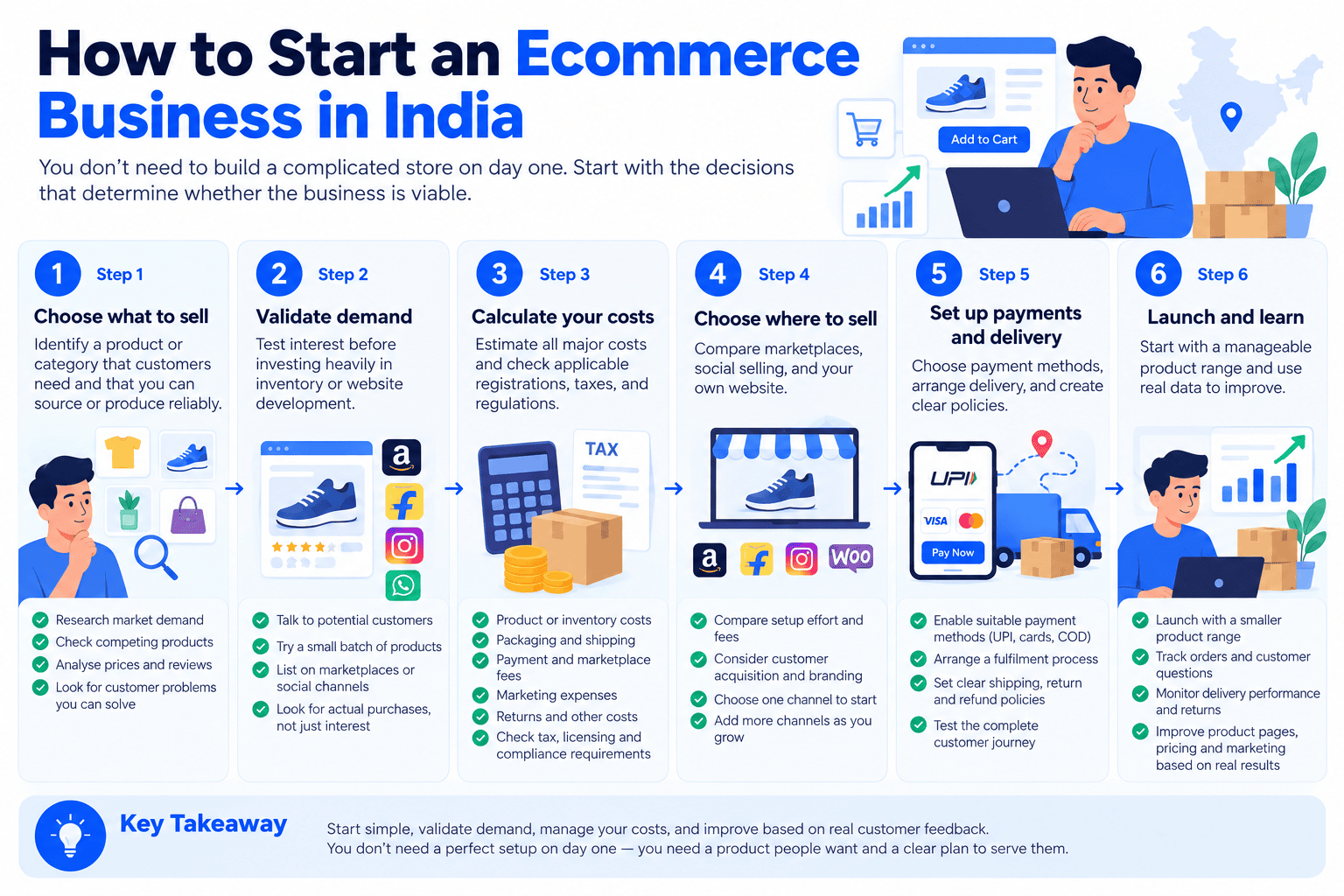
You don’t need to build a complicated store on day one. Start with the decisions that determine whether the business is viable.
Step 1: Choose what to sell
Identify a product or category that customers need and that you can source or produce reliably. Research competing products, selling prices, customer reviews, and the problems buyers still face.
Step 2: Validate demand
Before investing heavily in inventory or website development, test interest through customer conversations, a small batch of products, marketplace listings, or a suitable social channel.
Look for evidence that people are willing to buy—not just that they like the idea.
Step 3: Calculate your costs
Estimate product costs, packaging, shipping, payment processing, marketplace charges if applicable, marketing, returns, and other operating expenses.
Also check which registrations, tax obligations, licences, and product-specific rules apply to your business. Requirements vary according to factors such as the products sold, business structure, turnover, and sales channels. Seek qualified advice when necessary.
Step 4: Choose where to sell
Compare marketplaces, social selling, and an independent ecommerce website. Consider the setup effort, fees, customer acquisition, branding, and how much control you need.
You can start with one channel and add others when your operations can support them.
Step 5: Set up payments and delivery
Choose appropriate payment methods, establish a fulfilment process, and create clear shipping, cancellation, return, and refund policies.
Test the complete customer journey before launch, including successful payments, failed payments, order confirmations, and refund handling.
Step 6: Launch and learn
Start with a manageable product range. Track orders, customer questions, delivery performance, returns, and actual profit per order.
Use those findings to improve product pages, pricing, checkout, and marketing before expanding.
How Much Does It Cost to Start an Ecommerce Business?
There is no single startup cost that applies to every ecommerce business.
A seller taking a few orders through social media has different expenses from a brand that buys inventory in bulk, builds a custom website, and runs paid advertising.
Your budget may need to cover:
| Expense | What it covers |
|---|---|
| Products or inventory | Stock, raw materials, or manufacturing |
| Website and domain | Domain registration, hosting, platform subscriptions, or development |
| Payments | Transaction fees and other provider charges |
| Packaging and shipping | Packing materials, courier services, and fulfilment |
| Marketing | Content, promotions, advertising, and customer acquisition |
| Business administration | Applicable registrations, accounting, taxes, and compliance |
| Returns and contingency | Refunds, failed deliveries, replacements, and unexpected costs |
Some expenses are fixed, while others increase with each order. Compare total costs rather than choosing a platform based only on its advertised starting price.
If your budget is limited, validate demand first, keep the initial product range manageable, and avoid committing to expensive tools or large inventory purchases before you understand your customers.
Can You Create Your Own Ecommerce Website Without Coding?
Yes. Modern ecommerce website builders and platforms can help beginners create product pages, configure a storefront, manage orders, and connect payment or shipping services without writing all the code themselves.
The exact features depend on the platform and plan. You may still need to configure your domain, product catalogue, payment provider, shipping rules, tax settings, policies, and other business requirements.
If you want to build an independent store, Hostinger Ecommerce is one option worth evaluating.
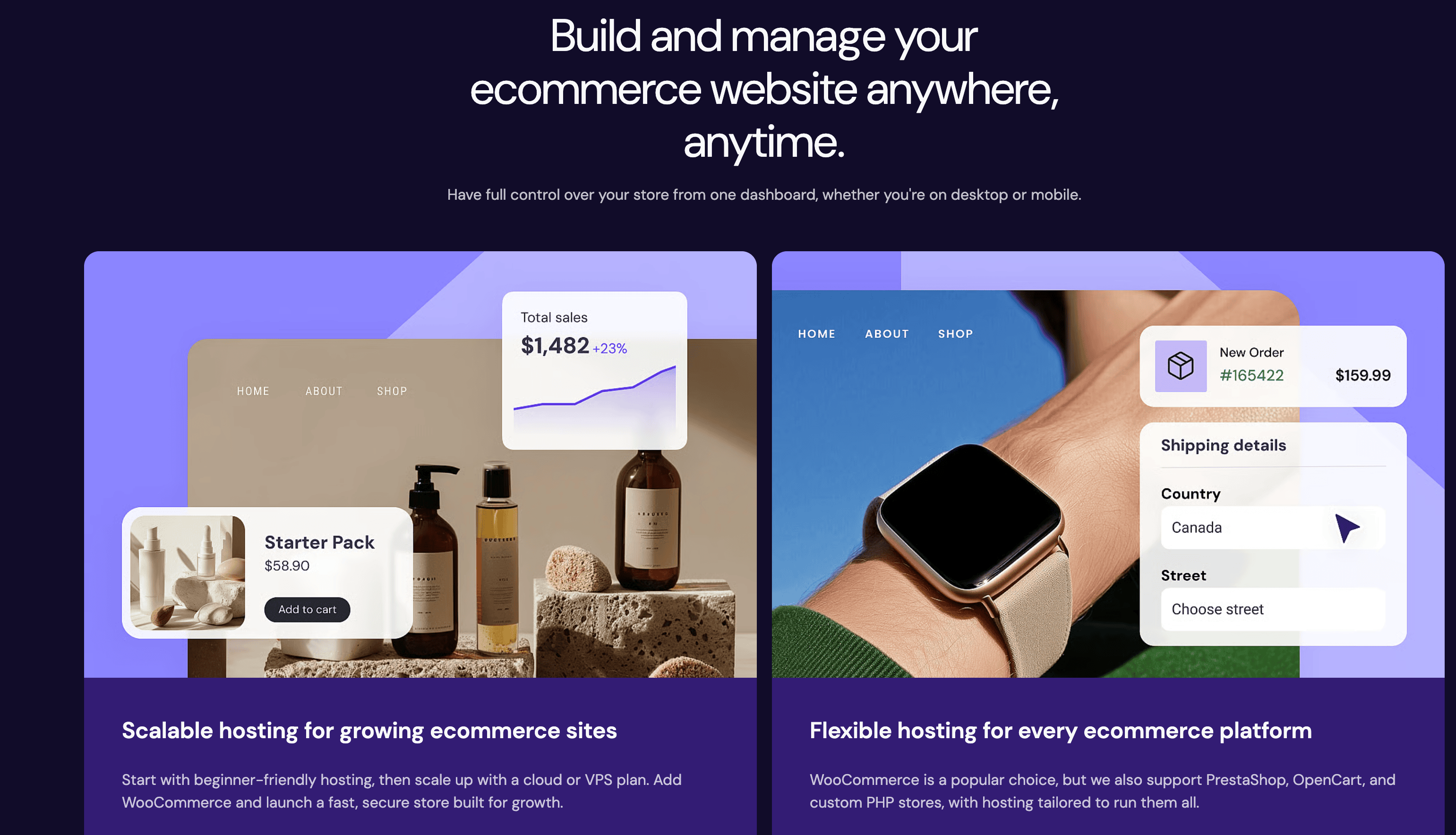
It provides a website-building approach for businesses that want to create an online storefront without developing everything from scratch.
Before choosing it—or any alternative—check the current plan features, supported payment methods, shipping integrations, transaction-related costs, product limits, and renewal pricing against your needs.
You don’t have to choose a website builder immediately. If you’re still validating your product idea, starting with a marketplace or a simple social selling setup may be more practical. An independent website becomes worth considering when the additional control over branding and the customer experience supports your business goals.
Frequently Asked Questions About Ecommerce
What is ecommerce in simple words?
Ecommerce is buying and selling products or services over the internet. Examples include ordering clothes from a website, buying groceries through an app, or purchasing a digital course online.
What is an example of ecommerce in India?
Ordering a mobile phone from an online marketplace, purchasing skincare from a brand’s website, or buying handmade products through a seller’s online store are all examples of ecommerce.
Is ecommerce the same as online shopping?
Not exactly. Online shopping is the customer-facing activity of buying products or services online. Ecommerce is broader: it also includes the business activities and systems used to sell, process payments, manage orders, and fulfil purchases.
Can I start an ecommerce business with a small budget?
Yes, depending on your product and business model. You can test demand through a marketplace or social selling before investing in a full website. However, product costs, delivery, marketing, returns, and applicable compliance requirements still need to be considered.
Do I need my own website to sell online?
No. You can sell through marketplaces or suitable social channels. An independent website is an additional option if you want more control over your storefront, branding, and customer experience.
Which payment methods should an Indian ecommerce store offer?
UPI, cards, and COD are common options, while net banking and supported wallets may also be relevant. Choose methods that fit your target customers and compare provider fees, settlement terms, and operational requirements.
Is ecommerce profitable?
It can be, but profitability depends on product margins, demand, marketing expenses, delivery costs, fees, returns, and operating efficiency. Revenue alone doesn’t tell you whether a business is making money.
Explore More:
- Black Friday Automations for eCommerce Store 2026
- Best Domain Names for eCommerce Site
- Top 10 Growing eCommerce Startups in India
- How to Sell eBooks Online?
- Top Ways to Make Money Online [For Beginners]
![Best Domain for eCommerce [A Complete Guide 2026]](https://bloggerspassion.com/wp-content/uploads/2026/06/best-domains-for-ecommerce-websites-1-300x160.webp)




![How to Start a Blog in 2026 in India [Beginner Friendly Way] – My Example](https://bloggerspassion.com/wp-content/uploads/2012/01/how-to-start-a-blog-300x157.jpg)

Leave a Comment
Your email address will not be published. Required fields are marked *