


Disclosure: We get a commission when you buy a product via our affiliate link at no additional cost.
The “Invisible” Traffic Problem

In May 2026, Google made a quiet update that changed everything. They removed the digital signature we used to track visits coming from AI summaries.
We used to have a clear window into how people moved from AI answers to our websites. Now, that window is gone.
Analytics platforms like GA4 tried to patch this. They introduced a new “AI Assistant” channel. It captures traffic from tools like ChatGPT, Claude, and Gemini. That sounds helpful but it is only a partial fix.
The biggest source of AI traffic is Google itself.
When Google pulls your content into an AI Overview, it does not send a signal that your analytics can read. It keeps that interaction inside Google. You are left with a dashboard that shows some AI traffic from external apps but ignores the giant elephant in the room.
You might think your brand has zero visibility in AI searches because your referral report says so. The reality is different. You are likely getting thousands of views and citations, but they are invisible to your current tools.
A New Way to Measure Success
Stop obsessing over clicks.
Consider these three metrics. They tell the real story of your brand’s power.

1. Citation Frequency: How often does an AI suggest your brand as a source? This is the new gold standard. Even if the user does not click the link, they see your name. So if we want to know if our brand gets cited, we have to track our brand mentions in AI answers.
2. AI Share of Voice: All you need to compare your brand’s presence against others. If your competitor shows up in every AI summary for your core keywords, they are winning. That matters more than a raw traffic number.
3. Trust: Does the AI view your site as a trusted source? All we have to prove that our content solves reallife problems. If the AI consistently points to your tools or your expert advice, you have locked in a prime spot in the future of search.
How do you track this?
You stop looking at isolated traffic reports. You look for tools that can see into the AI ecosystem. You need a way to combine the old way of tracking keywords with this new, complex layer of AI mentions.
When you report this to your leadership, stop showing them a declining line of traffic. Show them a rising line of influence. Tell them how many times your brand was cited as an expert.
How to Stay Ahead with The “New” Approach?
Most marketing teams have a “tool problem.” They use one platform for keyword rankings, another for traffic data, and a third for brand mentions. None of them talk to each other.
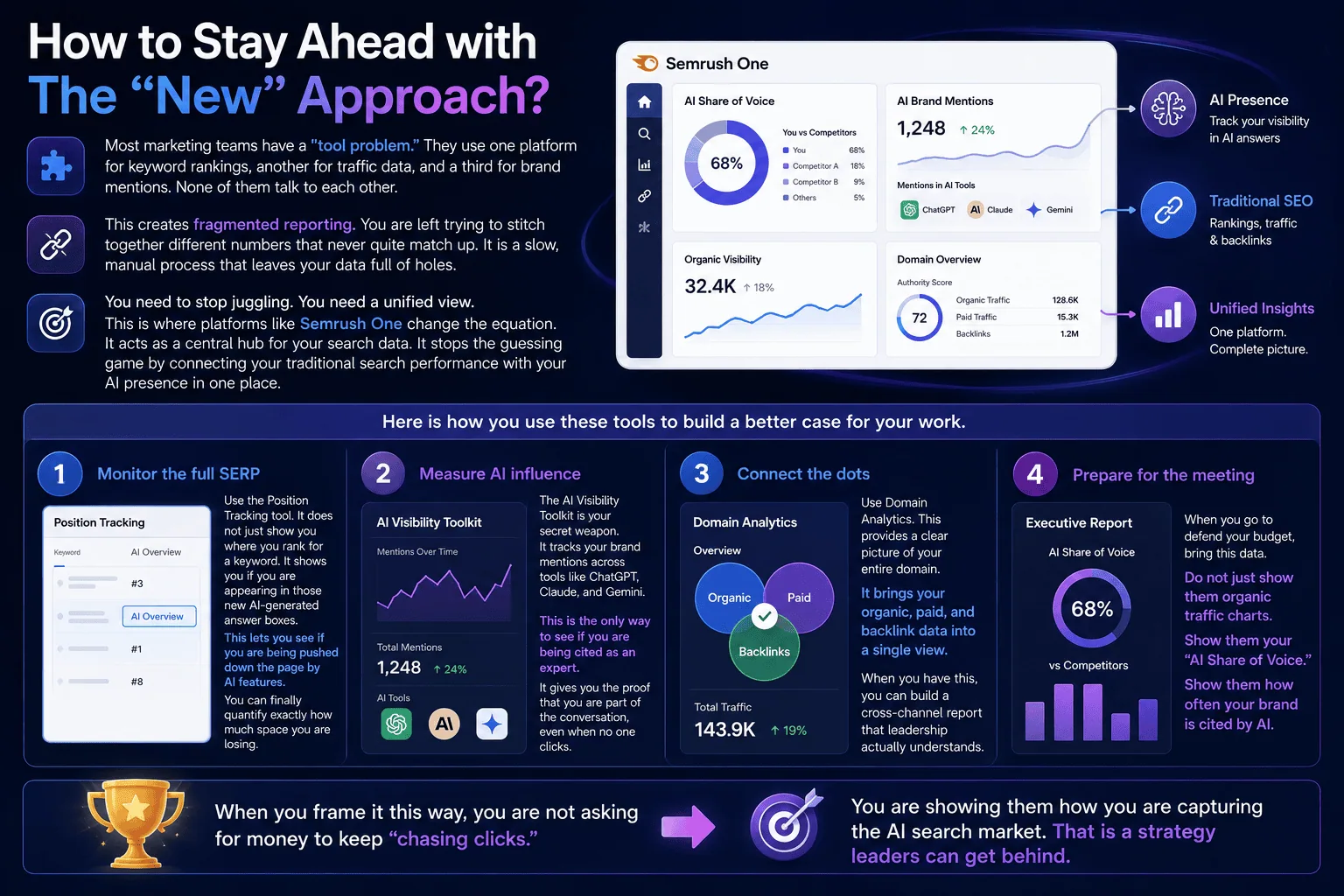
This creates fragmented reporting. You are left trying to stitch together different numbers that never quite match up. It is a slow, manual process that leaves your data full of holes.
You need to stop juggling. You need a unified view.
This is where platforms like Semrush One change the equation. It acts as a central hub for your search data. It stops the guessing game by connecting your traditional search performance with your AI presence in one place.
Here is how you use these tools to build a better case for your work.
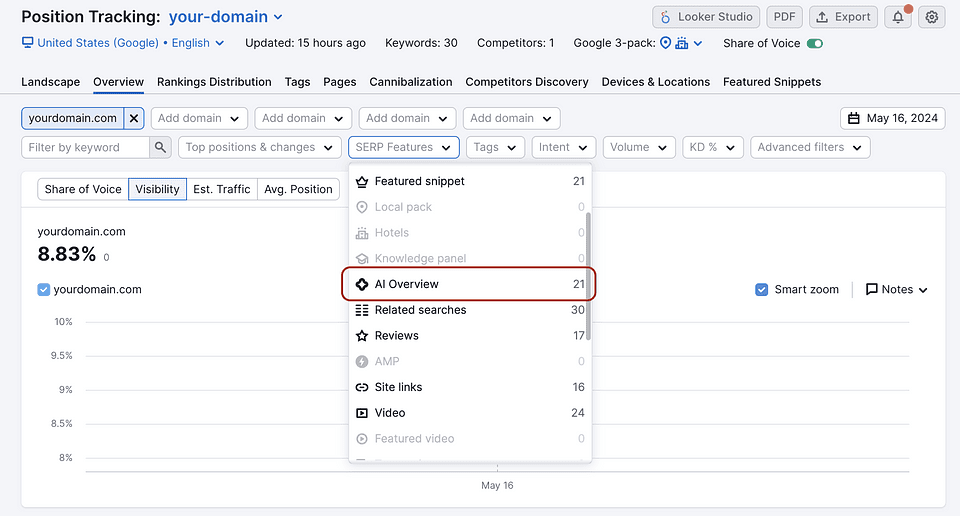
Monitor the full SERP: Use the Position Tracking tool. It does not just show you where you rank for a keyword. It shows you if you are appearing in those new AI-generated answer boxes. This lets you see if you are being pushed down the page by AI features. You can finally quantify exactly how much space you are losing.
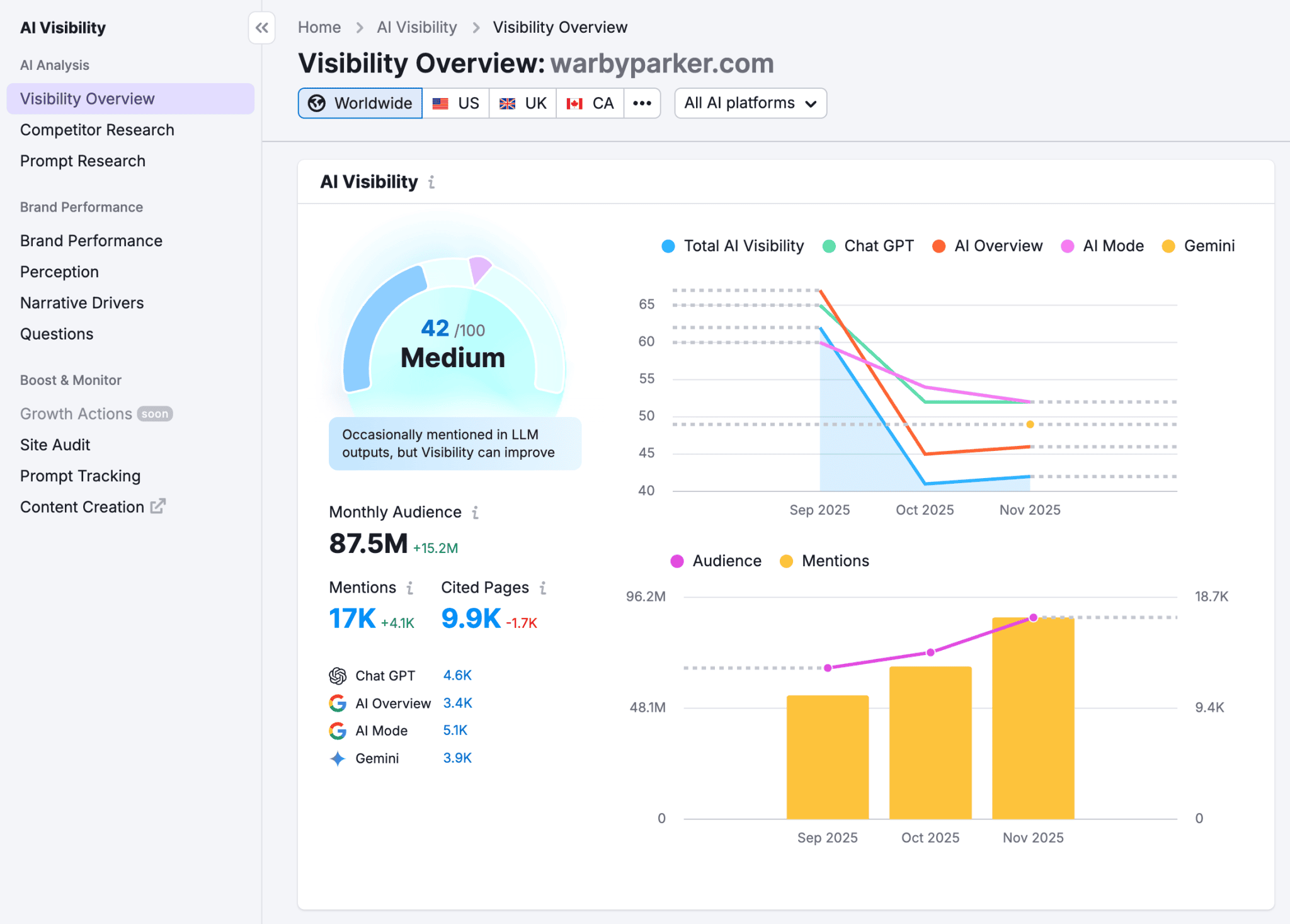
Measure AI influence: The AI Visibility Toolkit is your main weapon. It tracks your brand mentions across tools like ChatGPT, Claude, and Gemini. This is the only way to see if you are being cited as an expert. It gives you the proof that you are part of the conversation, even when no one clicks.
Connect the dots: Use Domain Analytics. This provides a clear picture of your entire domain. It brings your organic, paid, and backlink data into a single view. When you have this, you can build a cross-channel report that leadership actually understands.

Prepare for the meeting: When you go to defend your budget, bring this data. Do not just show them organic traffic charts. Show them your “AI Share of Voice.” Show them how often your brand is cited by AI.
When you frame it this way, you are not asking for money to keep “chasing clicks.” You are showing them how you are capturing the AI search market. That is a strategy leaders can get behind.
Try Semrush One (14 Days Trial)
Conclusion:
Because of up to 38% reduction in organic clicks, we just need to change how we measure our brand growth. In other words, we have to track our site presence in AI LLMs.
And without tools, we can’t do that. In the market, the AI tracking tools are everywhere but not all the tools are great. We should only use those tools who have been in the industry for more than 10 years.
Semrush, Ahrefs, and Moz are few of the industry popular tools. You can try them. I advise you to try their trial first.
Explore More:
- Why Google Is Stopping Indexing Your Content (2026)
- Why Is On-Site SEO Not Enough?
- Comparison of SEO vs GEO vs AEO
Move upMove downToggle panel: AI ButtonsMove upMove downToggle panel: Post Short TitleMove upMove downToggle panel: Why Trust Us?Move upMove downToggle panel: Alternate Language PostMove upMove downToggle panel: Post DateMove upMove downToggle panel: Verified byMove upMove downToggle panel: DisclosureMove upMove downToggle panel: Product BoxMove upMove downToggle panel: ReviewMove upMove downToggle panel: Related PostsOpen save panel
- Post
Let’s look at your traffic reports.
If your numbers look flatter than they did a year ago, you are not imagining things. It is a common sight in the industry right now. You publish great content. You spend time on your keywords. But the expected clicks are not showing up in your dashboard.
The reason is simple. Search engines are changing how they deliver information.
Users now find their answers directly on the search results page. They use AI-powered boxes or smart summaries to get what they need. They do this without ever clicking your link.
We call this the zero-click era.
It is time to look at the zero-click attribution crisis and figure out how to prove your worth in a world that no longer rewards the click.
The “Invisible” Traffic Problem
In May 2026, Google made a quiet update that changed everything. They removed the digital signature we used to track visits coming from AI summaries.
We used to have a clear window into how people moved from AI answers to our websites. Now, that window is gone.
Analytics platforms like GA4 tried to patch this. They introduced a new “AI Assistant” channel. It captures traffic from tools like ChatGPT, Claude, and Gemini. That sounds helpful but it is only a partial fix.
The biggest source of AI traffic is Google itself.
When Google pulls your content into an AI Overview, it does not send a signal that your analytics can read. It keeps that interaction inside Google. You are left with a dashboard that shows some AI traffic from external apps but ignores the giant elephant in the room.
You might think your brand has zero visibility in AI searches because your referral report says so. The reality is different. You are likely getting thousands of views and citations, but they are invisible to your current tools.
A New Way to Measure Success
Stop obsessing over clicks.
Consider these three metrics. They tell the real story of your brand’s power.
1. Citation Frequency: How often does an AI suggest your brand as a source? This is the new gold standard. Even if the user does not click the link, they see your name. So if we want to know if our brand gets cited, we have to track our brand mentions in AI answers.
2. AI Share of Voice: All you need to compare your brand’s presence against others. If your competitor shows up in every AI summary for your core keywords, they are winning. That matters more than a raw traffic number.
3. Trust: Does the AI view your site as a trusted source? All we have to prove that our content solves reallife problems. If the AI consistently points to your tools or your expert advice, you have locked in a prime spot in the future of search.
How do you track this?
You stop looking at isolated traffic reports. You look for tools that can see into the AI ecosystem. You need a way to combine the old way of tracking keywords with this new, complex layer of AI mentions.
When you report this to your leadership, stop showing them a declining line of traffic. Show them a rising line of influence. Tell them how many times your brand was cited as an expert.
How to Stay Ahead with The “New” Approach?
Most marketing teams have a “tool problem.” They use one platform for keyword rankings, another for traffic data, and a third for brand mentions. None of them talk to each other.
This creates fragmented reporting. You are left trying to stitch together different numbers that never quite match up. It is a slow, manual process that leaves your data full of holes.
You need to stop juggling. You need a unified view.
This is where platforms like Semrush One change the equation. It acts as a central hub for your search data. It stops the guessing game by connecting your traditional search performance with your AI presence in one place.
Here is how you use these tools to build a better case for your work.
Monitor the full SERP: Use the Position Tracking tool. It does not just show you where you rank for a keyword. It shows you if you are appearing in those new AI-generated answer boxes. This lets you see if you are being pushed down the page by AI features. You can finally quantify exactly how much space you are losing.
Measure AI influence: The AI Visibility Toolkit is your main weapon. It tracks your brand mentions across tools like ChatGPT, Claude, and Gemini. This is the only way to see if you are being cited as an expert. It gives you the proof that you are part of the conversation, even when no one clicks.
Connect the dots: Use Domain Analytics. This provides a clear picture of your entire domain. It brings your organic, paid, and backlink data into a single view. When you have this, you can build a cross-channel report that leadership actually understands.
Prepare for the meeting: When you go to defend your budget, bring this data. Do not just show them organic traffic charts. Show them your “AI Share of Voice.” Show them how often your brand is cited by AI.
When you frame it this way, you are not asking for money to keep “chasing clicks.” You are showing them how you are capturing the AI search market. That is a strategy leaders can get behind.
Try Semrush One (14 Days Trial)
Conclusion:
Because of up to 38% reduction in organic clicks, we just need to change how we measure our brand growth. In other words, we have to track our site presence in AI LLMs.
And without tools, we can’t do that. In the market, the AI tracking tools are everywhere but not all the tools are great. We should only use those tools who have been in the industry for more than 10 years.
Semrush, Ahrefs, and Moz are few of the industry popular tools. You can try them. I advise you to try their trial first.
Explore More:
- Why Google Is Stopping Indexing Your Content (2026)
- Why Is On-Site SEO Not Enough?
- Comparison of SEO vs GEO vs AEO



Leave a Comment
Your email address will not be published. Required fields are marked *