

Trying to get more customers from your local area? Local SEO is the key.
No matter what product or service you offer, local search optimization helps nearby customers find your business when they need it most.
In this guide, we’ll break down simple and effective local SEO tips that work in 2026, starting with the basics.
What Is Local SEO (And Why It Matters in 2026)?
Local SEO is the process of optimizing your business to show up in local search results. It helps your business get found by people searching for products or services near their location.
Local SEO uses location signals like city names, business addresses, Google Business Profile data, and local keywords so search engines can show the most relevant results to nearby users.
For example, it makes no sense to show a pizza shop in New York to someone searching from London.
One big advantage of local SEO is lower competition. You’re not competing with everyone—only with businesses in your area. If your product or service is better and your site is well-optimized, you can easily attract high-intent local customers.
Around 8 out of 10 people in the US search for a local business online at least once every week.
How Google Ranks Local Businesses (Local SEO Ranking Factors)
Google ranks local businesses based on three main factors: prominence, relevance, and distance. These three ranking signals help Google decide which businesses are most useful for local search results.
1. Prominence: Prominence shows how well-known your business is online. More positive 5-star reviews, mentions, and ratings help Google trust your business and show it higher in local search results.
2. Relevance: Relevance means how closely your business matches what people search for. Using the right local keywords helps Google understand your services and show your business to the right customers.
3. Distance: Distance refers to how close your business is to the searcher. The closer your store is to “near me” searches, the more likely Google is to send nearby, ready-to-visit customers.
10 Best Ways to Rank In Local Search [2026 Guide]

1. Collect and Respond to Customer Reviews
Every new customer trusts businesses that are transparent.
Genuine customer reviews are one of the most important local SEO factors. They send strong trust signals to both customers and Google, showing that your business is real, reliable, and active.
If you look at top-ranking local businesses, you’ll notice one common thing: they have more recent and genuine reviews than their competitors. Google sees honest feedback from real customers as a sign of quality and popularity.
That’s why customer opinions matter a lot. And it’s not just about collecting reviews, replying to them is just as important.
All you have to do is collect positive reviews for your business and respond to them to show that you care. Google rewards this by boosting your visibility in local searches.
How to get more reviews (simple & effective):
Here are some proven ways to get more reviews from customers to your local business.
#1. Ask right after a good experience
After a successful purchase or service, ask for a review immediately. Share a direct review link via email, WhatsApp, or SMS so customers don’t have to search for it.
Example: If you run a salon, send a short “Thanks for visiting us” message with your Google review link.
#2. Always reply to reviews (good or bad)
Responding to the reviews is also a significant factor. Replies show that you care and build trust.
For instance, you can reply with “Sorry, we missed the mark. We would love to fix this,” or for good feedback, “Thank you for your feedback. We hope to see you again soon.”
#3. Encourage real photos & videos
Real customer photos make reviews more trustworthy. New customers look for proof. Ask customers to add a photo or short video when leaving a review.
For instance, if you run a restaurant, customers often share photos of their favorite dishes or your restaurant’s ambience. These real images build trust and help your local business get more customers.
2. Post regular updates and offers on Google Business Profile
If you want to stand out in local searches, you must post regular updates and offers on your Google Business Profile.
Most businesses ignore this, but it’s a big mistake. Google prefers active profiles. Posting new offers, updates, photos, and short posts helps improve your local visibility.
Simple rule: the more active your profile is, the more Google pushes it in “near me” searches.
How to do it (simple steps):
Here are a few practical tips to make your Google Business Profile stand out.
- Post weekly offers and discounts: Share your best deals regularly. It gives people a reason to visit your store again. For example: “Flat 20% off this weekend only.”
- Announce new products or services: Let customers know what’s new. A simple post with a photo works well. For example: “Now offering home delivery.”
- Upload fresh photos: Add real photos of your staff, services, products, or ambience. These build trust and get more clicks. For example: Photos of happy customers or your workspace.
- Add a clear Call-to-Action: Tell customers what to do next. For example: “Call now,” “Book today,” or “Limited offer today only.”
3. NAP is crucial
NAP stands for Name, Address, Phone Number.
NAP is crucial for any business aiming to rank well in local search results.
Here’s an example of what NAP SEO looks like;
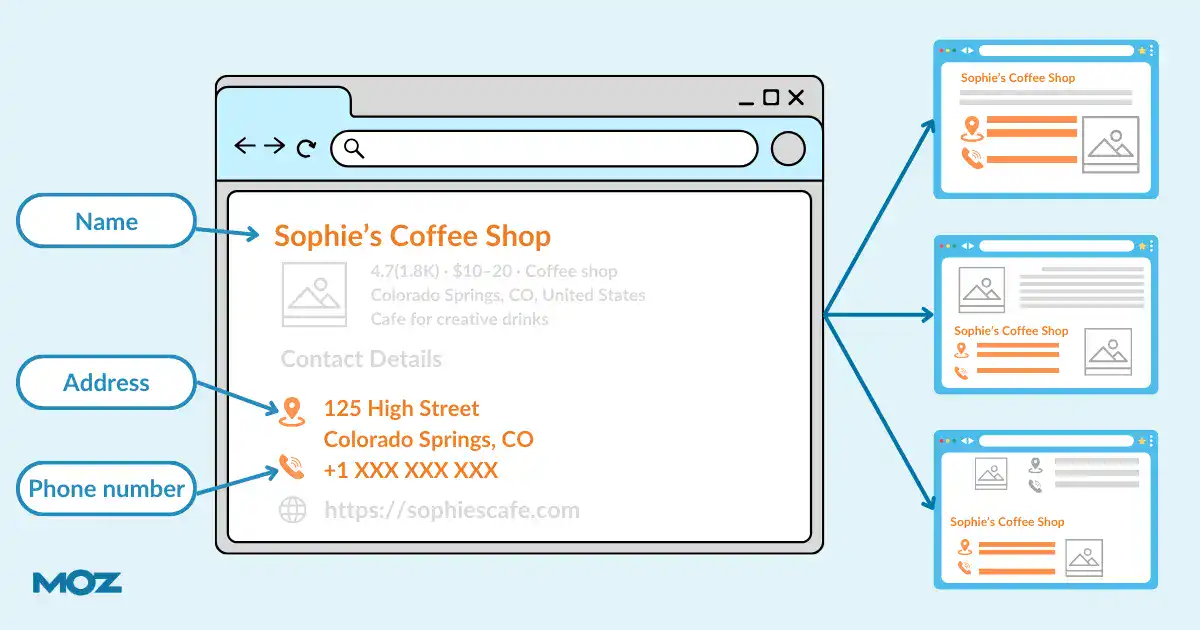
Since Google considers the NAP data when displaying relevant results for geo-targeted searches. Ensure that your NAP information is consistent across all relevant platforms, including your eCommerce store, website, app, and other appropriate channels.
Ensure that your NAP information is up-to-date and consistent to achieve optimal performance in local organic search results.
Where to use NAP information?
You should add your NAP details to your website, Google Business Profile, social media profiles, and local business listing sites. Make sure the details are the same everywhere.
Also, create a dedicated business page on your website. Add all important information about your business, including services, location, and contact details.
The key is to optimize this page for search engines. Use simple keywords that describe your business and what customers are looking for. This helps users better understand your business and brings in more organic traffic.
Quick Suggestion: For local businesses, AI SEO automation tools can save time by handling repetitive tasks like keyword tracking and content optimization.
4. Get listed on Google Business Profile
Google Business Profile is probably the #1 business profile listing site, which helps you reach and engage with local customers across Google Search and Maps.
Here’s what a Google Business Profile listing looks like;
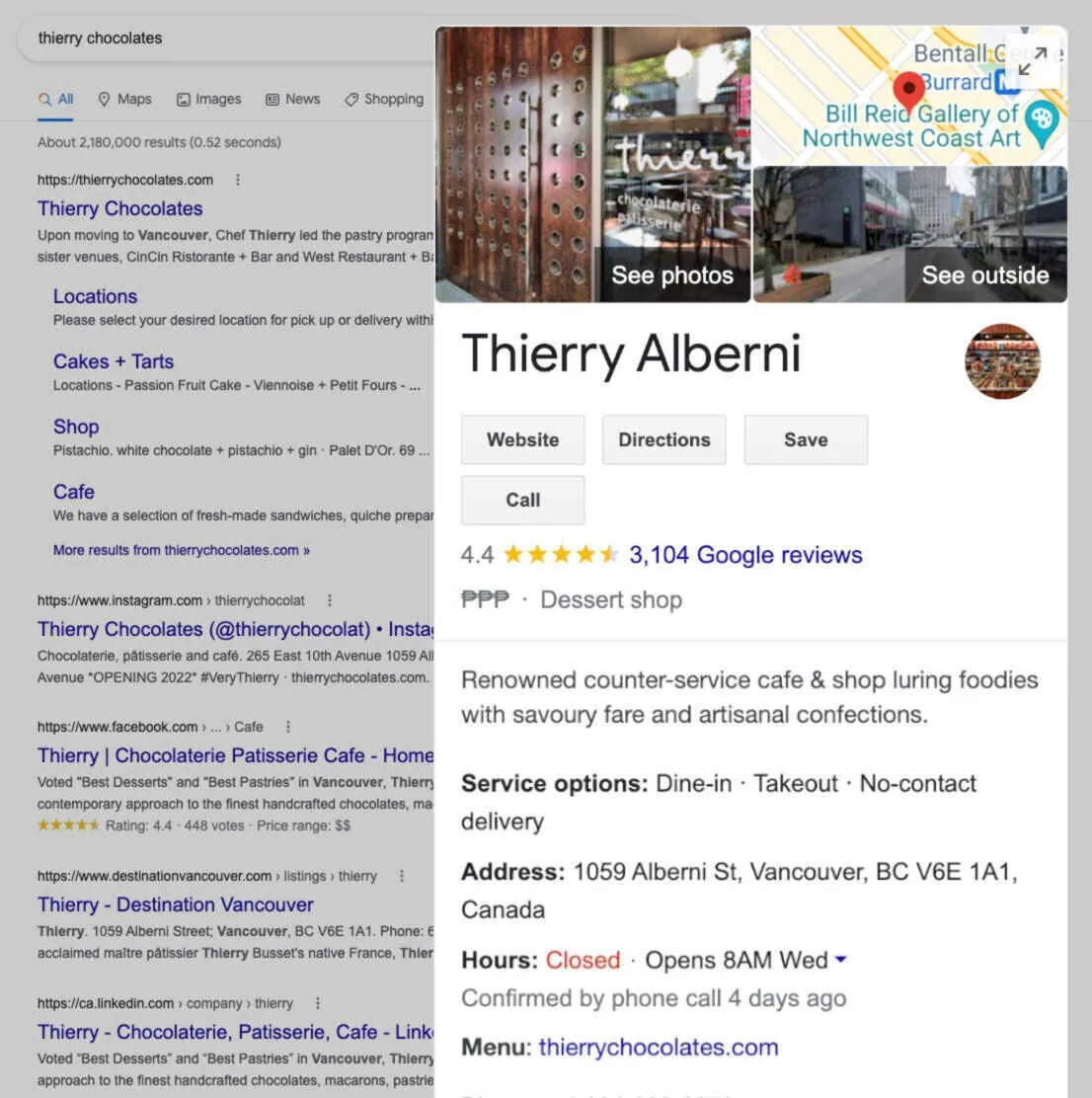
As you can see above, you can get a Google Business listing for both desktop and mobile users, which can immensely help you get more customers if you’re on a Google Business listing.
To get started with your listing, you need to sign in to Google Business (by signing in to your Google Account or creating a new one). Then, click Next.
Now, you can simply sign up with your business email domain and enter the name of your business.
You may also be asked to position a marker on the location of your business branch on a map. Finally, make sure to verify your account (read more details here). Once you are verified, you can edit your business information, respond to reviews, and add photos.
5. Find better keywords to rank for
You need to conduct keyword research to find low-competitive yet highly profitable keyword phrases to rank for.
You need to create a list of your target keywords. Keyword research is a no-brainer. Before dominating the local search results, you need to first define your target audience. Ensure you generate keyword ideas that have genuine potential for your business to rank higher in search engine results.
Using locally based keywords is the key to starting to dominate your local results and being found by your local customers.
Before conducting keyword research, ask yourself these questions.
- What keywords are your target customers searching?
- Are they ready to buy if they have enough solutions?
- Or are they just doing research for your keywords?
- Is your target audience ready to pay a high amount?
- What keywords are my competitors ranking for?
6. Get listed on local review sites
Apart from getting listed on GMB, you also need your business to get listed on other local review sites if you want to get more visibility for your local business.
It will also help you with user reviews, as they will not only increase awareness of the services or products you offer but also provide more local visibility, which enables you to gain more trust from users.
Here are a few top local review sites that you can try:
- Yelp
- Google Places
- Judy’s Book
- Angie’s List
- Yahoo! local
- Bing
- MerchantCircle
- Citysearch
- Foursquare
Ensure that you encourage your store visitors and users to leave 5-star and positive reviews for your services and products across these review sites.
Encourage your existing subscribers and readers to leave positive reviews about your products. This definitely helps your local SEO results to get more visibility. Additionally, it serves as social proof, attracting even more customers.
7. Keep an eye on your competitors
It doesn’t matter what niche you are in; if you want to take your local SEO strategy to the next level, you need to spy on your competitors’ strategies.
Why? There are so many benefits of competitor research, including;
- Gives you a ton of profitable topic ideas to write about
- Gives you ideas on what pages (products and services) are performing well in your niche
- You can find a ton of other monetization strategies that you never thought of
How can you spy on your competitors then?
Use competitor research tools like Semrush.
Once you get access to Semrush, focus on finding the following things;
- Perform deep organic research, which helps you find your competitors’ top-performing pages (including income-generating pages)
- Analyse your competitor traffic stats (find out if your competitors are getting traffic from search, social, referral, or paid, so you can also think about using those traffic sources)
- Find their Organic Search Positions (Semrush helps you with that!)
- Keep an eye on their SERP competition strength (to see what keywords their rankings are improving or declining)
Finally, make sure to do some PLA research (Product Listing Ads) using Semrush, as it reveals your competitor’s ads information, including all the keywords, titles, CPC, cost, and paid traffic they are using to generate more sales to their sites.
Bonus Read: Stay competitive in your local market by understanding the Future of SEO and adapting to new strategies.
8. Create local content
To rank #1 on Google for local search results, you need to provide local content that caters to your audience. There are several types of local content you can create, which are explained below.
- FAQ pages: Helpful FAQs can rank in featured snippets (zero position). They also work great for voice search, which many people use to find local businesses.
- City-specific pages: Create separate pages for each city you serve. Add local offers or discounts to attract nearby customers.
- Local events content: Write about local events, festivals, or promotions. This brings highly targeted local traffic from search.
- Service videos: Create simple videos explaining your services. Videos help you rank on YouTube and Google and build trust faster.
Keep it simple. Use a tripod to record short videos explaining your services, as they help people trust your business and improve local SEO.
For example, if you run a dental clinic, record a short video like “Best dental clinic in New York – services we offer”. Explain your treatments, pricing, and location. Add your main keyword in the video title, description, and tags. You can also share the video on your website and build links to it to boost its visibility.
9. Acquire relevant backlinks
If you’re running an online store or website, link building is crucial for driving more organic traffic.
Backlinks still matter in 2026, but quality and relevance matter more than quantity.
Focus on getting links from:
- Local business directories
- Nearby businesses and partners
- Local blogs, news sites, and community websites
- Competitor backlink sources (use tools like Semrush to find them)
Guest posting on relevant, niche websites still works well for local SEO. One good local link is better than ten random ones.
Additionally, use platforms such as Quora or LinkedIn to answer questions in your niche. Although they are nofollow links, they do attract quality traffic and help you balance your backlink profile nicely.
Note: Go through this detailed post on “Beginner’s Guide to Link Building” to build ethical backlinks around your sites.
10. Use AI Tools & Google Alerts for Local SEO
AI tools and Google Alerts can make local SEO easier and faster, especially if you don’t want to do everything manually.
For example, you can use Rank Math’s Content AI while creating content. It helps you find local topics people are actually searching for, suggests the right keywords, and helps you write better content for your area.

Also, you can set up Google Alerts to track what’s happening around your business.
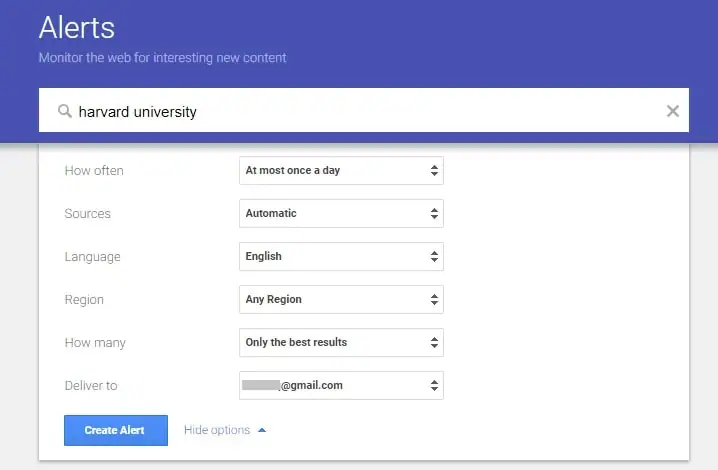
Example: If you run a salon in London, you can set alerts for “best salon in London” or your salon name. If someone writes a blog post or news article mentioning you, you can respond, share it, or ask for a backlink.
Set up alerts for the things that matter most to your local business:
- Your brand or store name, so you’ll get notified whenever it’s mentioned anywhere on the web
- Your location (city, area, or neighborhood)
- Nearby competitors
Learn what AEO in SEO means and how it can help improve your search visibility.
Local SEO Checklist (Quick Wins)
Here’s a quick checklist to help optimize your local business in 2026.
- Optimize your Google Business Profile
- Consistent NAP across all platforms
- Mobile-friendly website
- Add local keywords on service pages
- Make sure to get honest reviews from your customers every single month
- Acquire local backlinks through directories, guest posts, etc
- Create city-specific pages
Final Thoughts on Top Local SEO Tips 2026
Start by optimizing your Google Business Profile first. Then focus on getting more positive reviews, local pages, and backlinks. These alone can put you ahead of 90% of local competitors.
Don’t try to do everything at once. Focus on the factors that generate the maximum impact. Over time, these small efforts can significantly increase your local visibility, foot traffic, and sales.
Do you have any more questions about local search engine optimization? Let us know in the comments.
FAQs | Best Local SEO Techniques
Here are some of the most important questions to consider when optimizing for local search engine rankings.
Why local SEO is important for SEO?
Local SEO helps your business show up in nearby searches. It brings more local visitors, more calls, and more sales. It also helps your business stand out in your area.
What are the most important things to keep in mind while optimizing for local searches?
Focus on providing the correct NAP business details, targeting local keywords, Google Business Profile optimization, and positive reviews.
Is link building needed for local SEO?
Yes, Link building is needed. According to Moz’s survey, “link signals” are the most important ranking factor for local organic results.
Are there any tools for local SEO?
Yes, tools like Semrush help with keywords, backlinks, and audits, Google Business Profile manages your local listing, and review sites like Yelp help build trust through customer reviews.


I like the way you written article easy to understand and you have taken less word to describe in beautiful way. For local seo what I feel is inter personal communication between reader and website. It should be in language what local understand.