


Backlinks are links from other websites to yours. And yes, they still matter in 2026.
Earlier, backlinks mainly helped with Google rankings. Today, they do more, as AI platforms like ChatGPT, Gemini, etc., use backlinks and mentions to understand things like;
- who you are
- what you’re known for and
- whether your content is worth recommending
In this guide, you’ll learn NINE practical ways to build backlinks that work in 2026, for Google and AI search.
How to Build High-Quality Backlinks in 2026: 9 Practical Methods That Still Work
Table of Contents
- How to Build High-Quality Backlinks in 2026: 9 Practical Methods That Still Work
- 1. Publish Content People Want to Link To
- 2. Guest Posting Still Works (If Done Right)
- 3. Earn Links by Giving Expert Interviews
- 4. Get Natural Links from Expert Roundups
- 5. Turn Product Reviews into Backlinks
- 6. Earn Easy Links with Honest Testimonials
- 7. Create Compelling Infographics
- 8. Build Links by Fixing Broken Pages on Other Websites
- 9. Turn Blogger Mentions into Backlinks
- Real Benefits of Earning Quality Backlinks
- What Are Quality Backlinks?
- Types of Backlinks
- Tracking and Monitoring Backlinks
- Final Thoughts
- FAQs
1. Publish Content People Want to Link To
Create content that earns links naturally.
When your content is useful, original, and easy to understand, people link to it naturally.
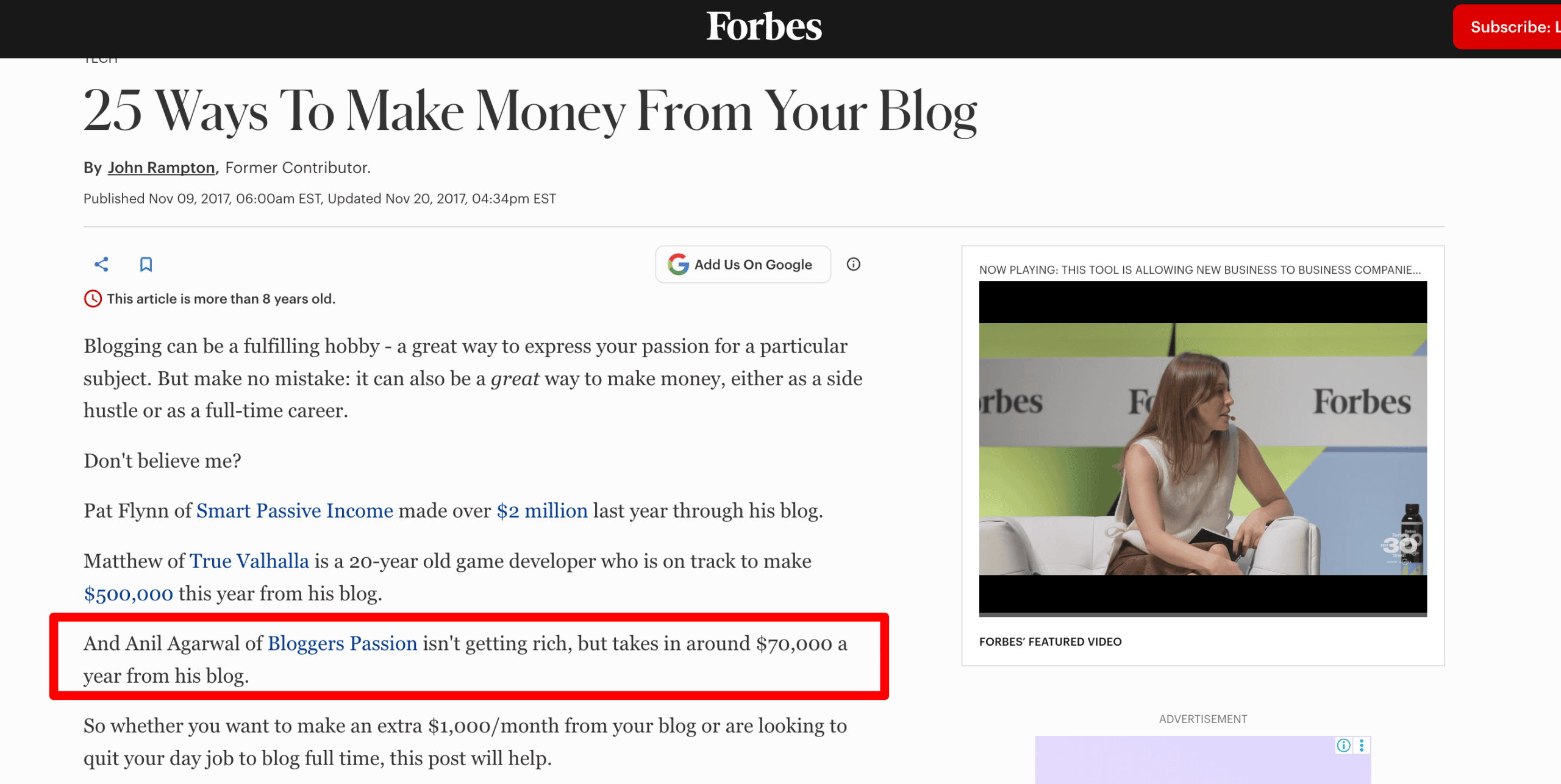
For example, our blog BloggersPassion has earned organic links from top sites like Forbes and WikiHow, without any outreach.
Here’s the link to a Forbes article where BloggersPassion got mentioned.
The same happened with WikiHow. They referenced one of our blog posts as a trusted source and added a link.
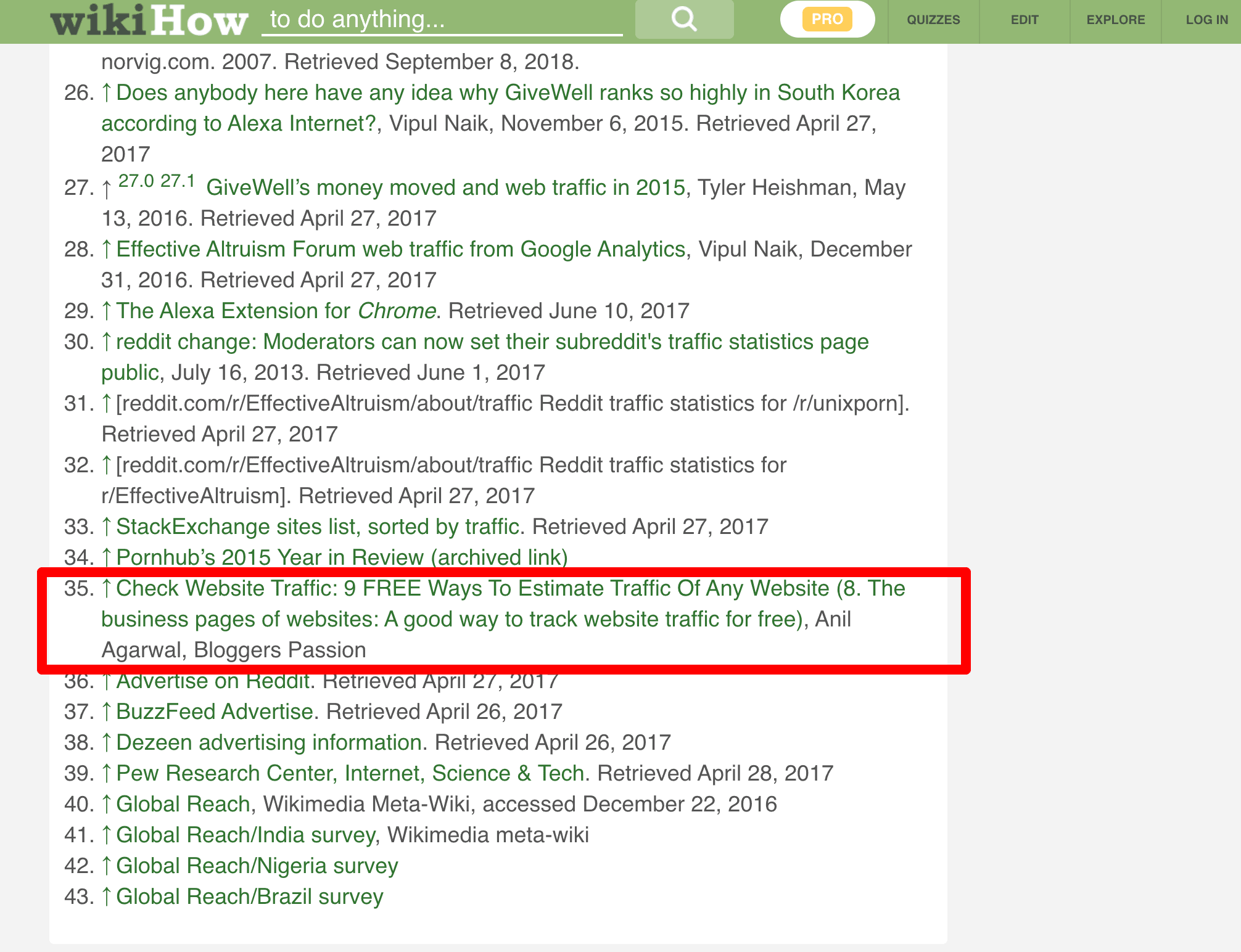
As you can see, even high-authority sites link out when your content is clear, credible, and genuinely useful, which is exactly what Google and AI platforms still reward in 2026.
So, what actually makes someone link to your content in 2026?
People link for just three reasons:
- It helps them explain something better (a blogger links to a “SEO basics” guide instead of explaining SEO from scratch)
- It helps them prove a point (a fitness coach links to a study to show calorie deficit causes fat loss)
- It helps them save time (a YouTuber links to tools they use instead of listing setup steps)
How to create content that attracts links (simple framework)
1. Pick a strong topic
Choose topics people already care about, but improve them. Use tools like Semrush (to find low-competition, high-intent keywords), Quora (real questions real people ask), and BuzzSumo (to see what’s already getting shared and linked).
A quick tip: Prefer topics that can be quoted by AI, including definitions, frameworks, stats, and step-by-step guides.
2. Create in-depth, link-worthy content
Thin content doesn’t earn links anymore. Cover the topic fully. Add examples, visuals, and clear explanations.
Long-form content still works, but only if it’s useful.
Tip: Write content people don’t need to Google again.
3. Keep it fresh
You’ll attract links if your content is up to date.
Regularly refresh your best posts with new data, AI examples, and current trends.
Tip: Keep an eye on the best-performing blog posts, do keyword research, and update the content with the latest information.
Start using the Skyscraper technique
The easiest way to attract more high-authority backlinks to your own blogs is to write epic posts that naturally attract links from other blogs. How can you do that?
There’s a proven strategy called the Skyscraper technique that helps you get quality links to your blogs with your own content.
Here are the 3 steps involved.
- Finding content that is popular in your industry.
- Making it better, detailed, compelling, and helpful.
- Promoting it to the right people to reach a wider audience.
2. Guest Posting Still Works (If Done Right)
Most people think guest posting is dead. It’s not.
Plenty of influential bloggers still write guest posts for one simple reason: guest posting works.
Here’s why it’s powerful:
- Build high-quality, relevant backlinks
- Create real relationships with blog owners (and readers via comments)
- Grow your email list faster
- Send targeted traffic to your homepage or key pages
But here’s the thing: guest posting takes time and it’s not easy!
You first need to know how to properly send email pitches if you want to guest post on authority sites in your industry.
Here are a few guest post link examples of BloggersPassion
We have been featured and guest-posted on a ton of authority blogs in our industry including Semrush.com, NeilPatel.com, HubSpot.com, and so on.
Here’s an example email pitch that we sent to the Problogger team when we reached out to them for the first time.
Hi,
I’m a huge fan of ProBlogger and I’ve been reading and implementing your stuff for a long time now.
I always wanted to contribute to ProBlogger and serve the readers. So after extensive research, I wrote a post titled “3 Growth Hacking Strategies for Bloggers to Quadruple Their Blog Traffic Without SEO” where I’ll be sharing a few proven ways to increase blog traffic quickly. It took me around 7 hours to finish this post.
I hope ProBlogger readers will definitely love it. Can I send you the attachment for the guest post?
Let me know what you think.
Best Regards,
Anil Agarwal,
BloggersPassion

Whenever you’re trying to send guest posting pitches to other bloggers (especially authority bloggers), keep your emails really short.
Here are a few things to remember about guest posting (2026):
- Write top-quality content: Authority sites won’t accept average posts. Send them your best work.
- Spend quality time in research: Before you start your guest blogging journey, create a list of guest posting sites where you can publish your content. Shortlist sites, read their blogs, and understand what performs well.
- Pitch relevant topics: Match your ideas with their audience and content style.
- Add real value: Teach something useful, not self-promotion.
- Build before you pitch: Comment, share their posts, and get on their radar first.
3. Earn Links by Giving Expert Interviews
Get interviewed by other bloggers. There are so many bloggers (including experts) who often publish interviews of other bloggers in their industries.
If you are wondering what they look like, check out these links where I got interviewed by few famous bloggers.
As you can see, both the above-mentioned blogs are well-known in the blogging niche.
When you do a quick search for “Anil Agarwal blogger interview”, you will see lots of blogs and YouTube videos where I’m getting featured (which means more mentions and backlinks for my blog).

Getting interviewed by others is the best way to:
- Attract highly relevant backlinks (mostly do-follow links)
- Improve your personal brand
- Get more traffic and exposure to your site
- Acts as word-of-mouth publicity online
- And the list goes on
So how to get interviewed by other bloggers in order to build backlinks?
One of the best ways to get interviewed is to reach out to others.
You should reach out to other bloggers to get interviewed especially when you don’t have enough personal brand but great content or results on your blog.
Here’s what an example email pitch looks like;

As you can see above, a well-known blogger emailed us with a simple interview pitch. He clearly explained why we should interview him on BloggersPassion.
The pitch was short, clear, and made sense, so we accepted it and sent him the interview questions.
That’s how it works.
- He gets links and exposure from our site
- We get valuable, useful content for our readers
A clear win-win.
4. Get Natural Links from Expert Roundups
Getting featured in roundup posts is one of the easiest ways to build authority as a blogger and earn relevant backlinks.
The best part? Many bloggers regularly publish roundup posts.
Here’s the example of roundup post where we have been featured on Huffington Post. Just have a look at this roundup post from HuffPost.
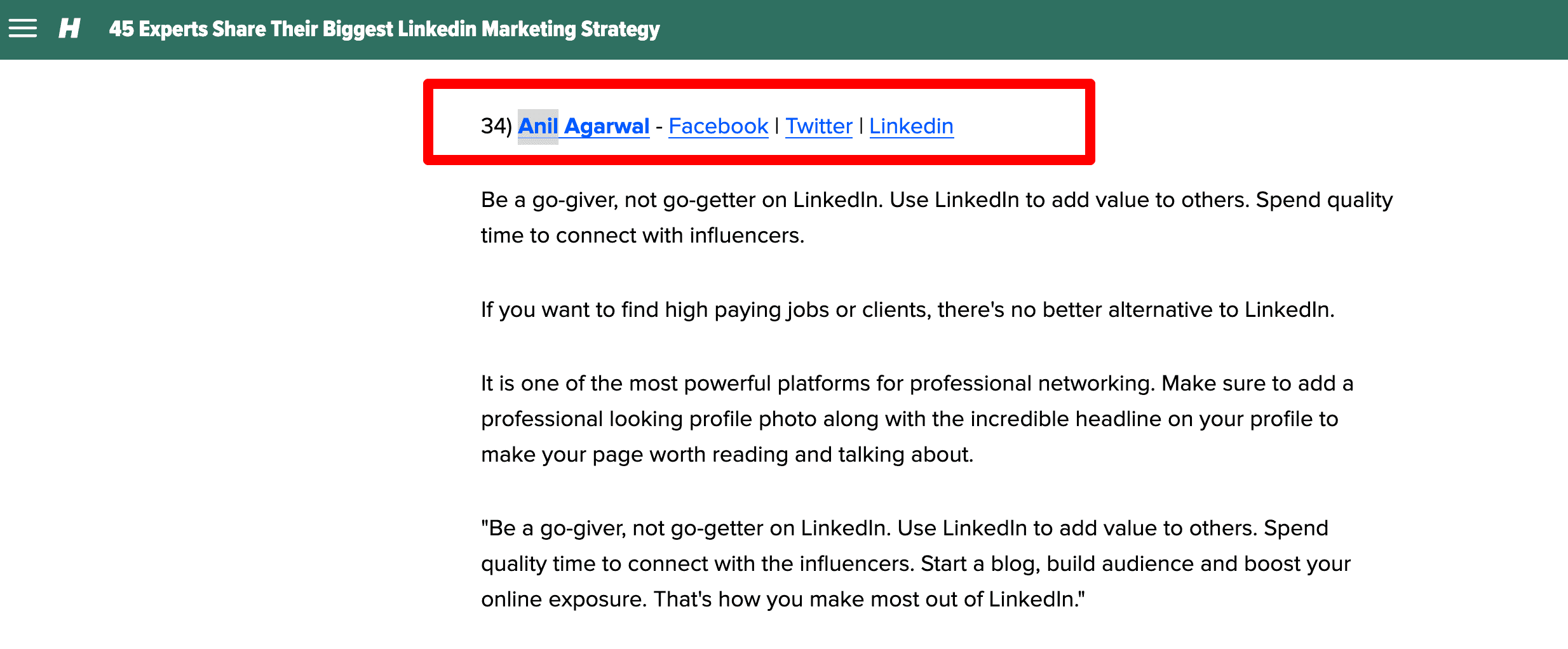
As you can see above, Huffington Post is an incredibly high DA site that has featured me in one of their roundup posts on “LinkedIn marketing strategy”.
How to get featured in blogger roundup posts (2026 & beyond)
- Be everywhere: Don’t stay on your blog only. Network, comment, share, and engage across blogs and social platforms.
- Get visible consistently: The more often people see your name, the more link opportunities you create.
- Build a roundup list: Track bloggers who regularly publish roundup posts.
- Engage before asking: Comment on their blogs, share their posts, mention them, and support their work.
- Ask smartly: Reach out and ask to be included in future roundups.
- Be genuinely useful: Share actionable answers, not generic fluff.
5. Turn Product Reviews into Backlinks
Another simple way to build high-quality links is through product reviews.
For example, we got a backlink from WPX Hosting by writing a detailed review. WPX featured our testimonial in their customer reviews section and added a link to our site. (Link to the page)
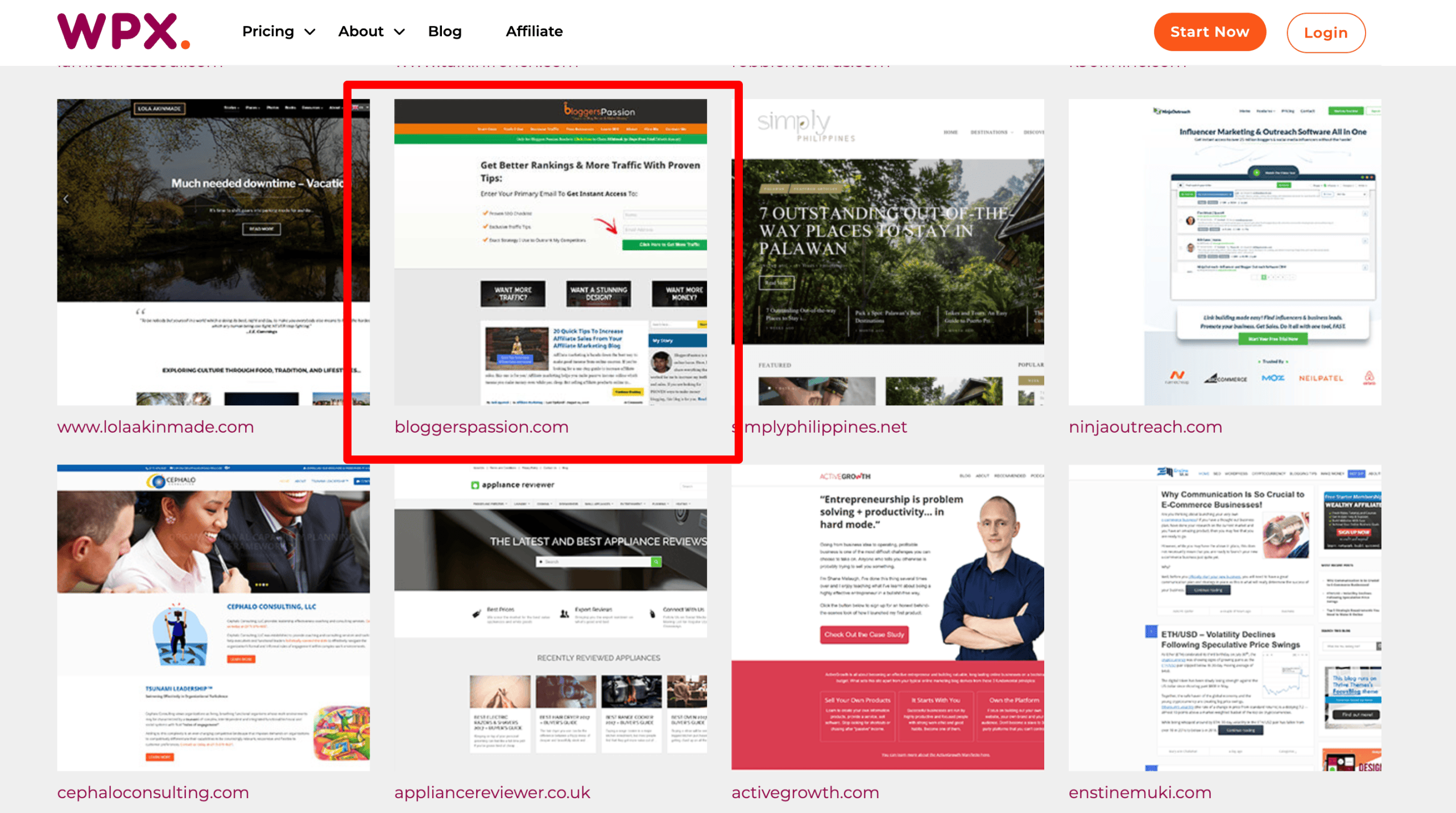
This works because many companies link back to genuine customer reviews.
What to do: Make a list of products you already use on your blog, or find tools that offer links in exchange for honest reviews.
Products that often give review links:
- Web hosting tools (like WPX Hosting)
- Email marketing tools (like GetResponse)
- SEO tools (like Semrush)
Let us demonstrate another example.
When we published an in-depth review of Hostinger, we emailed them to ask whether they’d like to share or link to it. They didn’t just tweet it, they linked to it from their own blog.
Also, they keep linking to our blog whenever there’s a relevant topic because it genuinely helps their readers.
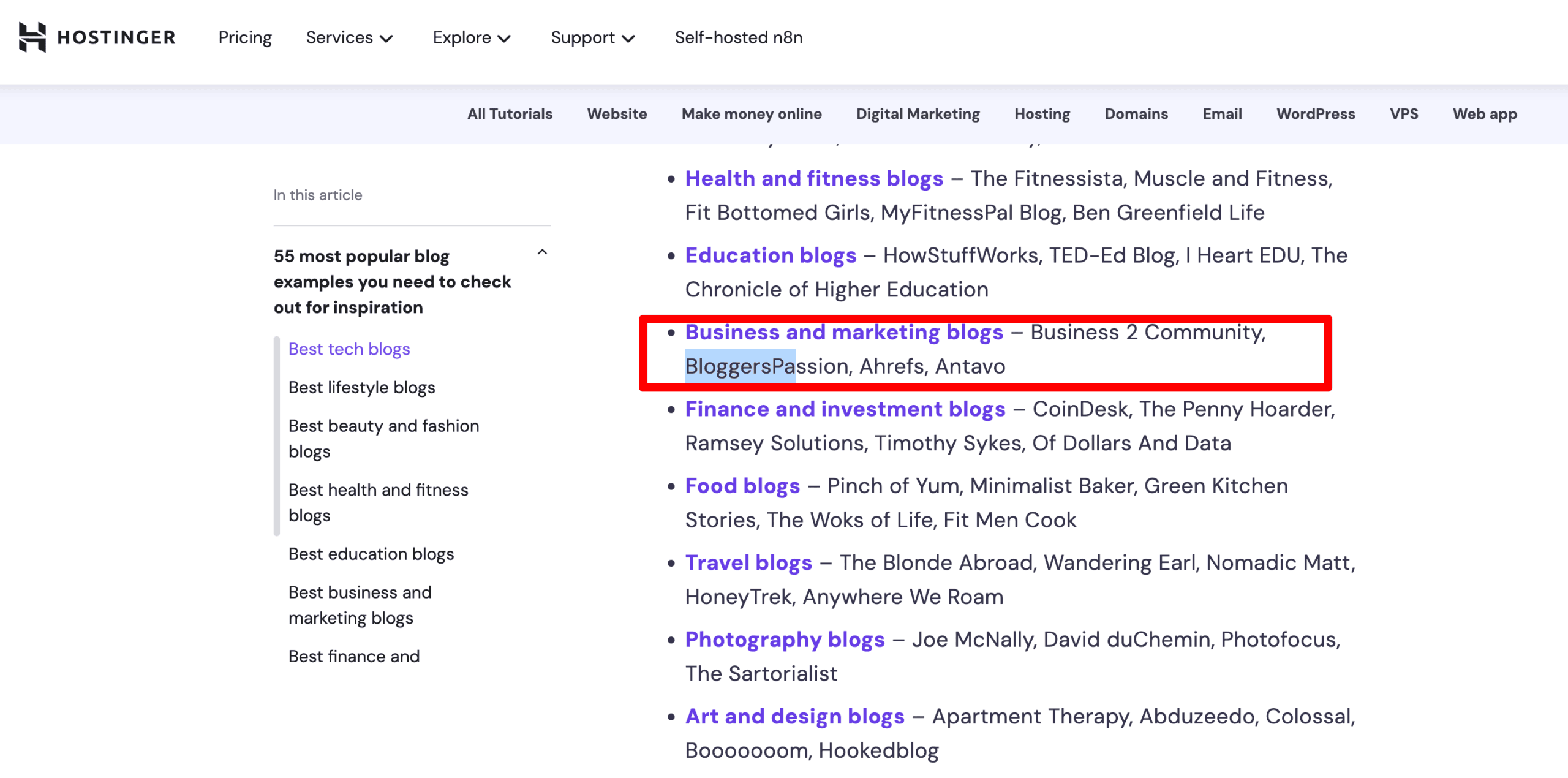
You can do the same:
- Write a highly detailed product review (aim for ~2,000 words)
- Add real screenshots and clear use cases
- Email the product team and ask them to check it out
If they find it useful, links usually follow.
6. Earn Easy Links with Honest Testimonials
Did you know that you can get highly relevant backlinks by using a testimonial hack?
What is a testimonial hack?
This is the least used yet most effective strategy for building high-quality backlinks without creating more content on your blog. Here’s how it works: Find relevant blogs or products and start giving testimonials.
Are you wondering how to use testimonials to build high DA backlinks?
Let us share the testimonial strategy.
Step 1: List the products you already use
Think web hosting, SEO tools, WordPress plugins, etc. Use them properly, write a short, genuine testimonial, and email it to the product owner.
Most companies showcase real customer testimonials with links. That’s an easy authority backlink.
Step 2: Apply advice from other bloggers
Follow strategies from blogs in your niche, get real results, and email the blogger about your experience. Many are happy to mention or link to you.
Step 3: Find opportunities
If needed, search for blogs and tools that accept testimonials openly. Plenty of sites, even authoritative ones, offer dofollow links in exchange for honest feedback.
For instance, we got a high-quality link from one of the authority sites called SearchLogistics.com.

As you can see above, we gave a testimonial about Matthew Woodward blog (who is a well known SEO expert and successful affiliate marketer) and we got a link in return.
So it’s a win/win approach. He got a testimonial from a genuine reader and we got a link in return. Now, your job is to find such blogs and websites that are offering backlinks in exchange for a testimonial.
7. Create Compelling Infographics

Did you know you can turn images into relevant backlinks?
Yes, it’s possible with Infographics. Infographics can help you easily create backlinks.
They are beautifully explained in simple images. The information in Infographics is not only easy to understand but it gets shared on social media and frequently linked from other blogs.
You can use tools like Photoshop, Gimp or hire a designer to design stunning Infographics. But if you can’t afford paid designers or not good at Photoshop, try Canva. It’s a simple image editing tool that helps to create Infographics easily even if you don’t know how to design!
You can also tap into this blog post which provides easy-to-understand steps on how to create beautiful infographics.
8. Build Links by Fixing Broken Pages on Other Websites
This is a smart, still-working strategy in 2026: broken link building (also called link reclamation).
The idea is simple. You find broken links on other websites, tell the site owner, and suggest your relevant content as a replacement.
You help them. You earn a backlink. It’s a win-win.
How to find broken links (the easy way)
Step 1: First, use any broken link checker tool to start finding broken or dead links on any site. You can use free tools like Ahrefs.
Step 2: Enter the domain name for which you want to find broken links.
Step 3: The tool will scan the site and show you all the broken links in a few seconds.
Step 4: After identifying the dead links, email the site owner or blogger and let them know about the issue.
A tip: Focus on updated, high-traffic pages. Fixing broken links on outdated pages rarely converts.
How to reach out (keep it short)
You can use the following email copy.
Hi [name],
I’ve been reading your blog for a while now and I’m fascinated with your content.
I just found a couple of broken links on your site.
[List all of them]
BTW, I’ve an article relevant to your audience which you can replace with your [broken link] only if you think it’s suitable for your readers.
Keep up your great work.
Regards,
Your name.
That’s it! That’s how you can easily find hundreds of broken links and send emails to at least 10 people every day to get natural links for your own blogs.
What to expect
Not everyone will reply, and that’s normal. A realistic benchmark is 1 or 2 links for every 30 to 50 emails.
But those links are:
- Relevant
- Editorial
- High quality
Bonus Read: Keep your strategies up-to-date by exploring the Future of SEO and the role backlinks will play.
9. Turn Blogger Mentions into Backlinks
In 2026, one of the easiest ways to earn quality links is simple: get mentioned, then turn those mentions into links.
When you publish a useful post, reach out to bloggers who’ve already talked about your topic or you. This works because your content is relevant to their audience.
Why would anyone link to you? Because it adds value to what they’ve already written.
This is where the reciprocity rule comes in.
- Want more blog comments? Comment on other blogs
- Want more social shares? Share others’ content
- Want backlinks? Link to other bloggers first
That’s reciprocity.
Link out to bloggers naturally from your posts. Do it often.
Then send a short email saying, “Hey, I mentioned your post here.”
In 2026, this works even better because:
- Bloggers monitor brand mentions
- AI tools often mention linked and cited sources
- Relationships always beat spammy outreach emails
How to track who mentions you or your brand?
Set up Google Alerts for your brand name, domain, and key product terms. Check weekly mentions in Search Console and social network platforms.
Real Benefits of Earning Quality Backlinks
- Better website rankings
- Stronger domain authority
- More visibility for the keywords you target
- Backlinks often help you attract more organic traffic
While building links is extremely important, it’s crucial to focus on high DA backlinks from authoritative websites.
What Are Quality Backlinks?
Quality backlinks are links that point to your site from other reputed websites in your industry.
Here are three things that make a backlink “quality”:
- Relevance: The website linking to your site should be highly relevant to your niche. For example, if you have a website about SEO, a backlink from a popular SEO blog like Semrush would be considered relevant.
- Authority: The website linking to yours should have a good domain authority (anything above 70 or 80). These high-authority domains usually have a strong backlink profile.
- Trustworthiness: The website linking to yours should have a solid reputation. You can consider various factors, such as its domain age, content quality, overall link profile, and website traffic.
Whenever you’re trying to build links, focus on high-quality backlinks, as they can improve your overall site’s traffic and authority. Low-quality backlinks, on the other hand, can damage your site’s authority and prevent your site from getting better search rankings.
Types of Backlinks
There are different types of backlinks used in SEO, such as user-generated (UGC) links, dofollow links, and nofollow links. Each type plays a different role in building a natural and healthy backlink profile.
Dofollow links pass ranking signals and help improve search visibility, while nofollow and UGC links do not directly pass link equity but are important for credibility, referral traffic, and link profile diversity.
Focusing only on dofollow links can make your backlink profile look unnatural. Google’s algorithms expect a balanced mix of dofollow, nofollow, and UGC links, especially from different sources. To stay safe and effective, invest your efforts in earning both followed and non-followed links from relevant and trustworthy websites.
Tracking and Monitoring Backlinks
Creating quality backlinks is one thing, monitoring your site’s backlink profile is another.
You want to make sure that your website’s backlink profile is healthy and not being negatively impacted by low-quality or spammy links.
That’s why tracking and monitoring backlink performance is essential.
Key Metrics to Track:
- Total number of backlinks to get a full overview of your backlink profile
- Referring domains to identify all the unique domains linking to your site
- Analyze the keywords used in the anchor text of the backlinks
- Ratio of DoFollow vs. NoFollow links
- High-quality links from authority domains
- Identify any spammy links
You can use tools like Google Search Console and Semrush to get a 360-degree view of your backlink profile. These tools help you identify all your website backlinks, track their quality, and monitor changes over time.
For instance, the Semrush backlink audit tool helps you identify spammy anchor text, low-quality referring domains, and unnatural links.
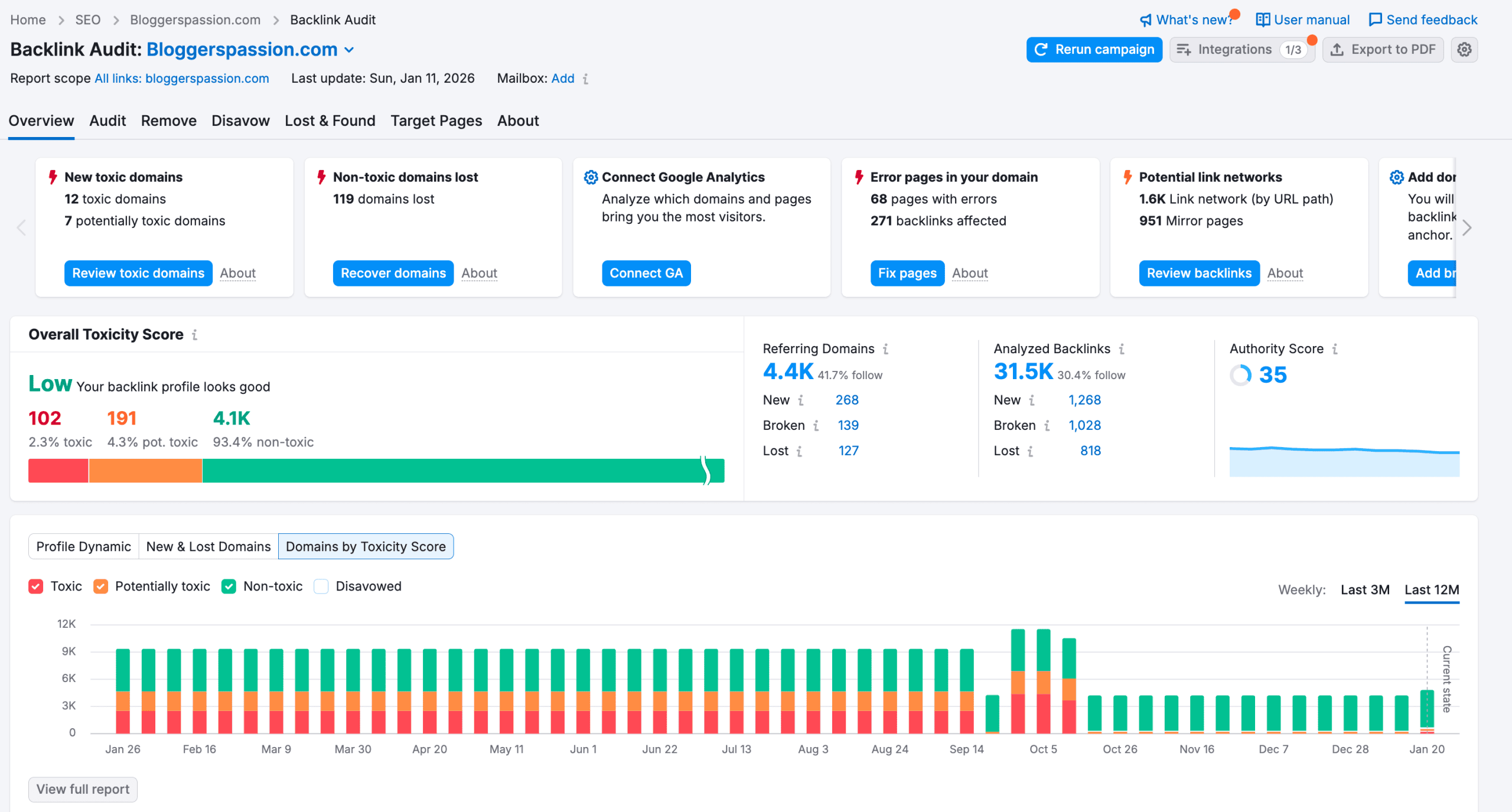
This backlink audit tool helps you monitor your backlinks in real time, especially toxic and potentially harmful links. It shows new, lost, and broken links, highlights risky domains, and flags error pages. This makes it easier to clean up toxic links and maintain a healthy, strong backlink profile.
If you identify toxic or spammy links on your website, you can disavow them. Here’s the ultimate free guide on how to remove toxic links.
Final Thoughts
No matter your niche, quality backlinks are the key to SEO success. One high-quality backlink > 10 low-quality links
So always choose quality over quantity. Focus on earning links from trusted, relevant, and authoritative sites in your niche.
Do you have any more questions on quality backlink building? Let us know your thoughts in the comments.
FAQs
Here are a few important questions about building high DA backlinks in 2026 and beyond.
Some of the fastest ways to build 100 backlinks are to use guest posting, broken link building, and blogger outreach strategies.
You can focus on building high-quality backlinks from authoritative websites in your niche by creating 10x better content, writing quality guest posts, etc.
You can create SEO backlinks in multiple ways; use link roundup posts in your niche, create comprehensive guides and find unlinked mentions of your website.
The most effective backlink is one that comes from a high-traffic and authoritative website in your industry.
A single high-authority backlink can have 10x more impact than multiple low-quality links.
Yes, buying links can harm your site. Use white hat techniques like guest posting, email outreach, broken link building to get backlinks.
They don’t pass direct link equity, but they help with traffic, visibility, and trust signals.




Hello sir nice post about backlink you are great sir keep it up and thank you for giving proven techniques to become pro in creating backlink.
Hi anil Sir,
Thanks for sharing helped a lot ( It looks i am reading a kind of e book for free haha)
Thanks for this article
Hi Anil,
Again a great post with tons of values. We all understand the importance of backlinks, but at the same time, we also have to be careful before building those links. Low quality links can decrease our search performances. And I believe that guest posting is the best method for linkbuilding. Keep inspiring.
Regards
Chayan
Hi Anil,
I’ve been looking all of the place for information on SEO Backlink building.
You really broke it down nicely in bite-size pieces that made it much easier to understand.
I do have one question though. What do you think about the SEOCloud Backlink Building technique that I saw something about on YouTube?
John Wann
Hi John
I haven’t heard about SEO Cloud Backlink Building technique. Please share few URL’s from where I can check about this method to help me understand it.
Thanks
Hi Anil,
That’s an incredible post.
Thanks for sharing great information about quality Backlinks. I prefer quora answering for getting backlinks.
I have a request for you. Please write a detailed post on dofollow and nollow.
Thanks for this article and Happy Christmas……
Great list of ideas to generate backlinks but I believe all strategies are not for anyone. It’ll be better if you suggest what technique is for whom. Else all techniques are good and effective to link building
Hello Anil sir,
Great post.
I also liked the infographic idea and i know how to create and l’ve been doing it for many years but I don’t know how to create backlinks through infographics… can you tell me??
Thanks, Anil. You said to me to read this post and I just finished and you can’t believe that it really helps me now I will implement all methods time by time.
Thank u Anil sir your every blog is helpful, thank’s for sharing this valuable information.
Hi, Thanks for the sharing link building strategy in 2019. But I have a question for you is there any problems to get a link from other niches. Like my niche is “health care” now I want to get a link from traveling blog. Is there any problem with this on ranking?
No, you can definitely build links even from other niche sites. The key here is to find a “relevant topic” so your links will be more useful in the long run. For example, you are in the health niche and want to get a link from a travel blog, you can write a guest post on the lines of “How travel bloggers should take care of their health”. That way you’ll be adding value to their audience and also you’ll have the option to cover your own topic.