

Blogging is not complicated! But growing a blog that consistently ranks on Google and generates income? That’s where most Bloggers struggle.
The truth is simple: blogging success is rarely about luck. It’s about avoiding the common blogging mistakes that silently destroy traffic, authority, and monetization potential.
If your blog is stuck beyond page 3, or if your content isn’t converting, then you are doing something wrong, and you need to fix it.
As a Blogging expert, I’m going to share an in-depth guide that covers the most critical blogging errors in 2026, along with practical solutions you can implement immediately.
Let’s get started.
Table of Contents
- 9 Top Blog Mistakes and Best Solutions To Correct Them
- 1. Writing Without Understanding Search Intent
- 2. Publishing Thin, Surface-Level Content
- 3. Ignoring Semantic SEO and Topical Coverage
- 4. Keyword Stuffing and Over-Optimization
- 5. Weak On-Page SEO Optimization
- 6. Not Building Topical Authority
- 7. Poor Internal Linking Strategy
- 8. Ignoring User Experience and Core Web Vitals
- 9. No Efforts To Build A Community
- 8 More Critical Blogging Errors That Hurt Your Search Rankings
- 10. Not Updating Old Blog Posts
- 11. Ignoring Data and Search Console Insights
- 12. Not Having A Clear Content Strategy
- 13. Targeting Extremely Competitive Keywords
- 14. Monetizing Too Aggressively Too Early
- 15. Relying Completely on AI-Generated Content
- 16. Ignoring Backlink Building
- 17. Expecting Quick Results
- Frequently Asked Questions
- Fix These Blogging Mistakes and Grow Your Blog
9 Top Blog Mistakes and Best Solutions To Correct Them
Blogging is a dominant tool to grow your business brand. Even small mistakes can hold back your visibility and SEO performance. I will explain the common blogging errors and how to fix them for better results.
1. Writing Without Understanding Search Intent
This is one of the biggest blog errors today. Many bloggers focus only on keywords. But what really matters is search intent and it is nothing but what the reader actually wants.
When someone searches for “blogging mistakes,” they are not looking for a short definition. They usually want:
- A clear list of mistakes
- Common SEO errors
- Beginner blogging problems
- Practical fixes
- Simple examples
- A checklist or action steps
If your content does not give them what they expect, they will leave. When users leave quickly, search engines see it as a sign that your content did not help.
Before writing, understand the type of intent behind the keyword. Most searches are:
- Informational – Want to learn something
- Commercial – Comparing options
- Transactional – Ready to buy
- Navigational – Looking for a specific site
If your content does not match the intent, it will not rank well.
Also, check the top-ranking pages before you write. Notice:
- Are they long guides or short posts?
- Do they use lists?
- What subtopics do they cover?
- What questions are answered?
Then create something better, which should be clearer, complete, and useful.
Focus on covering the topic fully instead of repeating one keyword. Add related ideas like SEO, user experience, internal linking, and content quality. Search engines understand context, not just keywords.
Finally, make your content easy to read. Use:
- Short paragraphs
- Clear headings
- Bullet points
- Simple language
- Actionable advice
When your content truly answers the reader’s needs, rankings improve naturally.
2. Publishing Thin, Surface-Level Content
Thin content is one of the most common blogging SEO mistakes. If your article repeats generic advice like “write quality content” or “do keyword research,” it will struggle to compete.
Google prioritizes depth and topical completeness. This means covering a subject from multiple angles, answering related questions, and providing meaningful insights; not just basic tips.
Instead of writing broad statements, explain the process clearly. Show readers:
- How something works
- Why it matters
- Common mistakes to avoid
- Real examples
- Step-by-step implementation
Thin content often lacks originality. If your article says the same thing as the top 10 results, there is no reason for Google to rank it higher. Add unique insights, data, personal experience, or updated information.
Another problem is skipping related subtopics. Strong content naturally includes supporting ideas, FAQs, and practical scenarios. This improves semantic relevance and keeps readers engaged longer.
Finally, structure matters. Use clear headings, examples, visuals (if possible), and summaries to make deep content easy to consume.
Depth builds authority, which in turn builds trust. Trust builds Google rankings.
3. Ignoring Semantic SEO and Topical Coverage
Modern SEO is no longer about exact-match keywords. It’s about semantic relevance and topical depth.
If you’re writing about blogging pitfalls, Google expects you to naturally cover related terms such as:
- SEO mistakes bloggers make
- Content marketing errors
- Blog traffic mistakes
- On-page SEO issues
- Keyword research mistakes
- Blogging strategy failures
- Beginner blogging errors
If your content lacks these related concepts, it feels incomplete. Instead of stuffing one keyword repeatedly, focus on covering the subject from multiple relevant angles.

Search engines now understand context, relationships between terms, and user intent. That means your content should answer related questions, address common problems, and include supporting subtopics that logically connect to the main theme.
You can strengthen semantic relevance by:
- Answering “People Also Ask” questions
- Including related FAQs
- Covering causes, effects, and solutions
- Using natural variations of key phrases
- Adding examples and practical scenarios
The goal is simple: make your article the most complete resource on the topic.
Topical completeness improves relevance and authority.
4. Keyword Stuffing and Over-Optimization
Over-optimization still hurts rankings in 2026.
When bloggers force their primary keyword into every heading and paragraph, the content becomes unnatural and repetitive. Search engines are advanced enough to recognize keyword stuffing patterns, and this can negatively impact rankings.
Instead of repeating the same phrase again and again, use variations and natural language. For example, rather than using “blogging mistakes” excessively, you can naturally include contextual phrases like:
- Common blogging errors
- Blog growth mistakes
- Mistakes that kill blog traffic
- SEO errors in blogging
- Blogging pitfalls
This approach keeps the content readable while maintaining semantic relevance.
Over-optimization also happens when bloggers use exact-match anchor text in every internal link, overload meta descriptions with keywords, repeat the same keyword-heavy headings, or force keywords unnaturally into image alt text. These tactics make content look manipulative rather than helpful.
Modern SEO rewards clarity, depth, and user experience. When your writing sounds human and helpful, rankings follow more sustainably.
5. Weak On-Page SEO Optimization
On-page SEO is not optional. It’s a foundational strategy!
Even excellent content will struggle to rank if technical basics are ignored. Strong writing alone is not enough. Search engines need clear signals to understand, index, and rank your page properly.
Common on-page blog errors include poorly optimized title tags, weak meta descriptions, improper header structure, missing internal links, broken links, slow page speed, and unoptimized images. These issues reduce visibility even when the content itself is valuable.
Your title tag should be clear, compelling, and benefit-driven while naturally including the main keyword. The meta description should encourage clicks by clearly explaining what the reader will gain. Higher click-through rates send positive signals to search engines.
Your introduction should clearly mention the main topic and align with search intent. Headings must follow a logical hierarchy (H1, H2, H3) so both readers and search engines can understand your content’s structure.
Internal links help distribute authority across your site and guide readers to related articles. External links to credible sources add context and trust. Images should be compressed for faster loading and include descriptive alt text for accessibility and SEO.
Technical optimization improves crawlability, user experience, and engagement. When your technical foundation is strong, your content has a much better chance of ranking consistently.
Google ranks websites, not just individual pages. One strong article is rarely enough to compete in a competitive niche. Search engines evaluate your overall site depth, consistency, and subject expertise.
If your blog lacks coverage in related areas, it becomes harder to establish authority. For example, writing one article about mistakes new bloggers make, without supporting content on SEO, keyword research, content strategy, traffic generation, or monetization, makes your site look incomplete.
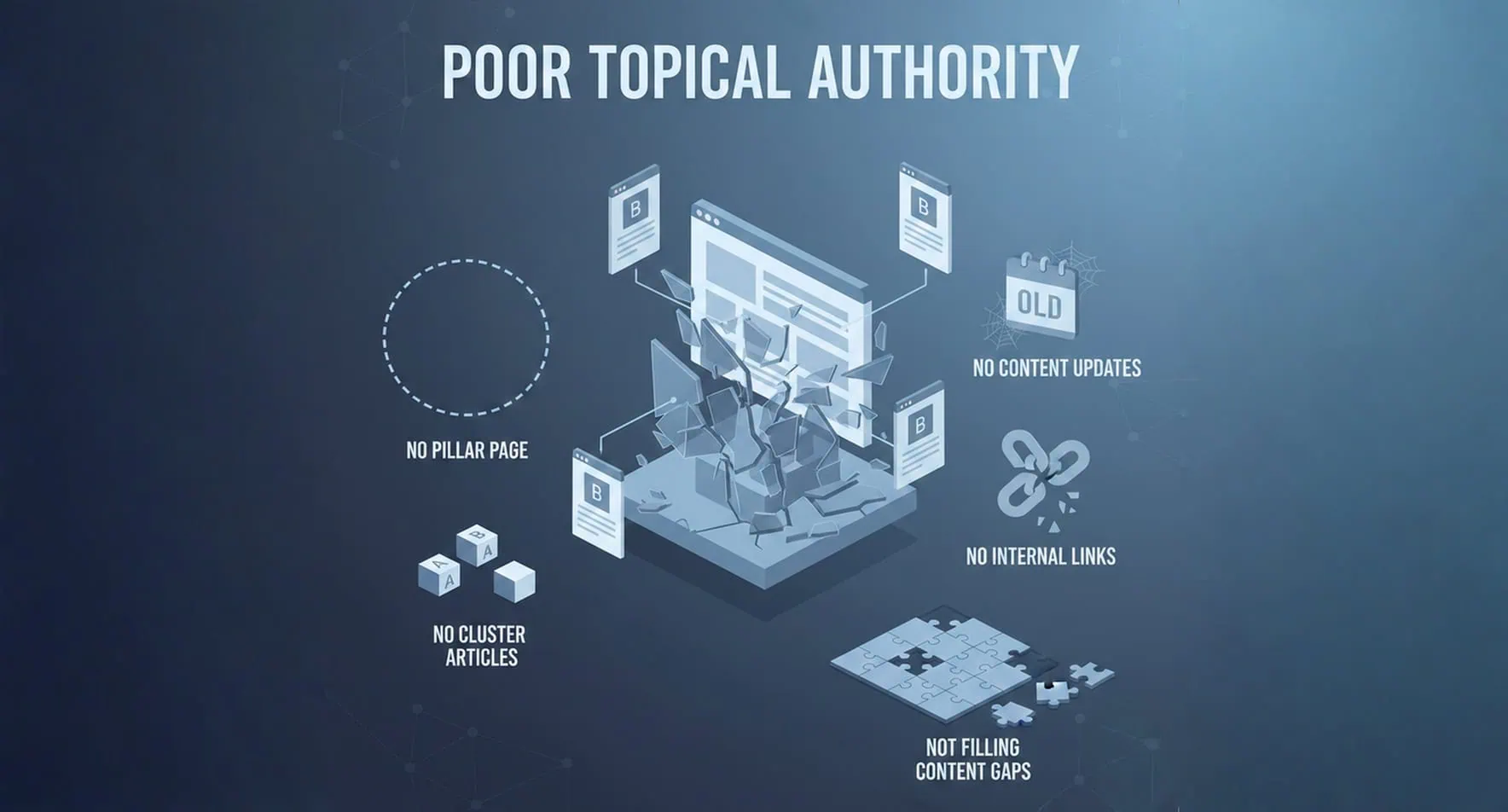
To build topical authority, focus on structured content expansion and smart internal linking. A strong topical strategy includes:
- A comprehensive pillar page targeting the main topic
- Supporting cluster articles covering detailed subtopics
- Strategic internal links connecting all related posts
- Regular content updates to maintain freshness
- Filling content gaps that competitors have missed
This structure improves crawlability, distributes authority across pages, and increases user engagement. It also signals expertise because your site demonstrates deep knowledge rather than surface-level coverage.
Over time, strong topical authority improves rankings not just for one keyword, but for dozens of related search terms across your niche.
7. Poor Internal Linking Strategy
Internal linking is one of the easiest ranking wins.
When you link relevant articles naturally within your content, you improve crawlability, distribute authority across pages, and increase user engagement. It helps search engines discover deeper pages and understand how your content is connected.
Yet many bloggers either ignore internal linking or add links randomly without a strategy. Linking just for the sake of it does not help. Links must be relevant and contextually useful. It guides readers deeper into your site and signals topical depth to search engines.
For example, a post about blogging mistakes can naturally link to articles on keyword research, on-page SEO, content strategy, or traffic generation.
Good internal linking also:
- Uses descriptive anchor text instead of generic phrases like “click here.”
- Links from high-authority pages to important target pages
- Supports pillar and cluster content structure
- Helps reduce bounce rate by encouraging further reading
- Keeps important pages within 2–3 clicks from the homepage
Avoid overloading a page with too many links. Focus on quality and relevance.
When done correctly, internal linking strengthens site structure, improves user experience, and boosts rankings without creating new content.
8. Ignoring User Experience and Core Web Vitals
User experience plays a critical role in SEO performance. Search engines analyze how users interact with your site, and poor experience can directly affect rankings.
Common UX problems that hurt SEO include slow page loading speed, intrusive ads, cluttered layouts, poor mobile optimization, unreadable fonts, and confusing navigation. These issues frustrate users and increase bounce rates.
Good UX should focus on clarity, speed, and simplicity. Your pages should load quickly, work smoothly on mobile devices, and use a clean design with proper spacing. Short paragraphs, clear headings, and logical formatting make content easier to consume.
Strong user experience typically includes:
- Fast-loading, optimized pages
- Mobile-responsive design
- Clean and distraction-free layout
- Clear navigation and internal links
- Readable fonts and proper spacing
- Simple menus and search functionality
Trust signals also matter. A secure HTTPS site, visible author details, and clear contact information increase credibility.
When users enjoy browsing your blog, they stay longer, explore more pages, and return again. Higher engagement and longer session duration send positive signals to search engines, supporting stronger rankings over time.
9. No Efforts To Build A Community
A supporting community will bring loyal followers and make sales/conversions. Without it, your blog will struggle to grow beyond just numbers.
Many bloggers focus only on publishing content but fail to take efforts in connecting with their readers, and yes, it is one of the Blogging pitfalls.
Without a community, your blog becomes just another website with information, but not a place for people to trust or discuss.
There are 2 best ways to build a blog community that helps you succeed as a blogger in 2026 and beyond.
- Use LinkedIn
- Building an email list
Let’s briefly talk about the above 2 ways.
1. Use LinkedIn to build a community
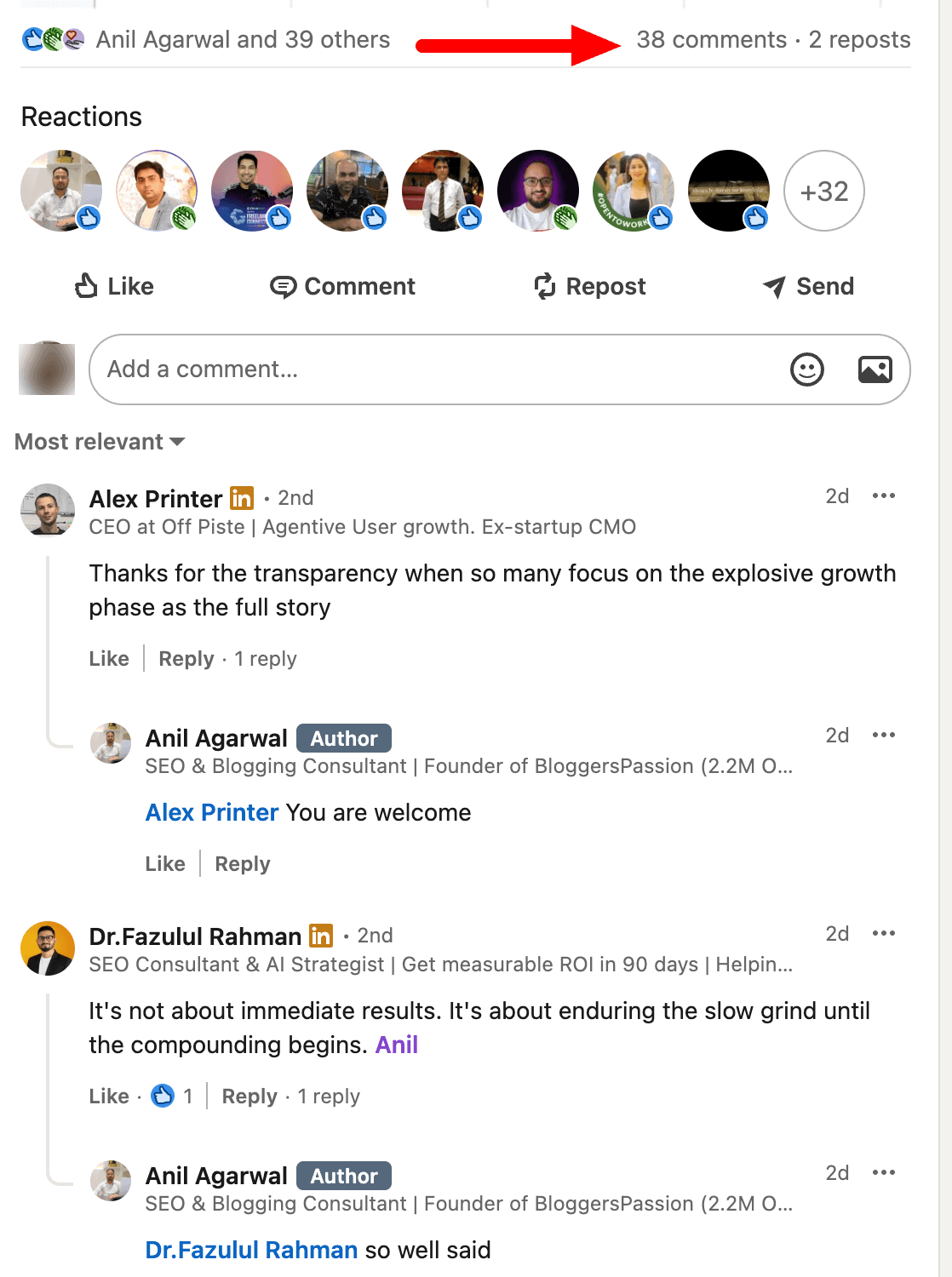
I use LinkedIn to connect and interact with like-minded people who share priceless information about blogging and content creation. By offering true value, engaging in meaningful conversations, and supporting my connections, I’ve formed a supportive community over there.
It is not just about growing followers; it is about building real connections that help everyone grow together. Have a look at the engagement of my recent LinkedIn post.
How to use LinkedIn to form a supportive community?
- Share useful content – Instead of only posting your articles, share key takeaways and tips from your blog. Make your posts helpful, short, and easy to understand.
- Ask questions – At the end of your LinkedIn post, ask your audience what they think or how they handle the topic. This action invites engagement and builds real connections.
- Support others – When you read, like, comment, and share the posts of other professionals, they remember you forever.
- Reply to comments – Respond to comments on your posts. It shows your care and builds trust with your followers.
- Use LinkedIn tools – Create LinkedIn groups, and tag people in relevant posts to increase visibility and interaction.
- Be active – Post regularly and be patient to grow your community with honest and helpful interactions.
2. Build Email List for Long-Term Success
An email list is a great way to build a loyal fanbase for your blog. The best part about building an email list over social media is that an email list gives you the highest ROI.
Once you start building an email list, make sure to provide freebies such as eBooks and giveaways to earn more subscribers. Also, provide highly educational content in the form of newsletters to your email list instead of sending sales pitches.
Subscribe to top bloggers’ email newsletters in your industry and analyse how they are sending emails (at what intervals) and see how they are using their email lists to make money.
8 More Critical Blogging Errors That Hurt Your Search Rankings
10. Not Updating Old Blog Posts
Many bloggers focus only on publishing new content. But updating old posts is essential.
Content freshness matters, especially in competitive niches. If competitors update their guides regularly while yours remains outdated, search engine rankings decline.
Refreshing content by adding new sections, improving examples, updating statistics, and enhancing internal linking can significantly revive traffic.
11. Ignoring Data and Search Console Insights
Guessing is not a strategy. Google Search Console reveals valuable data such as:
- Keywords you rank for
- Pages with high impressions but low clicks
- Queries ranking on page 2
- Declining traffic trends
Optimizing pages that are already ranking often produces faster results than creating new posts. You must make use of the search console data to rank better.
Data-driven blogging always outperforms assumption-based blogging.
12. Not Having A Clear Content Strategy
Random publishing leads to random growth.
A solid blogging strategy defines your niche, keyword targets, content structure, monetization plan, and growth roadmap. Without a strategy, even consistent effort may not produce meaningful results.
Strategic bloggers focus on content gaps, search intent, monetization opportunities, and authority building.
13. Targeting Extremely Competitive Keywords
New bloggers often target high-volume, competitive keywords immediately. It rarely works.
Instead, focus on long-tail keywords with lower competition. These keywords may have smaller search volume but higher ranking potential. As your authority grows, you can gradually target more competitive phrases.
Smart keyword selection accelerates growth.
14. Monetizing Too Aggressively Too Early
Another blogging mistake is prioritizing ads and affiliate links over value.
If every paragraph pushes a product, readers lose trust. Authority and trust must come first. Monetization works best when it aligns naturally with helpful content.
Trust builds long-term income.
15. Relying Completely on AI-Generated Content
AI can help with outlines and drafts. But publishing fully AI-generated content without adding real insights often results in generic articles.
Search engines increasingly value experience-driven content. Add your voice, case studies and unique opinions.
Human expertise differentiates your blog.
16. Ignoring Backlink Building
While content quality is essential, backlinks still matter.
Many bloggers focus only on publishing and ignore promotion. Outreach, guest posting, collaborations, and linkable assets help strengthen domain authority.
Quality backlinks accelerate ranking growth.
17. Expecting Quick Results
Blogging is a long-term investment.
SEO growth takes months. Authority takes time!
The bloggers who succeed are not necessarily the most talented; they are the most persistent.
Patience combined with strategy wins.
As a beginner, you will make blog errors, but don’t get stuck with them. If you’ve identified yourself in any of the pitfalls I have mentioned, it is not failure; it’s your learning process.
Frequently Asked Questions
What is the biggest blogging mistake?
The biggest blogging mistake is ignoring search intent. If your content doesn’t match what users expect, it won’t rank. No matter how optimized it is.
Do blogging pitfalls affect SEO rankings?
Yes. Issues like thin content, keyword stuffing, weak internal linking, and poor user experience can significantly reduce rankings.
How can blog beginners avoid mistakes?
Beginners should focus on clear niche selection, proper keyword research, intent-focused content, and consistent optimization rather than chasing trends.
Is content length important for blogging success?
Length alone doesn’t determine rankings. Depth, relevance, and usefulness matter more than word count.
How often should you update blog posts?
High-performing bloggers update important articles at least once every 6–12 months to maintain freshness and competitiveness.
Fix These Blogging Mistakes and Grow Your Blog
Stop letting simple mistakes hold your blog back. Every thin post, keyword overload, or outdated article is costing you traffic, authority, and potential income.
Take action now! Audit your content, optimize for search intent, improve user experience, and build your topical authority. Small, consistent improvements compound into massive results over time.
Your blog can rank higher, attract loyal readers, and generate real income, but only if you start fixing these mistakes today.
With over a decade of experience, I specialize in spotting and fixing blogging issues to help your content reach top rankings in search results. If you need help, catch me in the comment section.





Thanks for the inspirational overview and ideas!
My key takeaway (that many pros seem to recommend) – and probably my biggest personal content challenge – consistency. In a way it’s because I keep on (sort of) giving up to early before getting a good read on the results.
Consistency in creating good content is something I am working at becoming better at in 2021.
And while I never really gave up in the past, I am realizing I need to more seriously pursue creating and sharing my music content (lessons, ideas, music, etc) for a longer period of time before evaluating the results.
It seems to me 12 months of consistent creation nwould be a decent time frame to commit before re-evaluating.
I’ve been dabbling/working on my music site/blog/YT channel for many years, but just in a little bits at a time. I’d add a few videos and posts a year, and my traffic was hovering around 1.5k/month last year.
Starting in Nov 2020, I’ve started becoming more serious about working on my website, writing, re-writing, editing, quality of content, lessons, videos, visuals etc. I’m starting to see a small uptick in traffic and engagement as well.
Music blogs (imho) don’t have as much financial opportunity as some other hot topic areas, but if it’s something that’s someone is passionate about (like myself), I believe it may make sense to pursue!
I just also read your 25 blogging tips article and found much room for improvement – consistency, content assets, podcasts and YT, writing a book, being more transparent, improving my marketing and sales skills, building a tribe, etc.
In terms of creating content assets – I used try to only write unusual, interesting articles and eschewed sharing basic guitar lesson content & knowledge. But I’ve come to the opinion that even if other places have similar content, it makes sense to really cover all the important aspects of my focus area so that readers can learn the basics plus all the interesting stuff on my site.
In any case, thanks and all the best!
Hi Anil Agarwal. You just wrote about what I was looking for. I am only 2 months in. There are many mistakes that new bloggers make like expecting results fast. The most Important thing that a blogger should focus on is building content. It is amazing how you mentioned sources that talk about royalty free image, I already wrote an article about that, and I am sure it will appeal to you. Keep up the good work
Hey,
Actually, I am learning about blogging for over a year but your amazing post gives me amazing tips that I didn’t know for the last one year and I really enjoy your article. also, I would like to thank you for sharing this informative article with beginners like us and I hope you will continue it in the future.
Just completed ten posts on my blog but i am using a free wordpress hosting. Though I will complete around 30 posts optimize them properly. then buy hosting is it a good idea. Also when i did my seo audit it said Alt tag images what is it. I have no idea would be a great help if you would help me knowing my mistake. Nice work keep it up
Great article Thanks for pointing out Deadly Blogging Mistakes. Yes most of the bloggers fail to choose correct niche, not focusing in one niche. These type of mistakes takes down the Productivity.
I also made this mistake, but after few months. I started working constantly on one micro niche blog, it bring success.
Hi Kathir, that’s so true as most beginners choose wrong niches and don’t focus much on one niche. That’s why they often struggle to build audience, generate more traffic and make money from their blogs. Glad that you’re learning from your mistakes.
Hey Anil,
Inconsistency is my problem. I knew that “Inconsistency” could really hurt my blog’s traffic but, I couldn’t do anything for that. Now I know how important the blog posting schedule is because within the last few months my blog’s traffic hit bottom.
However, now I know. Thank you very much for sharing this great post with us. I learned a lot from it.
Hi Nirodha, inconsistency is the biggest reason why most people fail to build profitable blogs. If you feel you can’t create content on a regular basis, try hiring someone to create content for you. Although it costs you some money up front but it works great in the long run.
Hi Anil,
This is really informative and talking the truth. What you’re telling is true. If we spent money on something then we will take it seriously. If I spend money on something then I look for ROI from it by working my ass off. Thanks for sharing this awesome article.
Hi, that’s so true. If you’re looking only for free stuff everywhere, you’ll never take blogging seriously. Only when you put your hard earned money into blogging, you will work even harder and put your best efforts to build a blog that makes money in the long run. Once you’ve that kind of mindset, everything becomes easy.
Hi Anil, I find #9 and #10 the most fatal mistakes newbie bloggers make. Each day I log into my WordPress dashboard and find more broken links from bloggers that quit. Many do not make it the first year and they were just getting started! I think they don’t invest in themselves or their blogs. So those 2 points are huge!
I would add that LOVE what you blog about, it’s the only way you will contiuously do it, week after week, year after year.
Have a nice weekend Anil and I’m enjoying your FB group!
Hi Lisa, that’s a big problem if someone comments on your blog with a broken link, LOL. Yes, there are way too many bloggers who quit blogging within few months. The #1 reason is, most people look for shortcuts or want to make money really quickly. They often forget the fact that, just like any other serious stuff, blogging is also a business. Thanks for the tips.
Hi Anil,
Definitely a great list of mistakes a beginner blogger tends to make.
Although there is nothing wrong in making mistakes and almost all of the blogging mistakes can be corrected, but it is better to learn from someone else’s mistakes. That way a blogger can build a successful blogging business fast.
However, thanks for sharing your valuable experiences.
Hi Anil
Read your whole article words by word and sentence by sentence. You just sum up all your experience in this article. Information that you shared in this article is really very good and sometimes even the pros does not bother about them as they think that they already know them.
Keep posting such wonderful article.
Hi Rakesh, glad to know that you read the whole article words by word and sentence by sentence, which is so rare especially these days. I think you’ve been blogging for a long time now and I hats off for your efforts for reading the whole stuff. Yes, it’s true that, we put the best efforts to compile this list of blogging mistakes (and majority of them from our experiences).
Hi Anil sir,
As a new blogger i have been watching youtube videos to improve my blogging skills. I read your blog from top to buttom and you mentioned all blogging mistake that i have been doing. Thank you very much for sharing this information. You jst explained everything in a single post. I have been searching fro this kind of invermation which will help me to get success in blogging and i so happy that a pro blogger like you wrote something that is very useful for beginner like us.
Thankyou very much for the information sir.