


If you are looking for an honest Elementor review, you’re in the right place!
I’ve been using Elementor for more than 3 years to build blog pages, landing pages, sales pages, and complete WordPress websites. I’ve also experimented with other page builders like Gutenberg, Divi, and Beaver Builder.
While each has its strengths, I keep coming back to Elementor for one simple reason: it helps me build professional-looking pages quickly without writing any code. That doesn’t mean Elementor is perfect.
Like any WordPress plugin, it has its pros and cons. In recent days, I’ve noticed significant improvements, especially in its Flexbox Containers, performance optimizations, and AI-powered tools.
At the same time, there are still a few things I wish were better, and I’ll discuss those honestly in this review.
So, is Elementor still worth buying in 2026? Let me answer this question! After using it on real websites, my answer is yes, but it depends on what you’re building.
In my detailed review, I’ll tell everything you need to know, including its features, ease of use, pricing, performance, AI tools, pros and cons, and whether Elementor Pro is actually worth the extra cost.
By the end of this blog post, you’ll know whether Elementor is the right page builder for your WordPress website.
Elementor – My Quick Opinion
If you don’t have time to read this detailed Elementor review, here’s my quick opinion!
Elementor is the best drag-and-drop page builder for WordPress users. It is beginner-friendly and offers plenty of design flexibility.
It holds powerful features like Theme Builder, Popup Builder, WooCommerce Builder, and AI tools that can save your time.
I’ve personally found Elementor useful when creating landing pages and custom website layouts because it lets me see changes in real time instead of constantly switching between the editor and the preview.
However, I don’t recommend Elementor to everyone!
If you want to build a lightweight blog with minimal customization, the default WordPress Block Editor is enough. But if you want complete control over your website’s design without hiring a developer, Elementor is the perfect choice.
Elementor Pros & Cons
| Pros | Cons |
| Easy to use drag-and-drop builder (no HTML or CSS skills required) | No lifetime pricing options like Divi. |
| Available for free (Pro version offers more features and modules). | Too many features can feel overwhelming |
| Contains a huge template library | Pro version is essential to build a complete website |
| Works with any WordPress theme and lets us create all types of websites | |
| Works with WooCommerce (Includes custom WooCommerce content elements) | |
| Straightforward mobile editing controls |
Now, let’s get into my comprehensive viewpoint about this WordPress design tool.
What is Elementor?
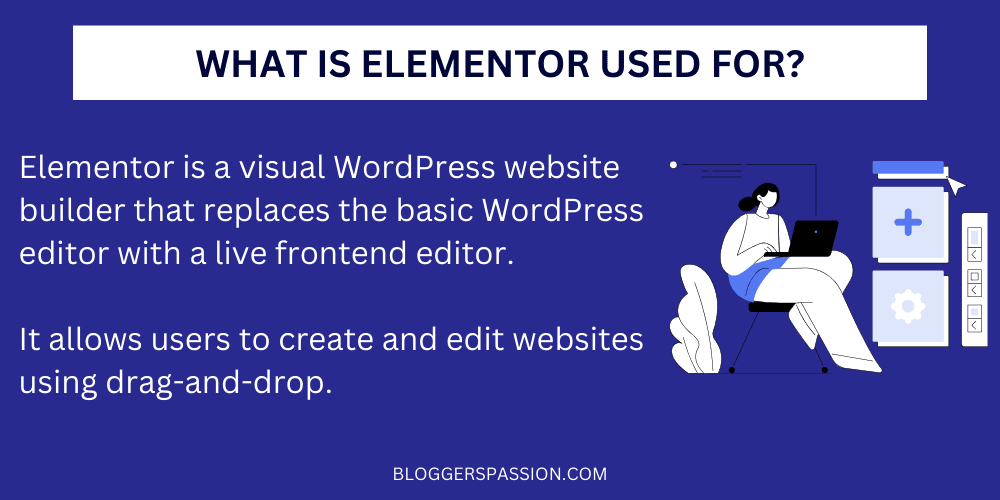
If you’ve ever wanted to build a beautiful WordPress website without learning HTML, CSS, or PHP, Elementor is one of the easiest ways to do it.
In simple terms, Elementor is a drag-and-drop page builder plugin for WordPress that lets you design your website visually.
Instead of writing code or hiring a developer every time you want to make a change, you can simply drag widgets onto your page and customize everything in real time.
When I first started using WordPress, I spent hours to make small design changes using themes and the default editor. Even changing the spacing between two sections could be frustrating.
Then I switched to Elementor.
The visual editor made website building much more intuitive. I could instantly see how my pages looked while editing them, which saved me a lot of time.
Whether you’re creating:
- A blog homepage
- Landing pages
- Sales pages
- Portfolio websites
- Business websites
- WooCommerce stores
Elementor gives you the flexibility to build them without touching a single line of code.
Who is Elementor Best for?
One thing I like about Elementor is that it isn’t built only for developers.
In my experience, it’s a great choice for:
- Beginners who want to build their first WordPress website without a steep learning curve.
- Bloggers who need attractive landing pages, opt-in pages, and custom blog layouts.
- Freelancers and agencies who create websites for multiple clients.
- Small business owners who want complete control over their website without hiring a developer for every update.
- WooCommerce store owners looking to customize product pages, cart pages, checkout pages, and other store elements.
If you’re comfortable with code, you have plenty of advanced customization options here. But the best part is that you don’t need coding skills to create a professional-looking website.
Elementor Working & User Interface (Is it Hard to Learn?)
Is Elementor easy to work with?
Absolutely yes!
The main reason I am using Elementor is its simple learning curve. Not only me, but over 5 million people are also using this site design plugin because of its editor.
With the help of the drag & drop approach, you can easily design professional-looking web pages in minutes. I’m sure that you will also admire its live editing feature.
This is how the interface of Elementor looks like,
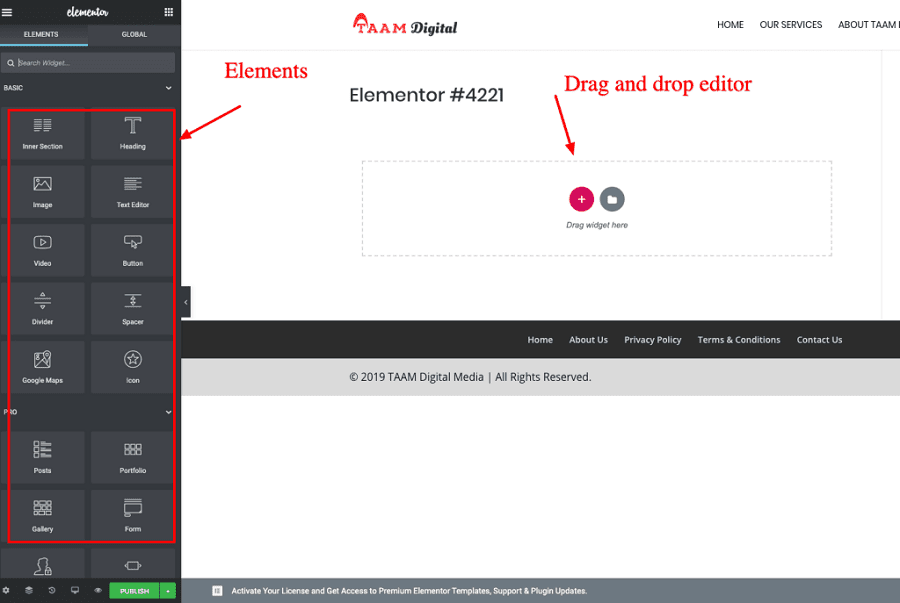
It offers “elements” (widgets) that you can drag and drop into their editor to make any kind of customizations you need.
You’ll find three sections in their editor,
- Content area (where you can drag and drop any widget needed)
- Elements area (these are the widgets that you need to design your page)
- Settings (you can preview the design on different devices, undo your changes and do few more activities )
Adding Widgets:

Customizing Elements:
Just drag the needful elements and do in-depth customizations you need like changing the text color, typpgraphy, etc.
Here’s how it looks like;
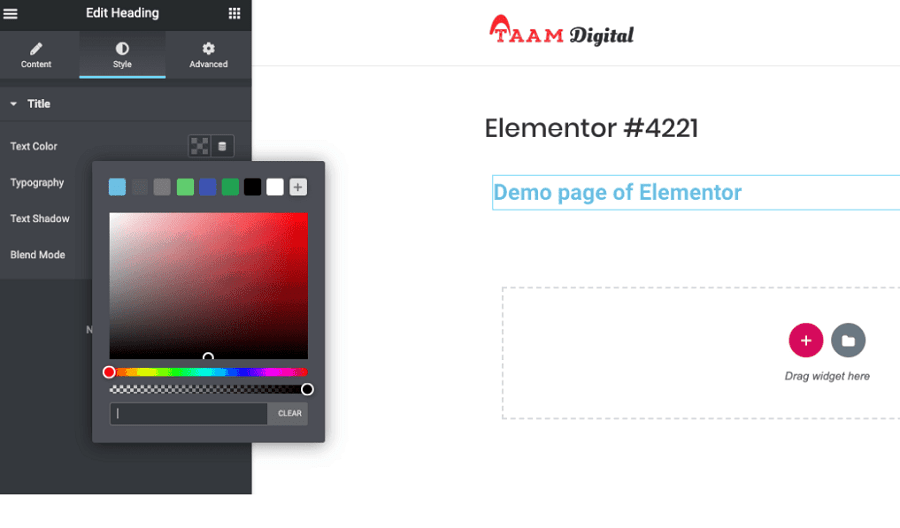
It is easy to add pricing tables on your landing pages or sales pages!
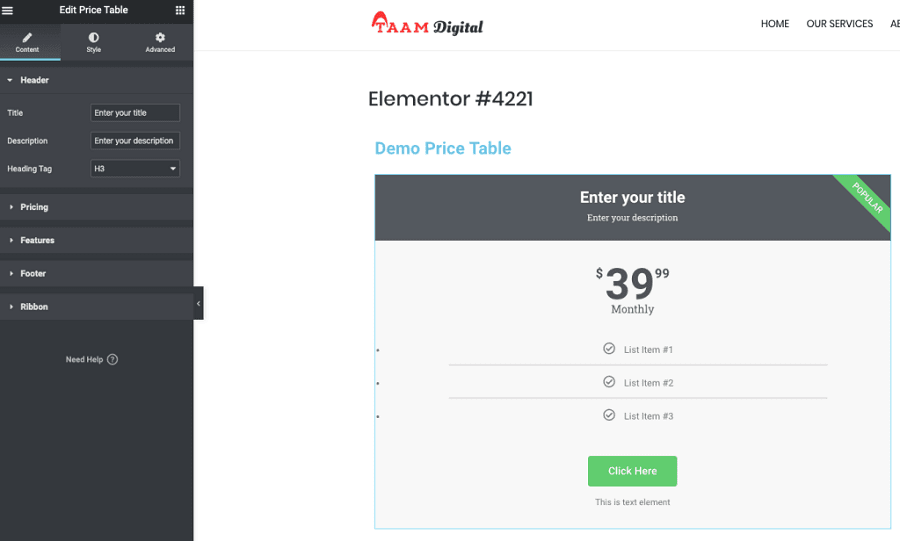
It also offers testimonials, star ratings, and more engaging features.
To create a page, all you have to do is:
- Create a new page and select “Edit With Elementor.”
- Click the “+” button and choose a layout that suits your requirements,
- Add drag and drop widgets like text blocks, images, and buttons from the Elementor panel into your page
- Customize the Content, Style, and Advanced tabs to fine-tune the appearance, position, and behavior of each element.
- The “Advanced” tab includes display conditions. This allows you to control when and how specific elements appear on your page based on factors like user role or date.
- Finally, save your progress and preview your page to see how it looks.
I love how Elementor Pro now integrates AI! You’ll find ‘Write with AI’ in text boxes and an AI icon in the image editor for easy content and image generation.
Elementor Features – What I Like Most?
Responsive Premade Templates
The main value Elementor gives you is “Premade Templates”. For those who don’t want to build a page from scratch, can take advantage of such hundres of templates.
I have found Elementor offers Templates for Individual Pages (About us, Contact us, Homepage), Embeddable Blocks templates (404 Block, Footer, etc), and Complete Website Kit templates.
Whenever I’m short on time, I start with one of Elementor’s pre-designed templates and customize it to match my branding.
This approach saves hours, especially when I create the Homepage, Contact Page, Service and Sales page. Rather than staring at a blank page, we have a professionally designed layout to work with.
Individual Pages Templates:

Blocks Templates:

Website Kit Templates (Set of Pages):

Elementor Modules: How Many Elements Are Offered By Elementor?

Elementor Widgets are the building blocks of your page. You will get 40+ widgets in its free version and 50 more in the Pro version.
Some of the widgets I use often are Buttons, Images, Icon Boxes, Pricing Table, Testimonials, Tabs, and Counters. Instead of installing separate plugins for these elements, I built everything directly inside Elementor.


Elementor Theme Builder
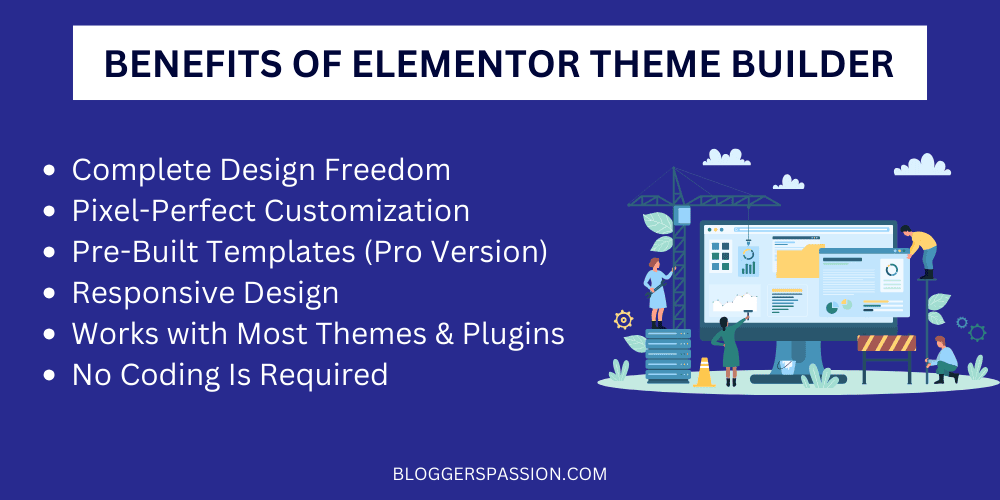
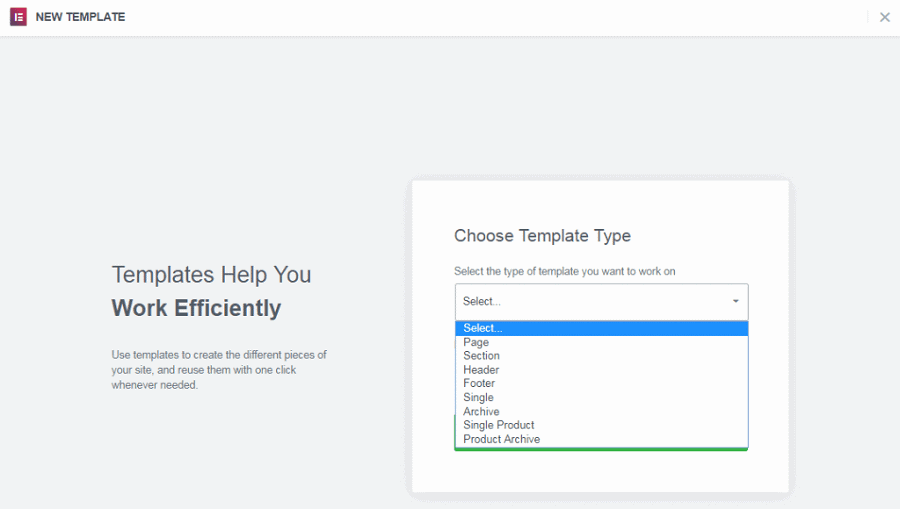
Elementor Pro offers a theme builder that lets you customize everything on your WordPress site. It is a great tool! Instead of being limited to designing individual pages, Theme Builder gives control to modify every part of your website.
It was easier for me to create custom headers & footers, as well as category & archive pages. With this level of control, you don’t have to rely entirely on your WordPress theme.
From pages to the header section, footer and archive pages, you can pick any template you want to and customize your site using drag and drop editor.
How to use Elementor Theme Builder from Elementor Pro?
Watch this tutorial from Elementor:
Compatibility with WordPress Themes
Elementor needs a WordPress theme to customize your site and it works well with any theme.
When it comes to WordPress themes, I advise you to avoid free themes. So, what options do you have for premium themes that work well with Elementor?
There are a ton of Elementor-compatible themes in the market, but there are two themes that are widely used by Elementor users and they are;
- GeneratePress and
- Astra
But what if you’re looking for a FREE theme that works out of the box with Elementor?
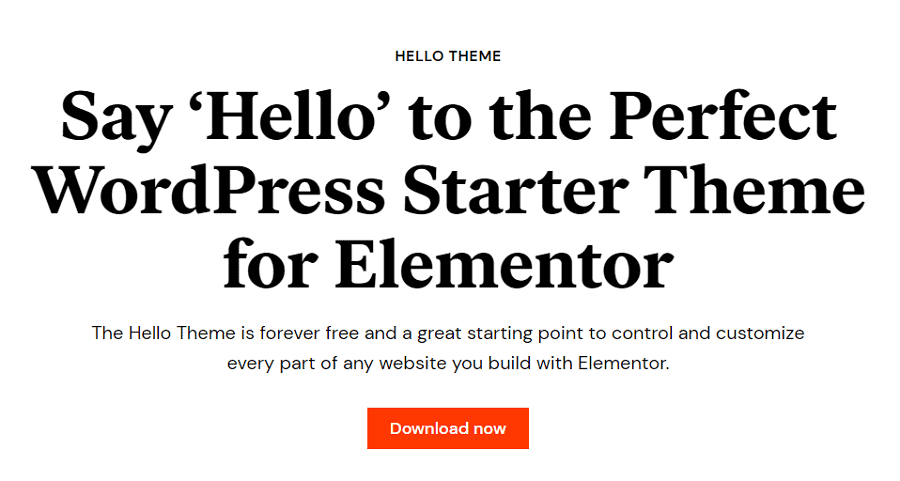
Fortunately, Elementor offers you a free WordPress theme, “Hello,” which is the “fastest WordPress theme ever created”.
Elementor and Popups

I should agree with the fact that Elementor Popup builder saves me 100’s of additional bucks that are supposed to spend on third party Popup form maker tools like OptinMonster. In a nutshell, Elementor Popups can influence your decision on the Elementor Pro version.
If used right, popups can work like a charm to boost your website conversions. No matter whether you want to grow your sales, email subscribers or leads, you can use popups to quickly grow your conversions.
If you’re a beginner, you can use their pre-made designs, as they currently have over 100 beautifully designed pop-up templates to increase your website conversions.
What type of popups can be shown on your WordPress site?
- Countdown timer
- Promotion & Sale Banners
- Lead Capture (Boost your conversion rate by creating smart popups)
- Content Lock & Upgrades (Reveal your premium content to users who opted in)
- Announcements (Notify visitors about maintenance, news, updates)
- Exit Intent (Popups trigger when your website visitors are just about to leave your site)
- Welcome Mat (shows full-screen welcome popups that your visitors see the second they visit your site)
- Related Products & Upsells (get more sales by creating popups that display related WooCommerce products)
Elementor & WooCommerce Support
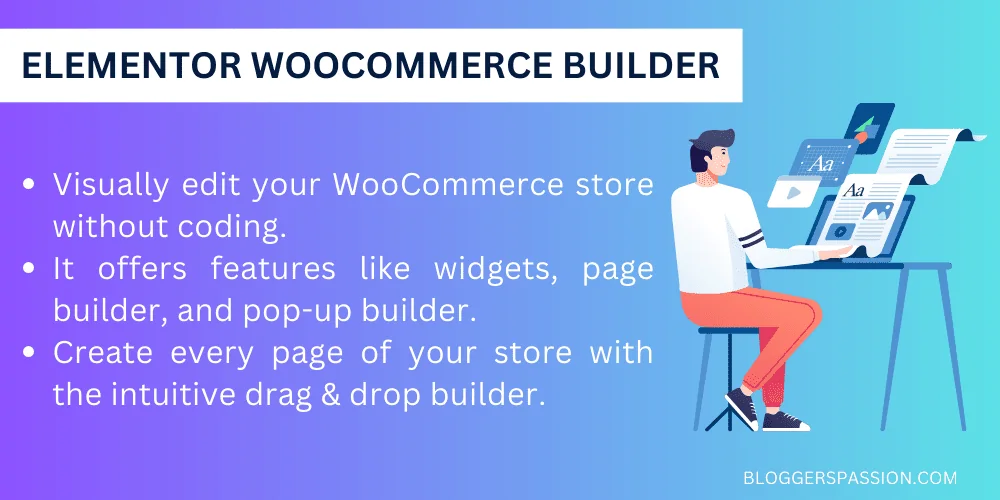
Do you want to create your own online store? This feature can save a lot of time.
With Elementor WooCommerce Builder, you can easily create your eCommerce store to sell products and it also offers page templates to customize your store however you want.
Here is the breakdown of all the parts that are included in a regular WooCommerce product page (including widgets).

As you can see above, from the menu cart to product description and related products, you can create your own online store without coding.

You can now edit and customize the template however you want (by including any Widget from the Elementor plugin).
Here are some of the features (widgets) that you can use in WooCommerce Builder from the Elementor plugin.
- Add to cart buttons
- Product images, price, product ratings, upsells
- Product title and description
- Product content
- Product breadcrumbs (easier for navigation and SEO benefits)
- Offers you Pop-ups, a countdown timer, a flipbox, and much more
Elementor allows you to visually customize Product pages, Shop pages, Cart page, Checkout page, and My Account page.
I’ve found this useful when tweaking product pages to improve conversions. Small changes, such as adding trust badges, FAQs, or custom call-to-action sections, were easier with the visual editor.
Elementor AI: Is It Really Useful?
Elementor has included a bunch of AI-powered features over the last couple of years, and I was curious to know about them.
I tested them on real pages to write some text and generate images for my blog posts. I have also used its code assistance to adjust spacing and create hover effects.
My Opinion on Elementor AI
If I had to sum it up based on my experience:
- Elementor AI is useful, but not essential
- It speeds up simple tasks, but doesn’t replace human input
- It works best as a productivity helper inside the builder
I don’t see it as the only reason to choose Elementor. But I do see it as a nice bonus if you have decided to use this plugin.
Elementor AI is a separate tool, and to use it, you’ll need to pay an additional fee of $2.99 to $8.25 per month.
Elementor Free Version & Pro Version
The Elementor free version stands at the top when you search for a Page Builder inside the WordPress plugin repository.

10 Million + websites have already been using the Elementor Free version.
So why Elementor Pro? What’s hidden inside Elementor Pro?
Well, there are dozens of differences b/w Elementor free version & Pro version, but you can consider this comparison table where I have mentioned the primary features you only get with Elementor Pro.
| Features | Elementor Pro | Elementor Free | Benefit |
|---|---|---|---|
| Theme Builder | ✓ | X | Full Theme Customization (No Coding) |
| Form Builder | ✓ | X | Inbuilt Form Maker |
| Pro Templates & Blocks | ✓ | X | Access to High level templates & widgets |
| Embed Anywhere | ✓ | X | Widgets can be placed anywhere on a site |
| Global Widget | ✓ | X | Change global settings of a widget (Highly Important) |
| Custom CSS | ✓ | X | Apply custom CSS to widgets |
| WooCommerce Widgets | ✓ | X | Access to WooCommerce Modules |
| Social Media Widgets | ✓ | X | Access to social media modules |
| Nav Menu | ✓ | X | For designing beautiful Menus |
| Header & Footer Builder | ✓ | X | Custom header & footer per page |
| Popup Builder | ✓ | X | Build Popup forms |
Is Elementor Pro Worth It?
My opinion – yes, but not for everyone!
You should buy Elementor Pro if you
- Want full design control over your website
- build client websites or freelance projects
- run a blog and care about conversions
- create an online store
You can skip Elementor Pro if you:
- Just experiment with WordPress
- You only need a simple blog
- You don’t care much about design customization
Elementor Speed – Does It Slow Down My Site?
“Will Elementor slow down my website?” I had the same concern when I first started using it.
And honestly, after building multiple websites with Elementor over the years, my answer is: Elementor can be fast or slow depending on how you use it.
Let me explain based on real experience.
When I used clean layouts, proper hosting, and minimal plugins, Elementor websites performed really well. But when I overloaded pages with animations, widgets, and add-ons, performance dropped noticeably.
You should understand the real factors that impact Elementor speed performance are – Hosting Quality, Design complexity, Add-ons usage, and Theme choice
When optimized properly, Elementor websites can perform well on Core Web Vitals. In my own tests, I’ve been able to achieve:
- Good LCP scores on landing pages
- Stable CLS when layouts are clean
- Improved INP after reducing heavy scripts
- But again, this depends on optimization.
Elementor doesn’t automatically guarantee good performance. You still need to build responsibly.
What Elementor Has Improved Over Time?
Some improvements I’ve personally noticed include:
- Better asset loading control
- Optimized DOM structure (compared to earlier versions)
- Flexbox Containers replacing the older section structure
- Reduced reliance on excessive wrappers
- Better mobile optimization tools
My Honest Take on Elementor Speed
I’ve seen Elementor websites perform well in real-world SEO tests when built properly. At the same time, I’ve also seen poorly built Elementor sites struggle with speed.
So the truth is simple: Elementor gives you flexibility, but you are responsible for performance.
Here is the my site speed result:

The performance will improve drastically if you use site optimization plugin like WPRocket.
Expert Tip: Make sure you have the right hosting for better speed. Find the best web hosting for beginners and fast performance.
Recently, I came across a Reddit thread where a user asked the Reddit community about Elementor’s performance.
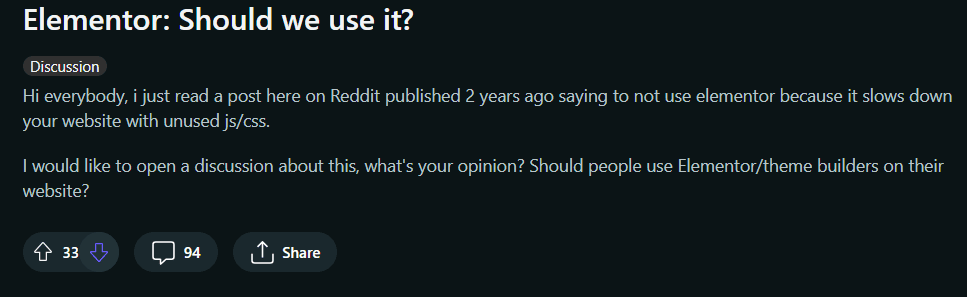
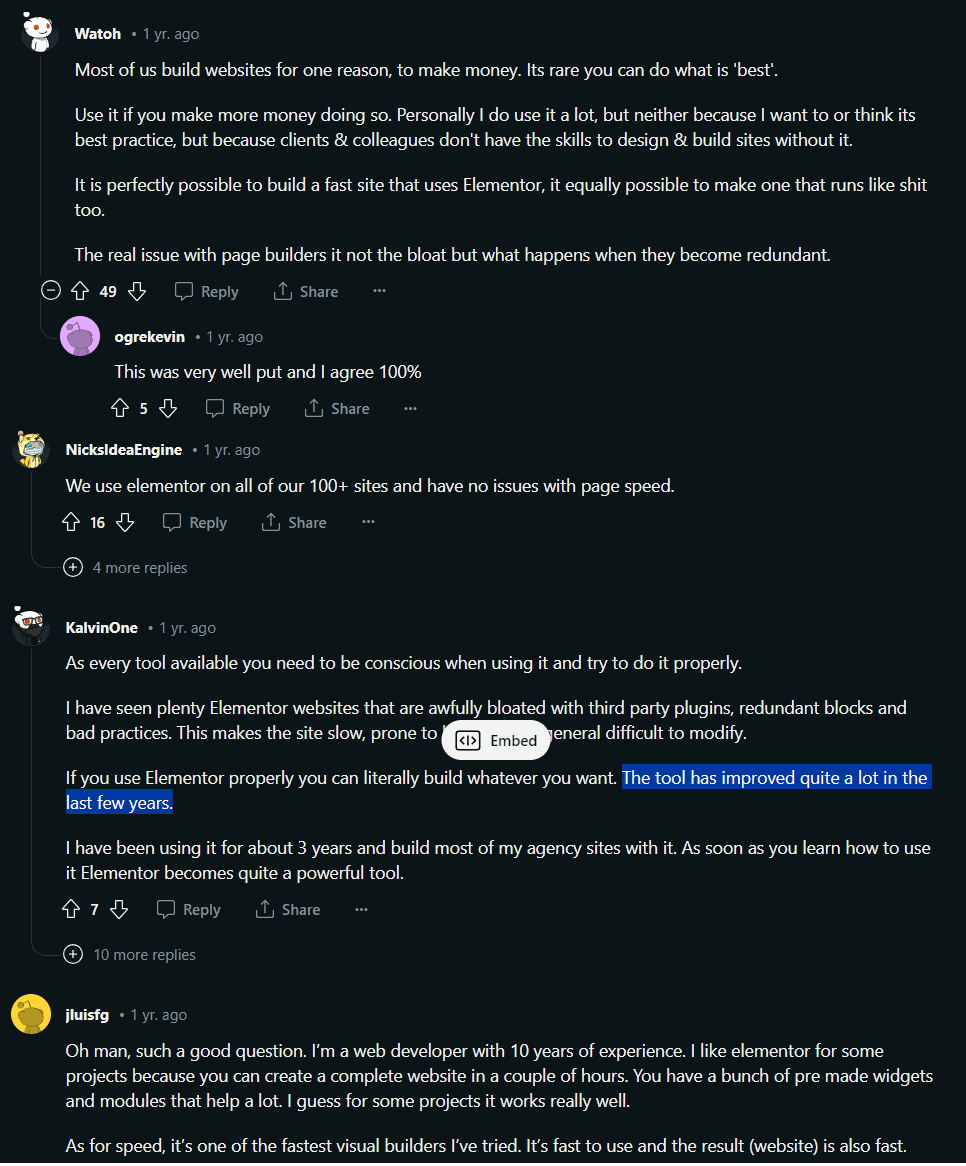
Users also say that Elementor performs well only when your website hosting server is good. I use WPX web hosting, which perfectly handles Elementor’s load without any performance issues.
Elementor Pricing and Plans
Elementor has recently updated its pricing plans!
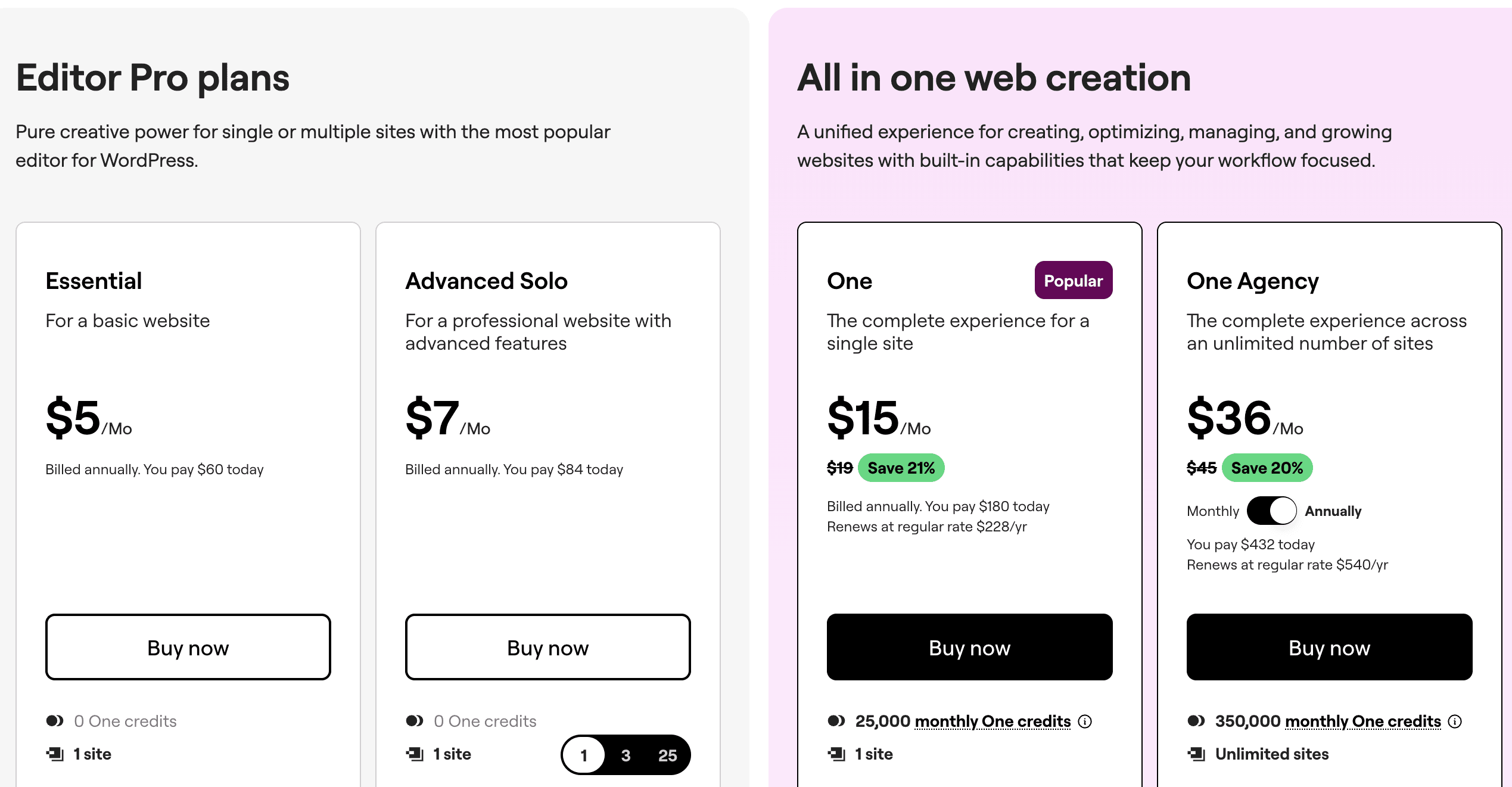
1. Editor Pro
- Essential – $60/year ($5/month billed annually) for 1 website.
- Advanced Solo – $84/year ($7/month billed annually) for 1 website with additional advanced features.
2. Elementor One (All-in-One)
- One – $180/year ($15/month billed annually) for 1 website.
- One Agency – $432/year ($36/month billed annually) for unlimited websites
Elementor offers two Editor Pro plans for those who need its website builder, along with Elementor One plans that combine the builder with managed hosting, AI tools, and website management.
Essential ($60/year): Includes Elementor Pro for one website with premium widgets, Theme Builder, Popup Builder, Form Builder, WooCommerce Builder, and one year of updates and support.
Advanced Solo ($84/year): Includes everything in the Essential plan, along with additional advanced capabilities for users building more feature-rich websites.
For those looking for an all-in-one solution, Elementor One starts at $180/year for one website, while One Agency costs $432/year and supports unlimited websites with hosting, AI credits, and website optimization tools.
I use the Essential plan that offers the best value. If you want hosting and AI tools included, Elementor One is the better choice.
What if you’re not happy with Elementor Pro? A 30-day money-back guarantee will always have your back.
Support Options
The Support options for Elementor users vary as per their plan.
Here are the support options found inside Elementor:
- Premium live chat support (For Pro users)
- Elementor Knowledge Base (For all users)
- Elementor Academy (Free high-quality video tutorials related to Elementor & website design)
- Elementor Facebook community (For quick help from existing users)
Elementor Alternatives
Personally, I would advise you to start with Elementor (If you are a beginner). However, you can always have various WordPress page builders to choose from.
1.) Divi:
I’ve used Divi Builder on a few projects, and it offers lifetime pricing.
Compared to Elementor, Divi feels more like an “all-in-one design system” rather than a flexible ecosystem.
What I like about Divi:
- One-time pricing option (no recurring subscription)
- Visually appealing design system
- Good template library
- Built-in marketing features
| Features | Elementor | Divi |
|---|---|---|
| Theme Builder Functionality | ✓ | ✓ |
| Performance | Faster | Little Bit Slower |
| A/B Testing Module | ✕ | ✓ |
| Free Version | ✓ | ✕ |
| Elements Count | Free Version: 40+ Elementor Pro: 100+ Extra | 200+ |
| Global Modules | ✓ | ✓ |
| Popup Builder | ✓ | ✕ |
| Drag & Drop Builder | ✓ | ✓ |
| Adding Elements Method | Follows section & columns approach | Follows section & rows approach |
| Ease Of Use | More | Less |
| Dynamic Interface | ✕ | ✓ |
| Real time page editing | ✓ | ✓ |
| Individual Pages Templates | More | Less |
| Website Kit Templates | Less | More (350+) |
| Inbuilt Theme | ✕ | ✓ (Divi) |
| Compatibility with Other Themes | ✓ | ✓ |
| Shortcode Widget | ✓ | ✕ |
| Custom CSS | ✓ | ✓ |
| Embed Anywhere (Templates/Blocks) | ✓ | ✓ |
| WooCommerce Widgets | ✓ | ✓ |
| Inbuilt Form Widget | Missing Conditional Logic | More Powerful (Conditional Logic is there) |
| Add-ons Supported | Huge third party plugins can be integrated with Elementor | Can be integrated with only few third party plugins |
| Lock Elements | ✕ | ✓ |
| Maintenance Mode | ✓ | ✕ |
| Role Editor | Less Powerful | More Powerful |
| Lifetime Subscription | Not available | Available |
| Pricing | Cheaper (Elementor Pro starts from $60/year) | Expensive (Starts from $89/year) |
There has always been a running debate between these two awesome page builders. You can read my Elementor vs Divi post to understand how these plugins differ from each other.
2. Gutenberg:
Compared to Elementor, the WordPress default Gutenberg editor is simplified, easy to use. It has improved a lot in recent years, and many users now rely on it instead of page builders.
What I like about Gutenberg:
- Lightweight and fast
- No extra plugin dependency
- Built into WordPress
- Good enough for simple blogs
FAQ About Elementor Plugin
What can I do with the Elementor plugin?
It has a drag-and-drop editor that lets you customize almost every part of your site. You can
– create popups
– build email optin forms
– design custom pages (like 404 error pages)
– make landing pages
– get custom footer, header
Is Elementor a theme or plugin?
Elementor is a WordPress plugin (not a theme). The Elementor plugin is a page builder that requires a WordPress theme to build and customize your site. You can create anything, including landing pages and custom layouts, by using their drag-and-drop editor.
It contains hundreds of pre-made templates to customize your WordPress site.
What happens to pages created in the Elementor free version after I upgrade?
If you’re already using the Elementor free version and wondering about what happens to those pages that are created with the free plugin, don’t worry. You won’t lose anything.
What happens if I deactivate Elementor?
If you deactivate or delete Elementor, your site will be unable to display the elements you created with it (such as popups, landing pages, etc).
Does Elementor Pro offer a demo version?
No, they do not offer any demo version of Elementor Pro or free trials. However, you can use their free version to customize your sites.
Does Elementor impact SEO?
No, Elementor doesn’t harm a page’s SEO. It is SEO optimized and compatible with major SEO plugins such as Rank Math, and Yoast SEO. But, make sure to implement other speed optimization strategies for your website.
Should you install the Elementor free version or the pro version?
If you are a beginner, go with the free version. You should upgrade if you want
– full control over your website design
– to customize headers, footers, and layouts
– run a WooCommerce store
– better conversions with popups and landing pages
– to reduce dependency on multiple plugins
Is Elementor suitable for beginners?
Yes, Elementor is designed specifically for newbies. With the help of the drag-and-drop builder, they can create stunning websites.
Which WordPress theme works well with Elementor?
GeneratePress, Astra, and Elementor Hello Theme are the best Elementor themes you can choose from.
Does Elementor impact website speed?
Elementor is a plugin, hence it definitely adds some load on website speed. However, if you have a high-performance hosting server, everything will be smooth.
Should You Use Elementor In 2026?
After using Elementor for years across different websites, my honest answer is: Yes, Elementor is still worth it, but only if it fits your use case.
It’s not the fastest or the most lightweight page builder, but it strikes a very good balance between:
- Ease of use
- Design flexibility
- Feature set
- Ecosystem support
What I personally like most is that it allows me to build professional-looking websites quickly without relying on developers or complex coding. However, it is not the perfect choice for everyone.
My Final Thoughts
If I had to summarize everything I’ve learned after years of using Elementor, here is my viewpoint!
Elementor gives you freedom, but you still need to use it wisely. When used properly, it can dramatically speed up website creation and give you full control over your design without technical barriers.
It works best when you keep things simple, optimized, and intentional. If you’re still unsure, here’s my simple advice:
- Start with the free version
- Build a few pages
- See how it fits your workflow
- Upgrade to Pro only if you need advanced features
This is how I started, and it worked well for me. If you want to build professional websites without coding, Elementor is one of the safest and most practical choices in 2026.



![GeneratePress Review 2026 [Pros, Cons, Theme Features, Pricing & Verdict] – Why I Use it For My Site Design](https://bloggerspassion.com/wp-content/uploads/2022/05/generatepress-review-2022-300x157.jpg)


Leave a Comment
Your email address will not be published. Required fields are marked *