

Are you looking for the best tips for SEO content writing? Do you want to know how to write SEO content articles that rank really well in Google search?
Creating blog posts to impress both search engines and people is an art. In this detailed post, you’ll discover how to make such content that performs well.
Table of Contents
- What is SEO content writing?
- 9 Most Effective Tips To Write SEO Content in 2026
- 1. Follow the core pillars of SEO-friendly article writing
- 2. Use topic clusters to strengthen content relevance
- 3. Leverage essential SEO tools for optimization
- 4. Avoid common on-page SEO mistakes
- 5. Analyze top-ranking Google pages
- 6. Write with a clear user search intent
- 7. Target 1–2 intent-matched long-tail keywords
- 8. Integrate keywords naturally across content
- 9. Earn backlinks to expand Content reach
- Final Thoughts
What is SEO content writing?
There’s a huge difference between regular content writing and SEO friendly content writing.
SEO friendly article writing involves creating content that is optimized well both for search engines and your target audience, whereas regular content writing is written only for people.
Well, it may sound like a good deal of writing your content only for people, but if you really want to make sure your content ranks in Google, then you can’t ignore optimizing your content for search engines.
The MAJOR difference between content that ranks well and the content that barely gets any traffic is “SEO friendly content”.
So if you’re someone who’s struggling to increase search engine traffic, focus on improving your SEO content writing and you’ll definitely see positive results after a few months.
Are you curious to learn about how to write SEO friendly content that ranks on top of Google search in 2026 and beyond? Let’s get started then.
9 Most Effective Tips To Write SEO Content in 2026
- Follow the core pillars of SEO-friendly article writing
- Use topic clusters to strengthen content relevance
- Leverage essential SEO tools for optimization
- Avoid common on-page SEO mistakes
- Analyze top-ranking Google pages
- Write with a clear user search intent
- Target 1–2 intent-matched long-tail keywords
- Integrate keywords naturally across content
- Earn backlinks to expand content reach
1. Follow the core pillars of SEO-friendly article writing
There are types of pillar pages, let’s check out in detail:
Pillar 1: Keyword Research
First things first, search engines like Google need to know what your content is about.
If you’re simply creating content without targeting any specific keywords, you’re not going to get any kind of search traffic. It’s as simple as that.
You can’t write SEO friendly articles without doing keyword research first. The key to getting more search traffic is to find and use high-search-intent, low-competitive keywords.
If you’re wondering about the importance of keyword research, here are some of the biggest reasons for finding better keywords before you start writing content.
- You’ll attract “highly targeted visitors from search engines” by targeting the right set of keywords within your content
- You can increase your website conversion rates by including “profitable keywords.”
- Keyword research gives you a ton of potential blog post ideas that increase your sales and search traffic.
- You get to know what your competitors are ranking for. This alone helps you write SEO optimized articles with more ease
Here at Bloggers Passion, we always come up with a list of highly profitable yet low competition keywords before we start working on any new blog post.
We often focus on long-tail keywords rather than short-tail keywords because we know the importance of long-tail keyword research for increasing traffic. Have a look at the following illustration for a better understanding.

As shown in the image above, long-tail keywords are easier to rank for and produce higher conversion rates.
Whenever we’re doing keyword research for our blog, we usually pick a primary keyword for every blog post we’re going to work on along with other essential things like;
- Monthly search volume for the primary keyword
- Keyword difficulty
- Secondary keywords that are relevant to the primary keyword we’re trying to rank for
To find the above things and do proper keyword research, you need a tool like Semrush. We have already written a tutorial on using Semrush for finding keywords. Make sure to check it out.
That said, focus on the following essentials when conducting keyword research so you can write better content that ranks well in Google search.
- Before doing keyword research, determine the goal of your content. That means, you need to make sure whether you’re doing keyword research to increase your conversions or optimizing it for search traffic. That way, you will have better odds of getting the exact results you want from the keyword research process.
- Find out the value of every single keyword you find while doing keyword research. This ensures you’re picking only those keywords that are proven to convert and bring maximum value from every visitor you attract to your website.
- If you want to find out high traffic-generating keywords, you can consider scraping keywords from your competitors’ websites. Also, make sure to use Google search suggestions to find highly relevant keyword ideas to drive more search traffic.
Pillar 2: Keyword optimization
Keyword research is one part, and optimizing your content properly for search engines is another part.
Here’s where most people do it all wrong.
They either over-optimize their content by repeating the same keyword phrases or don’t properly optimize at all.
If you want to get better search rankings, you should insert your primary keywords in the appropriate places, such as;
- The title of your blog post
- The headings and subheadings of your blog post (h1, h2, and h3 tags)
- The first paragraph of your blog post
- The last paragraph of your blog post
- The meta descriptions of your blog post
- The image descriptions within your blog post
- The URL of your blog post and so on
Also make sure to have the following things in place on your website for better SEO.
- Submit a Sitemap: Sitemaps tell search engines like Google how many pages of a website are accessible to crawlers and search users.
- Robots.txt: Robots.txt files control crawler access to certain areas of your site.
- Use Schema Markup: Schema markup is code you add to your website to help search engines find highly informative results for users.
If you want to learn more about how to do proper on page SEO, check out this post.
2. Use topic clusters to strengthen content relevance
Do you want to know a secret content writing tip to improve your overall website rankings and search traffic in 2026? Use topic clusters.
A topic cluster is a group of interlinked web pages. All the topic clusters are built around one pillar content idea targeting a broad topic which is interlinked to several related pages.
Let us explain what topic clusters are in simpler terms.
Most bloggers create individual blog posts that rank for specific keywords.
Let’s say you want to rank for the keyword best fitness apps, You’ll be creating an exclusive post using “best fitness apps” as a primary keyword, right?
What happens when you create multiple blog posts around similar topics?
It simply results in your own URLs competing against one another in search engine results pages (SERPs), which often can be treated as duplicate content, which is not suitable for your website’s SEO.
Here’s where the solution of topic clusters comes into play, where you pick the broad topics that you want to rank for and then write articles based on specific keywords related to that particular topic (where you link to similar content) to boost your search engine visibility.
Here’s how the organised content looks;

What did you notice? Using topic clusters, Hubspot was able to organise specific topics surrounded by blog posts related to the topic which connected to other URLs in the cluster through internal linking.
Now comes the central question: how to create topic clusters to rank well?
Topic clusters usually include 3 components, which are listed below;
- Pillar content
- Cluster content
- Hyperlinks
Here’s how the topic clusters look;

Here’s an informative video from Hubspot explaining topic clusters.
To put it simply, a pillar page is a long-form content page that is rich in information, highly engaging, and covers a broad topic.
The cluster content pages usually cover more detailed and specific topics that fall under the umbrella of the pillar page.
A perfect example of topic clusters.
Beginner’s Guide to SEO by Moz is the most popular article on SEO, which is read by over 3 million people worldwide, and it’s a perfect example of a topic cluster.
4 steps to create topic clusters
If you’re wondering about how to create topic clusters for your own site for effective content writing, follow the 4 steps mentioned below.
- Pick a highly popular topic in your niche that you want to rank for: Make sure to come up with a broad topic idea that should be specific enough to cover all the different aspects of one pillar page, such as fitness, SEO, marketing, or anything that’s a broad topic in your industry. You can use tools like Semrush, Buzzsumo, or even Quora to find highly popular content ideas in your industry.
- Divide your broad topic into topic clusters: Once you’re done with the first step, you should also determine your topic clusters, which are broad enough to support an in-depth blog post. Make sure to come up with 8 to 10 topic clusters so you can use them around a solid pillar article to rank high on Google.
- Perform a content audit to find your most popular content: The best way to divide your topic clusters and to come up with a pillar blog post idea is to do research on your own blog posts that really performed well in the past, so you can interlink and use some of them as topic clusters.
- Compile them in one place: Once you’re done with all the above steps, create a landing page, use appealing images, and curate all your topic clusters at one place (look at the above example of Moz SEO guide to get an idea). You’re done!
3. Leverage essential SEO tools for optimization
Let us tell you one thing, honestly: SEO friendly article writing is not easy. It’s not easy to impress both search engines and people with your content or blog posts. Here’s where you need to think about getting your hands on a few essential tools to make the whole writing process more manageable.
Here are some of the tools for effective article writing. These are also the same tools we use here at Bloggers’ Passion for content marketing.
1. Rank Math SEO plugin
Do you want to optimize your content easily? As we discussed above, keyword research is one thing, and keyword optimization is another. If you’re really concerned about better writing and properly optimizing it for search traffic, install the Rank Math SEO plugin.
It is the most powerful WordPress SEO plugin, which helps you easily optimize your content for your primary keywords. In fact, you can target up to 5 keywords with every blog post you write.
Not only that, but it also offers you LSI keyword suggestions on the go. Yes, it’s an excellent plugin for optimizing your content for SEO.
We’re currently using Rank Math and migrated from the Yoast SEO premium version on our blog because we know how great the plugin is. You can also check out our Rank Math review to find more details.
The best part about this plugin is that it’s completely free to use and more than enough for most bloggers and SEOs.
2. Semrush
Semrush is the only SEO tool we depend heavily upon.
It’s the reason why we increased our search traffic and also sales. If you are wondering why you need Semrush for effective content creation, here are some of the benefits of using it.
Effective Keyword Research: Hands down, keyword research is one of the most powerful features of Semrush; it is also why millions of people use it to find better keywords. Apart from finding relevant keywords to increase your search traffic, you can also perform an advanced search to find out keywords used by your competitors.
Using Semrush keyword research, you can easily find the following things.
- Search volume of any keyword every month
- The density of each keyword used in comparison to your competitor’s site
- The number of pages seen in the results of search engines
- The PPC, or Cost Per Click, is required to advertise the keyword
- The number of Phrase Matches, which means the phrases containing the targeted keyword in your niche
- And so on
So if you’re looking for a perfect tool for keyword research, Semrush can be your weapon. Apart from that, here are a few more features that make it an incredible SEO tool.
- Analyzing Your Competitors With Ease: If you want to outrank your competition and get ahead in the SEO game, Semrush is the perfect choice for you, as this tool gives you all the data, such as backlink sources, top-performing pages, best keywords, etc, to easily analyze your competitors’ websites.
- Site Audits: Using this audit tool, Semrush lets you run an SEO audit of your site (which provides a site health score) to identify areas for improvement and easily fix site issues to rank higher in Google search.
- Link Building Made Easy: Want to build links? Use Semrush, and building links becomes easier, as you can get your hands on all the backlink data for your competitors’ websites.
- Organic Research: You can generate an organic research report with this tool by entering a domain name or keyword phrase, which will outline the essential steps needed to build a proper SEO strategy and content marketing plan.
- Social Media Marketing: Semrush makes it easy to create a social media marketing strategy and provides a range of features to build brand awareness on social channels like Facebook, Twitter, and more.
- PPC Advertising: PPC or Pay per click advertising can be effectively carried out with the help of Semrush, as it allows you to easily analyse all the top-performing keywords of your competitors that your rivals are using for their ads to increase their leads and revenue.
So what are you still waiting for?
Try Semrush 14 days free trial (Worth $129.95)
3. Quora
We extensively use Quora for 2 significant reasons: to generate new blog post ideas that people are looking for and to write answers on key topics to build more brand exposure.
Quora is useful for many reasons. Quora can be used as:
- A platform to promote your website
- A traffic source to generate more traffic to your sites
- A platform to hone your writing skills
- A platform to generate blog post ideas
Quora is used by millions of people worldwide, so you’ll have a vast scope to express your views about your industry and attract the right kind of visitors to your websites by writing answers on selective topics.
You can also link back to your posts, which is a great way to build links (even though they’re nofollow, they do enhance your website’s backlink profile over time).
4. Avoid common on-page SEO mistakes
Here are a few of the most common on-page SEO mistakes most people make while creating content for their blogs or websites.
Duplicate content in headings: This is not an intentional mistake; most people use similar or repetitive headlines. Do you know the reason? There are millions of blog posts getting published every single day, so it’s really hard for anyone to come up with a completely unique headline.
That’s why you need to double check on Google search to see if anyone else is using the same headline copy. Just make sure to add some uniqueness to your headlines so there will be no duplicate content in your H1 tags or titles.
Have a look at the illustration below from Semrush to learn more.
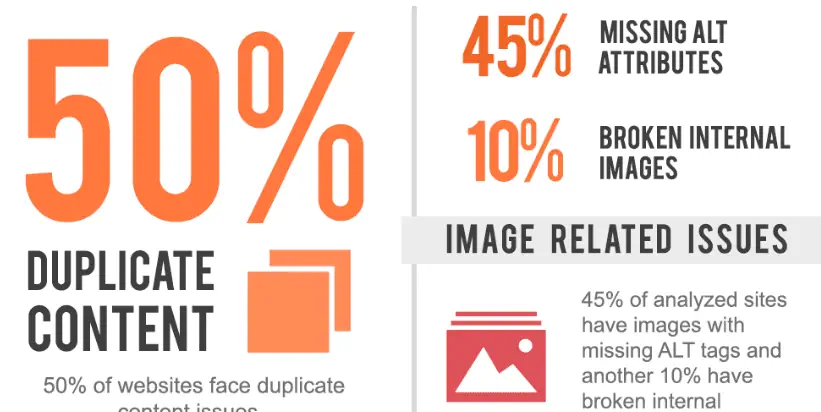
15% of the information online has duplicate content in H1 and title (so it’s a common on-site SEO mistake most people make).
Duplicate content: Semrush finds that over 50% of online content has duplicate content issues. Although there are no specific Google penalties for duplicate content, it doesn’t mean you should blatantly copy and paste other people’s stuff on your blog to get more traffic.
If you’re a beginner and think that copying others’ content is fine while writing, you’re wrong. It has to be changed, and you need to focus on creating your own unique content to get higher rankings on Google.
H1 tag mistakes: If you’re entirely new to SEO, here’s one thing you should remember: Use the H1 tag only once within your blog post or blog page. Don’t use it for fun, or it will really badly affect your search rankings. Use the H1 tag only for the title tag and for subheadings; you can use the H2 or H3 tags as many times as needed.
Missing or duplicate meta descriptions: If you’re using a plugin like Yoast SEO and don’t set a meta description for your blog posts, it will show something like: “no meta description has been specified, so search engines will display copy from the page instead.” This is not okay if you want to rank for your pages.
If you really want to rank for specific keywords, you need to optimize your meta description properly by keeping your primary keyword in mind. Also, make sure not to copy and paste from your own copy or from anywhere else in your meta description. Keeping it unique is the key to better search rankings.
Not using links properly: There are two types of links. One is internal links that point to your own blog pages and posts. The other one is external links that link out to other sites. Most people don’t use both of these links properly when writing content. The best way to use them is to use at least 1 internal ink for every 200 words of your content. Also, make sure to use 2 or more external links to authority sites or pages with highly informative, relevant content.
Not optimizing images: As a rule of thumb, use at least 1 image for every blog post or page you create. Make sure to use a keyword in the image alt tag to better optimize for Google search. If you’re using images without using any alt tags, you’re missing out on a lot of search visibility. Although it’s not a big deal to skip alt tags, if you want to better optimize your content, you need them.
5. Analyze top-ranking Google pages
Do you want us to tell you a secret to write SEO friendly articles that rank well on Google?
Look at your competition.
Analysing your competitors’ websites is the fastest way to learn how to write SEO articles that increase your search visibility. Ask yourself these questions to analyse your competitors.
What’s the average word count for the top 10 pages ranking on Google search for your target keyword?
How are the top 10 pages formatted? Do they include long-form content with images, videos, etc?
How relevant and informative are the top 10 ranking pages?
Once you’ve the answers to the above questions, here’s a 4-step strategy you can use to perform an in-depth competitor analysis to increase your website’s SEO with your content.
Step 1: Identify your competitors
No matter what industry you are in, you need to build a list of at least 10 to 20 of your competitors’ websites. Create a spreadsheet and include your competitors.
- Website URL
- Social media accounts
- Product pages and so on
That way, you’ll know what type of strategies they are using to drive more search traffic and sales to their websites. It won’t take more than a day or two to complete this step, so the sooner you identify your competitors, the better your understanding of your target audience and market.
Step 2: Identify the strategies and tactics of your competitors
By determining the goals and objectives of your competitors’ websites through competitor analysis, you can easily find out;
- You can perform a domain vs domain comparison to see who is actually winning the organic search engine visibility between you and your competitors
- Highly valuable keywords
- You can also find out the successful backlink strategies used by your competitors in order to improve your website’s content SEO rankings
So what are you waiting for?
Start doing competitor analysis and determine their goals to improve your own blog’s content strategy.
Step 3: Evaluate your competitor’s strengths and weaknesses
You can use tools like Semrush to know your competitors’ websites’ strengths and weaknesses. By getting access to the complete backlink profile of your competitors’ websites, you’ll be able to monitor where their authority links are coming from.
That way, you can also use various tactics like guest posting, blogger outreach, broken link building, etc, to get links from those sites to improve your overall website’s backlink profile.
Step 4: Fill the gaps with your content writing
The final step is to fill the gaps with your content. If your competitors are ranking in the #1 spot for a highly promising keyword with generic or low-quality content, you can work on a similar topic and make it highly informative and engaging, and use tactics like the skyscraper technique to get ahead in search results.
Pro tip: Do the backlink gap competitor analysis to find a list of all the websites linking to your competitors but not to your website. That way, you can create a list of websites that you can possibly get a backlink from or create content for (using techniques like the skyscraper technique).
6. Write with a clear user search intent
When coming up with new blog post ideas, most people don’t think about what their target audience truly wants. They either look for those keywords with less keyword search volume or low competition, and ignore the search users’ intent entirely.
What is search intent anyway, and why is it so important when it comes to SEO content writing?
Search intent focuses on the search users’ needs. It is the reason behind a searcher’s query on search engines like Google.
To put it simply, search intent represents the objective of the search user and to find out what he is trying to accomplish with the search term.
Here’s a great example to know about the users search intent for the keyword “buy backlinks”.

From the image above, you can see that Google is showing various search intent keywords, including informational and transactional ones. Ultimately, Google gives top rankings to pages where people click the most. In the above case, people are looking more for informational content for the keyword “buy backlinks”.
Once you understand the concept above, you can easily identify what your target audience is looking for, create appropriate content for them, and improve your search rankings.
7. Target 1–2 intent-matched long-tail keywords
Whenever we’re creating content for Bloggers Passion, we always target 1 or 2 long-tail keywords that match the searcher’s intent we discussed in the first step above.
The most important thing you need to know in content writing for SEO is that optimization is not about finding a primary keyword and stuffing it into your blog posts. It’s all about finding highly relevant long tail keywords (also known as LSI keywords) and integrating them nicely within your content.
That way, you can not only rank for your primary keyword, but you can also bring more search engine visitors to your sites for multiple keywords.
Long tail keywords are generally longer and are often question-based keywords that satisfy your target audience’s wants and needs.
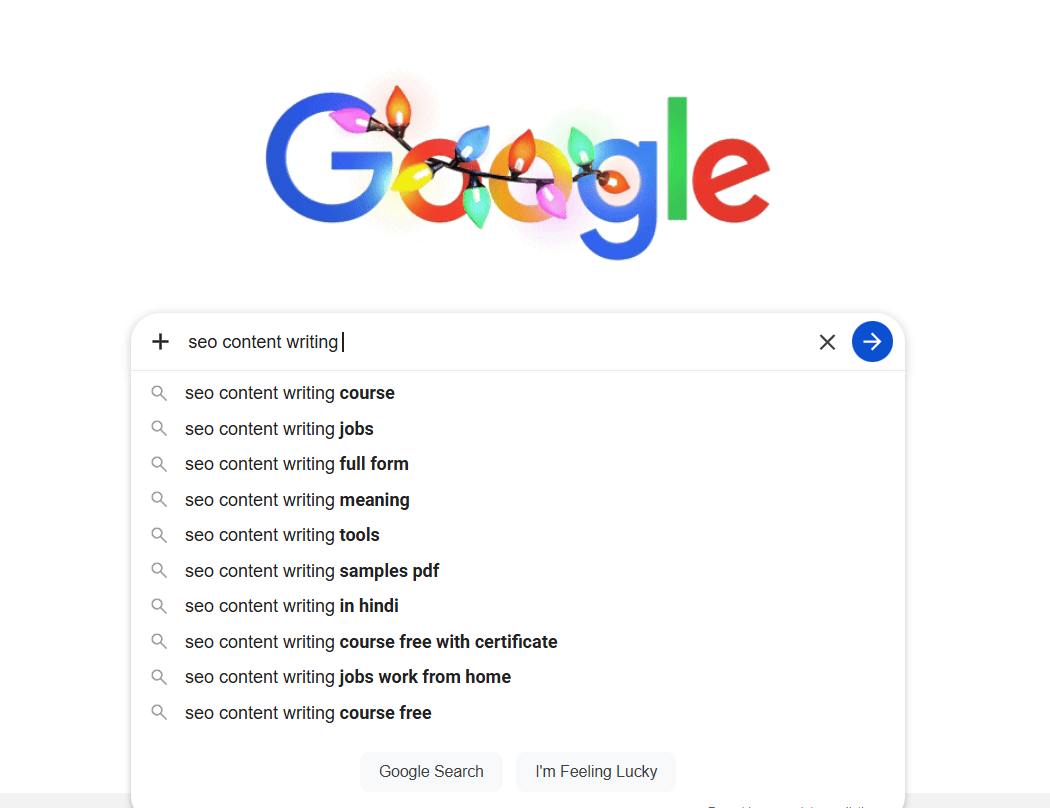
The simplest way to find long tail LSI keywords is to use the Google auto-suggestion tool and try to come up with 1 or 2 highly relevant keywords you can use within your content.
Here’s an image of Google autocomplete, which helps you easily find 1 or 2 long tail keywords to rank well in Google.
8. Integrate keywords naturally across content
Once you’re done with the above two important steps, it’s time for you to integrate your preferred keywords (both primary keyword and long tail keywords) within your content.
Why? Because if you want to make your content rank in Google search, you need to optimize it properly. That’s where your SEO friendly article writing skills will show up.
You don’t have to stuff your desired keywords, though, but make sure you’re integrating them naturally within your title tags, meta description, image alt tags, URL, and throughout the content to let search engine crawlers easily rank your content for various keywords.
Just remember that you’re writing for humans, not search engines. So focus on engaging your website readers with a natural writing style by using your selected keywords naturally.
9. Earn backlinks to expand Content reach
Whether you know it or not, Google puts a search result in the #1 spot on search by determining the quality of the backlinks it has.
That means, if you’re trying to rank #1 for a potential keyword or topic, you can get those rankings by attracting as many quality links from other sites as possible. Google gives top priority to the web pages with more links.
So if you really want to increase your organic traffic with your content, don’t forget the importance of attracting links from other sites.
Below is an illustration that shows the importance of backlinks for higher rankings on Google search for your content.

The illustration above is a case study by Searchmetrics that shows the most common ranking factors Google uses to determine web page rankings, and it shows that backlinks have a significant impact on search results.
That being said, there are several types of backlinks that you should know about.
- Informational backlinks: As the name suggests, these are the backlinks that provide helpful and more information on the words linked within the text. Wikipedia is a better example of this type of link.
- Definitional backlinks: These are the backlinks that provide a more elaborate and extended definition to the linked words of your content. The Thesaurus is a classic example of this, providing a reference work that lists words grouped by similarity of meaning.
- Referential backlinks: These are the links where a web page is linked for source citation purposes. The Skyscraper technique is a great example of this type of link.
- Promotional backlinks: These are the most commonly used backlinks, where you can acquire links from guest posts, forums, Q&A platforms, etc.
You should always target the #2 and #3 types of backlinks mentioned above to improve your content’s rankings.
Pro tip SEO backlink strategy: Make sure to check a site’s DA to attract quality links. Domain Authority (DA) is a search engine ranking score developed by Moz that tells you how well a website will rank on search engine result pages (SERPs). A DA score ranges from 1 to 100, with higher scores corresponding to a greater ability to rank. That means you should aim to get links from higher DA sites (preferably with DA 40+).
We have recently written an interesting SEO case study where you’ll discover the importance of Google search rankings, along with other details like how long it takes to rank for a keyword on Google. It’s a great case study that is really useful for anyone looking to improve rankings on Google.
Final Thoughts
It doesn’t matter what industry you are in; if you want to get a higher ranking on Google, you need to learn and practice the right article writing tips. Hopefully, the SEO friendly content writing tips and techniques mentioned above can be useful for you to create great content for your target audience.
Do you have any questions about creating content for both search engines and people? Share your thoughts in the comments below.







Your seo content writing technique I must say is super duper good.
Following this list, you can rank for a less competitive keyword in less thank a week.
You are a blessing.
Thanks Anil!
Thanks Anil. You just killed it all at once with this well detailed post on increasing traffic with SEO content writing. I have been following this process and it’s been working out as you said. I really appreciate
Very helpful post, as this post covers many points to increase the website traffic.
Awesome tips , SEO is very important for Increase the visibility of our sites, thank you for sharing the post.
Thanks to Anil for great post. I followed your suggestion and writing unique content and get traffic on sites.
nice posts, i didn’t really focus on keyword research, now i know why even after witing quality contents i get no traffic
Wow that a lot of great blogs and i also appreciate your content. Specialty I will admonish you to focus on your content for SEO.
Wow This is best seo content writing technique and tips.
i read this post and follow your best tips.
Thanks for sharing your best suggestion
Hi Anil,
You have covered all the points, including “Yoast seo”,Thanks to Anil for great job.
i read this post very slowly,i have some query regarding long tail keyword and short tail keyword can you please provide some tips about them.
Hi Anil
You wrote a great content on Yoast SEO, and this is very helpful for me to make my post SEO good. This article makes me understand the proper meaning of seo and how it is important for post to rank on google.
Thank you Anil
Thanks for this great list of bloggers. I am reading bloggers passion blogs from last 2 month, I receive very important information regarding how to increase traffic on website & online marketing from Blogger Passion website and I learn a lot of things from bloggerspassion.com.
This is an awesome post for content writing. But I want to ask a question that one of my keywords ranks on google 1st page. But after 2 days it gets removed. WHy this has happened??
Hi Manoj, keyword ranking changes due to Google algorithms. You didn’t say what type of contents you’re targeting, if they are trending keywords, you’ll see a lot of fluctuations (unless you’ve an authority site). Make sure to keep an eye on your rankings, build links and do proper on page optimization to sustain rankings.