


Affiliate marketing is now a $21.60 billion global industry, and it is growing at 8% every year. By 2031, it is projected to reach $31.7 billion.
These numbers are not surprising when you look at what the channel actually delivers. Brands earn an average of $15 for every $1 spent on affiliate marketing. It drives 16% of all ecommerce sales in the United States. And 81% of brands worldwide now run some form of affiliate program.
This post covers the latest affiliate marketing statistics for 2026, across market size, top niches, earnings, traffic sources, networks, and the risks that come with the channel.
Let’s get into the details without much ado.
Affiliate Marketing Key Stats 2026
- The global affiliate marketing industry is valued at $21.60 billion in 2026 and is projected to reach $31.7 billion by 2031.
- The U.S. affiliate marketing spend is expected to cross $11.99 billion in 2025, the first time it has crossed the $10 billion mark.
- Brands earn an average of $15 for every $1 spent on affiliate marketing, equal to a 1,400% ROI.
- 81% of brands worldwide use affiliate marketing programs, and 84% of publishers participate in at least one affiliate program.
- The average affiliate marketer earns $8,038 per month, with experienced affiliates (10+ years) earning over $44,000 per month.
- 78.3% of affiliate marketers rely on organic SEO as their primary source of traffic.
- Amazon Associates holds 46.11% of the global affiliate network market share, with approximately 900,000 affiliates on its platform.
- Affiliate marketing drives 16% of all ecommerce orders in the United States and Canada.
Affiliate Marketing Market size & growth
As of 2026, the affiliate marketing industry is valued at $21.60 billion globally.
The global affiliate marketing industry was valued at $18.5 billion in 2024. According to Cognitive Market Research, this figure is projected to reach $31.7 billion by 2031, growing at a compound annual growth rate (CAGR) of 8% from 2024 to 2031.
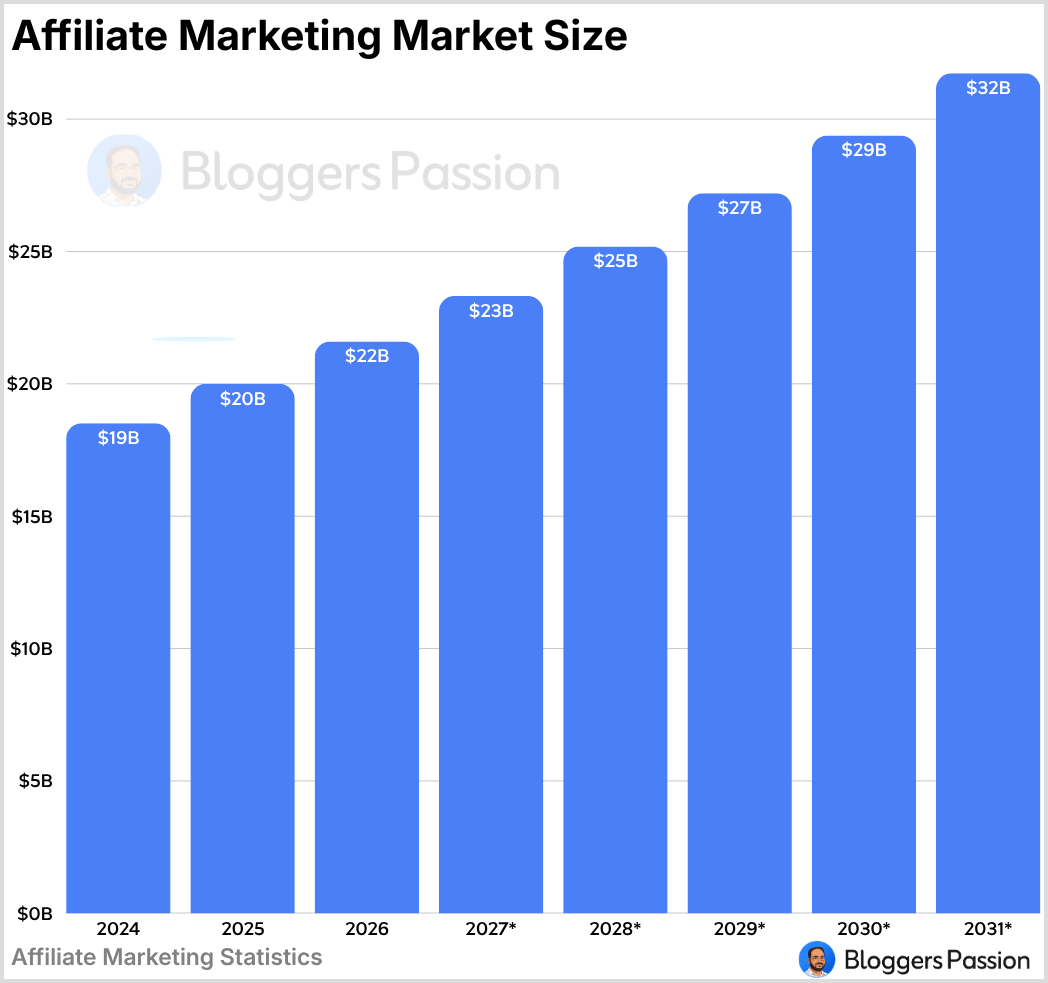
The table below shows the projected global affiliate marketing market size from 2024 through 2031:
| Year | Estimated Global Market Size | Growth vs. Previous Year |
| 2024 | $18.51 billion | Baseline |
| 2025 | $20.00 billion | +8.0% |
| 2026 | $21.60 billion | +8.0% |
| 2027* | $23.32 billion | +8.0% |
| 2028* | $25.19 billion | +8.0% |
| 2029* | $27.20 billion | +8.0% |
| 2030* | $29.38 billion | +8.0% |
| 2031* | $31.73 billion | +8.0% |
The platform (software) side of affiliate marketing was valued at $22.58 billion in 2025 and is expected to reach further to $35.7 billion by 2033.
(Note: This figure refers specifically to affiliate marketing software and platforms, not the broader industry spend figure.
To put the growth in perspective, the industry has roughly doubled in size over the last decade, driven by the rise of content-based publishing, ecommerce expansion, and performance-based advertising models that give brands a measurable return on their spend.
From a return standpoint, on average, affiliate programs deliver brands a 1,400% ROI, generating $15 in revenue for every $1 spent on affiliate advertising.
This performance-based efficiency is one of the main reasons adoption keeps growing. Affiliate marketing currently drives 16% of all ecommerce sales in Canada and the United States, making it one of the four largest sources of online orders.
For major brands, affiliate programs contribute anywhere from 5% to 25% of their total online sales.
(Source: Cognitive market research, eMarketer)
Affiliate Marketing Adoption by Brands & Publishers
81% of brands worldwide use affiliate marketing programs, which commissioned Forrester Consulting to survey advertisers and publishers on how they use affiliate programs.
On the publisher side, 84% of publishers participate in at least one affiliate program. Infact, these brands use affiliate programs at multiple points in the customer journey, not just at the point of sale.
83% of advertisers targeted consumers during the discovery and awareness phase, 79% used affiliate programs at the conversion or purchase stage, and 79% used them to create ongoing customer engagement after the initial sale.
When surveyed about the performance of their affiliate programs, 33% of marketers described their programs as highly successful, and 42% described them as successful. Only 3% said their programs were not successful, and 2% said they were not successful at all.
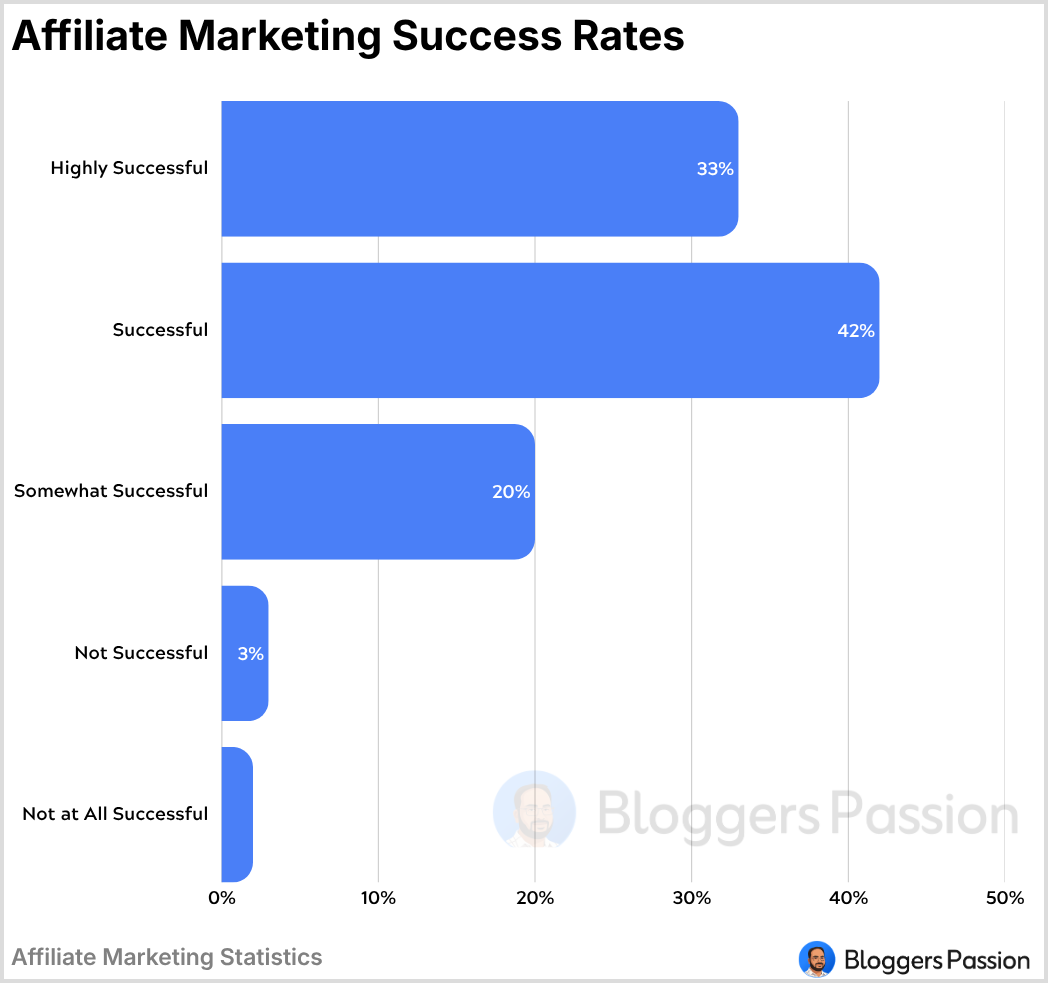
The table below breaks this down:
| Program Success Rating | Share of Marketers |
| Highly Successful | 33% |
| Successful | 42% |
| Somewhat Successful | 20% |
| Not Successful | 3% |
| Not at All Successful | 2% |
(Source: affiliatestatistics.marketing)
The business case for running an affiliate program is supported by the revenue impact reported by brands.
- 65% of retailers say their affiliate programs have increased their annual revenue by up to 20% (Awin).
- 31% of web publishers say affiliate marketing is their top revenue source (eMarketer), and 76% of publishers say affiliate marketing makes monetizing their website simple (Sovrn).
These numbers point to an arrangement that works reasonably well for both sides of the relationship.
Beyond this, 79% of marketers use affiliate marketing to engage new customers, while 46% use it for customer retention.
Top Niches & Commission Rates
When it comes to how much affiliate marketing contributes to overall sales, affiliate programs account for 5% to 25% of total online sales for major brands, with the range depending on the brand’s vertical, commission structure, and how actively the affiliate program is managed.
At a broader level, affiliate marketing is responsible for 16% of all ecommerce orders in the United States and Canada, making it one of the four largest online sales channels by volume.
Globally, Retail and ecommerce account for the largest share by far, generating 44% of all global affiliate marketing revenue. Telecom and media come in second at 25%, followed by travel and leisure at 16%, with all other industries making up the remaining 15%.
The table below shows this global revenue distribution:
| Niche / Sector | Share of Global Affiliate Revenue |
| Retail & Ecommerce | 44% |
| Telecom & Media | 25% |
| Travel & Leisure | 16% |
| All Others | 15% |
(Source: Influencer Marketing Hub)
Most Profitable Niches by Monthly Earnings
When looking at which niches actually pay affiliates the most per month, the rankings shift significantly.
SaaS products pay the highest commission rates of any niche. According to the Influencer Marketing Hub Affiliate Marketing Benchmark Report, SaaS affiliate programs pay commissions ranging from 20% to 70%, depending on the product and its pricing tier.
Many SaaS programs also offer recurring commissions. This recurring structure is a major reason why 90% of affiliates say they are more likely to promote products with recurring commissions or longer cookie durations.
The average monthly revenue for software affiliates sits at $5,967.
Finance and fintech programs work differently from most other niches. Rather than paying a percentage of a sale, many finance programs pay a flat fee of $50 to $200 per qualified lead.
Finance is consistently rated among the most profitable niches for affiliates, with commission rates typically ranging from 35% to 40% for programs that do offer percentage-based payouts
Education and eLearning affiliates come next, averaging $15,551 per month in earnings, according to Authority Hacker. Travel follows at $13,847 per month, and beauty at $12,475 per month.
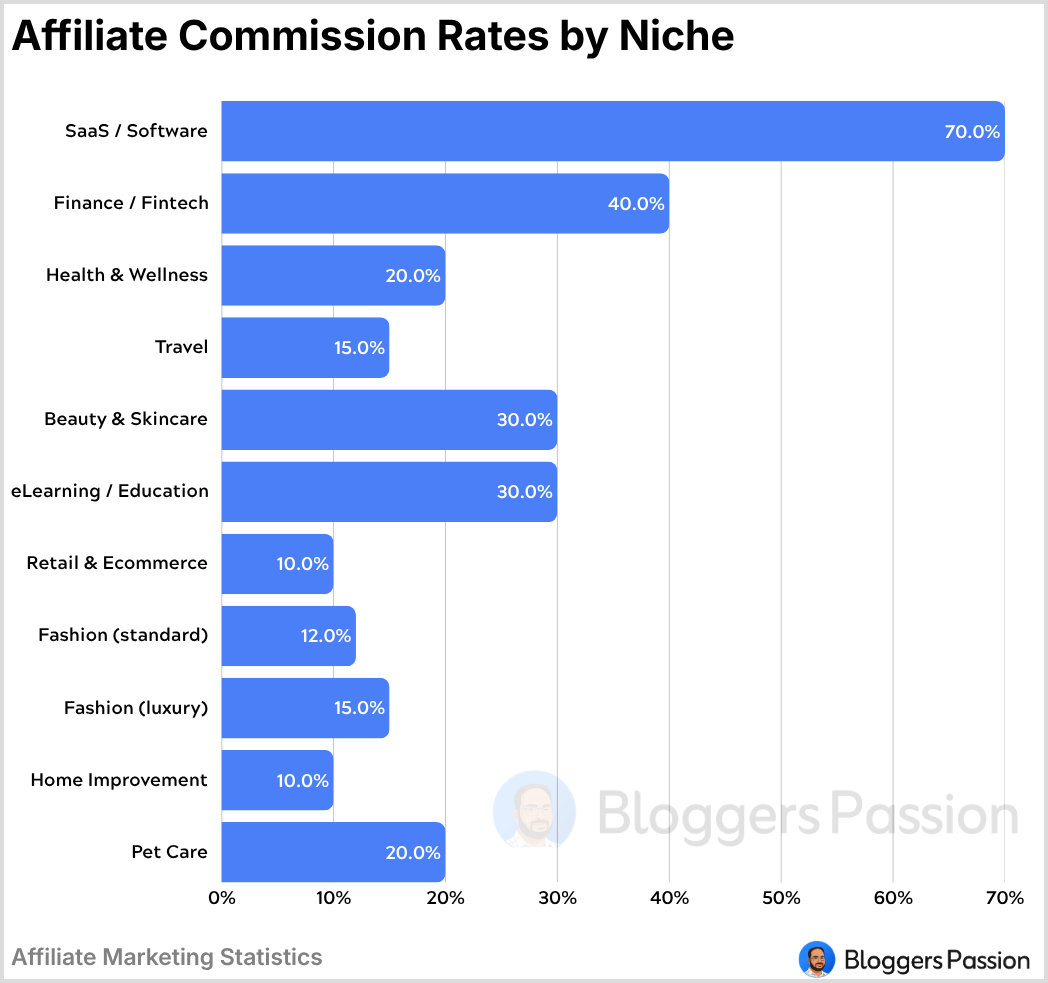
The full breakdown by niche, average commission rate range, and average monthly revenue is shown in the table below:
| Niche | Commission Rate Range |
| SaaS / Software | 20% to 70% |
| Finance / Fintech | 35% to 40% (or $50 to $200 flat per lead) |
| Health & Wellness | 3% to 20% |
| Travel | 10% to 15% |
| Beauty & Skincare | 10% to 30% |
| eLearning / Education | 15% to 30% |
| Retail & Ecommerce | 2% to 10% |
| Fashion (standard) | 8% to 12% |
| Fashion (luxury) | Up to 15% |
| Home Improvement | 2% to 10% |
| Pet Care | 2% to 20% |
(Source: Authority Hacker, Affiliate Statistics Marketing, Hostinger)
Affiliate Marketer Earnings & ROI
The most widely cited figure for affiliate marketer earnings comes from Authority Hacker’s survey of over 2,270 affiliate marketers. It found that the average affiliate marketer earns $8,038 per month, which translates to roughly $96,456 per year.
The same survey found that the average affiliate website earns $149.76 in revenue per 1,000 visitors (RPM), which gives a useful benchmark for estimating income based on traffic.
According to AffiliateWP, 81.2% of affiliate marketers make more than $20,000 annually. While this sounds positive, it is important to read this alongside the data on lower earners.
Customers who arrive via an affiliate link make 21% more repeat purchases than customers who arrive through other channels.
According to the Influencer Marketing Hub Affiliate Marketing Benchmark Report, 57.55% of affiliate marketers earn less than $10,000 per year. Only 11.18% earn over $100,000 per year, and just 3.78% earn over $150,000 per year.
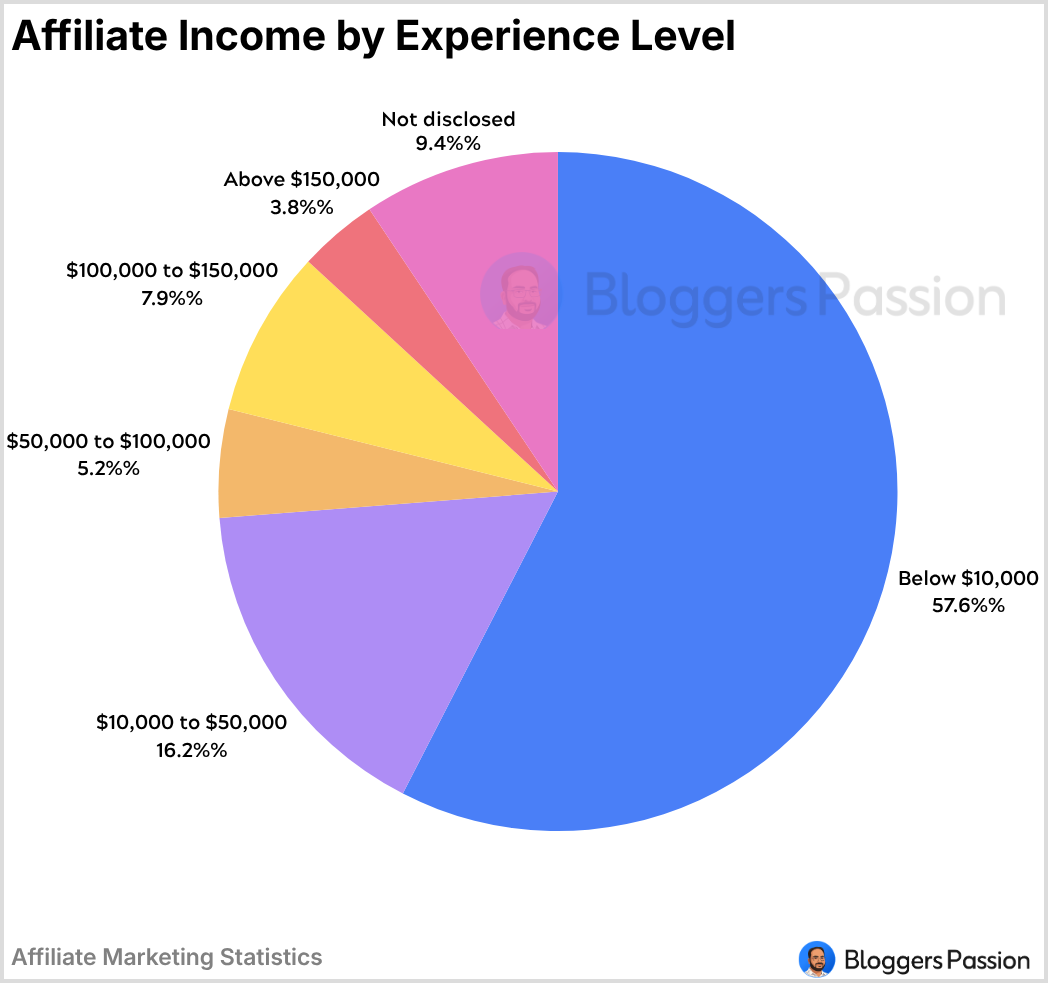
The table below shows the full annual income distribution among affiliate marketers:
| Annual Income Range | Share of Affiliate Marketers |
| Below $10,000 | 57.55% |
| $10,000 to $50,000 | 16.21% |
| $50,000 to $100,000 | 5.15% |
| $100,000 to $150,000 | 7.94% |
| Above $150,000 | 3.78% |
| Not disclosed | 9.37% |
(Source: Influencer Marketing Hub Affiliate Marketing Benchmark Report)
Earnings by Experience Level
Authority Hacker’s survey data shows that affiliate marketers with more than 3 years of experience earn 9.45 times more than beginners.
Those with over 10 years of experience earn an average of over $44,000 per month, compared to far lower figures for those just starting out.
The income tiers by experience level, commonly referenced across the industry, break down as follows:
| Experience Level | Typical Monthly Income |
| Beginner (under 1 year) | $0 to $1,000 |
| Intermediate (1 to 3 years) | $1,000 to $10,000 |
| Advanced (3 to 10 years) | $10,000 to $100,000 |
| Super Affiliate (10+ years) | $100,000 and above |
(Source: Influencer Marketing Hub, Authority Hacker)
The gap between beginners and experienced affiliates is also visible in traffic data. Affiliates with less than one year of experience average around 13,700 monthly visitors to their sites, while those with 3 to 5 years of experience average 67,800 monthly visitors, and those with 10 or more years average 216,000 monthly visitors.
The typical affiliate marketer has approximately 2.8 years of experience in the industry.
Earnings by Work Structure
77.1% of affiliate marketers work alone, with no team members (Authority Hacker).
Among those who do have teams, the average team size is 2.3 people, and around 17% of affiliates have between 2 and 5 team members. Only about 5% of affiliates operate with a team of more than 5 people.
Affiliate Marketing ROI for Brands
From the brand side, the return numbers on affiliate marketing are consistently reported as strong. Brands using affiliate marketing report an average return of $15 for every $1 spent, which equals a 1,400% ROI.
Rakuten Advertising, using data from seven major affiliate networks and platforms including Awin, CJ, Partnerize, and ShareASale, reports the average return on ad spend (ROAS) for affiliate marketing at 12:1.
This means that for every $1 put into affiliate programs, brands receive $12 back in revenue on average.
65% of retailers say their affiliate programs have increased annual revenue by up to 20%. 20% of brands describe affiliate marketing as their single most successful customer acquisition channel.
(Source: Awin, Authority Hacker)
Affiliate-acquired customers also show a 15% higher average order value compared to the site average across affiliate networks.
Conversion Rates and Click Performance
Affiliate marketing conversion rates sit between 0.5% and 1% on average across all programs.
By business model, B2C affiliate programs convert at an average of 2.0%, while B2B affiliate programs average 1.2%.
In retail and fashion specifically, affiliate conversion rates can reach 4.2%, particularly when coupon and cashback partnerships are involved. Affiliate landing pages built around product reviews achieve 5% to 6% conversion rates, nearly double the rates seen on generic brand pages.
The click-through rate (CTR) for affiliate links in 2026 typically falls between 0.5% and 1%. Across all affiliates combined, over 5 billion clicks are recorded on affiliate marketing links annually, which result in over 170 million online transactions per year.
The average affiliate website RPM of $149.76 per 1,000 visitors means that traffic quality and niche targeting matter considerably more than raw visitor numbers alone.
Traffic Sources & Consumer Behavior
Organic search is the number one traffic source for affiliate marketers by a wide margin.
78.3% of affiliate marketers use SEO as their primary traffic acquisition method. The dominance of SEO as a traffic source increases with experience. Among affiliates with 3 to 10 years of experience, approximately 90% use SEO as a primary traffic source. Among those with over 10 years of experience, the figure is 84%.
Google’s AI Overviews have reduced click-through rates significantly on affected search results pages. CTRs drop to just 8% when AI Overviews appear, compared to around 15% on pages without them, which represents nearly half the traffic gone from organic positions in some query categories.
As a result, algorithm updates negatively impacted 25.1% of affiliates in 2025, and of those affected, 47.4% changed their content strategy in response.
Traffic Source Breakdown Across All Affiliates
Beyond SEO, affiliates use a range of channels to drive traffic.
| Traffic Source | Share of Affiliate Marketers Using It as Primary Source |
| Organic SEO | 78% |
| Organic Social Media | 35 to 40% |
| Email Marketing | 22 to 23% |
| Paid Social Media Ads | 12% |
| Paid Search (SEM) | 8 to 34%* |
| Influencer Marketing | 5% |
(Source: affimaven)
Blogging and content marketing are used by 65% of affiliates to drive traffic and commissions. Content and blog-based affiliates drive 40% of all affiliate revenue.
When publishers are asked which channel they prefer for affiliate promotion, blogging remains the most widely used non-social-media channel. 27.8% of brands prefer working with bloggers for affiliate marketing. Review sites are next at 18.7%, followed by coupon sites at 14.8%, newsletters at 7.2%, and editorial sites at 6.5%.
The table below shows the full breakdown:
| Affiliate Channel (Excluding Social Media) | Share of Brands |
| Bloggers | 27.8% |
| Review Sites | 18.7% |
| Coupon Sites | 14.8% |
| Newsletters | 7.2% |
| Editorial Sites | 6.5% |
| Other | 23.2% |
On the technology side, 73% of marketers now prefer using SaaS-based platforms to manage their affiliate programs rather than traditional affiliate networks (Influencer Marketing Hub).
Moreover, over 70% of affiliate transactions are completed on smartphones and tablets. Advertisers have taken note, with 48% of brands increasing their mobile-specific affiliate ad budgets in 2025 and 2026.
Mobile-optimized affiliate websites achieve a 64% higher conversion rate compared to sites that are not optimized for mobile.
In-app affiliate links produce a 45% higher CTR than traditional web-based affiliate links, and in-app affiliate campaigns deliver a 50% higher user engagement rate than non-app campaigns.
(Source: Ahrefs, Salesforce, Business of Apps)
Influencers & Social Media in Affiliate Marketing
The global influencer marketing industry reached $32.55 billion in 2025 and is projected to surpass $40 billion in 2026.
- 86% of marketers say they use influencer marketing in 2025, up from 82.7% in 2024 and approximately 78.6% in 2023.
- 59% of brands report that using influencer partnerships increased their sales by up to 46%.
- On the ROI side, brands earn an average of $5.78 for every $1 spent on influencer marketing, with top-performing campaigns returning between $18 and $20 per dollar.
When talking about social media,
Social media is the second-largest traffic source for affiliates overall. Social commerce is projected to reach $1 trillion in global sales by 2028. Approximately 35% to 40% of affiliates use organic social media as a primary traffic source.
67.32% of affiliate marketers use social media to communicate with their audiences and promote products.
The platform breakdown among affiliates who use social media for promotions is as follows:
| Social Media Platform | Share of Affiliate Marketers Using It |
| 75.8% | |
| 61.4% | |
| 42.2% | |
| TikTok | 29.6% |
| YouTube | 57% (Phonexa) |
| 19% |
(Source: Authority Hacker, Phonexa)
According to Nielsen’s Trust in Advertising research, 88% of consumers have made purchase decisions based on influencer recommendations.
Top Affiliate Networks
Amazon Associates remains the dominant affiliate program globally, holding 46.11% of the affiliate marketing market share. The next largest networks, Rakuten at 7.78%, Awin at 6.68%, ShareASale at 6.46%, and CJ Affiliate at 6.24%, collectively control less than 30% of the market.
However, market share by participating domains tells a different story. By total link share, Awin holds approximately 30.4% of all affiliate links worldwide, making it the largest by that metric.
By active publisher sites, CJ Affiliate leads at 15.7%. When including Amazon Associates, Amazon dominates at 48% of the market by participating in domains.
The table below summarizes market share by the most commonly referenced metric, which is the share of participating affiliate domains:
| Network | Market Share (by Domain) |
| Amazon Associates | 46 to 48% |
| Awin (incl. ShareASale) | 6.68% to 30.4% |
| Rakuten Advertising | 7.78% |
| CJ Affiliate | 6.24% |
| ShareASale | 6.46% |
| Impact | 15.7% (publisher preference surveys) |
(Source: Optinmonster, Cognitive Market Research)
Publisher Count by Network
Amazon Associates has approximately 900,000 members in its network, making it the largest by affiliate count. ShareASale comes in second with 700,000 affiliates, followed by Awin at 225,000, Rakuten at 150,000, and ClickBank at 100,000.
The table below shows the publisher count and the number of sites using each major network:
| Network | Estimated Publisher Count | Active Sites on Network |
| Amazon Associates | 900,000 | 215,129+ |
| ShareASale | 700,000 | Part of Awin group |
| Awin | 225,000 | 59,335+ |
| Rakuten Advertising | 150,000 | 34,116+ |
| ClickBank | 100,000 | Primarily digital products |
| CJ Affiliate | Not disclosed | 80,063+ |
(Source: marketingltb.com)
Research by Cognitive Market Research shows that only 6% of publishers work with just one network, with most successful affiliates working with 3 or more networks to diversify income streams and reduce dependency on any single program.
Challenges & Risks in Affiliate Marketing
Affiliate marketing carries real operational and financial risks for both brands and publishers.
Traffic generation is the top challenge for nearly 50% of affiliates, with search engine algorithm changes making it hard for many affiliates to generate traffic to their sites.
In the U.S., the effect is similar. 25.1% of affiliate marketers were negatively affected by search algorithm updates, and of those affected, 47.4% changed their content strategy in response.
Moreover, click-through rates fall to just 8% when AI Overviews appear in search results, compared to around 15% on pages without them.
For affiliates who have built their programs almost entirely on organic search traffic, this represents a direct reduction in traffic of nearly 50% on affected queries.
Click bots and fake traffic continue to rise 33% since 2022, costing $71 billion in advertising spend globally.
The table below shows the distribution of top challenges reported by affiliate marketers:
| Challenge | Share of Affiliates Reporting It |
| Getting enough traffic | ~45 to 50% |
| Affiliate fraud | Over 60% cite it as an industry challenge |
| Algorithm updates affecting rankings | 25.1% directly impacted |
| Inadequate support from affiliate managers | 26.9% |
| Commission structure and sustainable rates | 46% of marketers globally |
| Tracking difficulties | 18% say better tracking would increase their spend |
| Finding effective and aligned partners | 17% of brands cite this |
| Expert support availability | 17% of brands cite this |
(Source: affiliatestatistics.marketing, Authority Hacker, Fintel Connect, Forrester)
Some of the other challenges are:
31.3% of affiliate marketers have considered giving up affiliate marketing at some point. Among those who earn six figures annually, 31.3% also reported having considered quitting at some stage.
- 46% of marketers globally cite commission structures and sustainable rates as one of their biggest challenges.
- Roughly one in five impressions is fraudulent or non-human.
- About 25% of all affiliate traffic is considered fraudulent.
- 38% of affiliate disputes relate to attribution and cookie-window inconsistencies.
- 95% of beginner affiliate marketers struggle to succeed in their first year.
Final Thoughts
So what’s the future trend of affiliate marketing? The stats mentioned above show that affiliate marketing is growing rapidly.
Almost everyone benefits from affiliate marketing, including product vendors and publishers. If you’re a marketer, use the stats mentioned on this page to create a solid strategy to grow your sales.
What are your thoughts on affiliate marketing stats? Do you have any questions? Let us know in the comments.
FAQs
Here are some FAQs around affiliate marketing, its stats, trends, and facts.
How big is the affiliate marketing industry in 2026?
As of 2026, the global affiliate marketing industry is valued at $21.60 billion. It has been growing at a steady 8% per year since 2024 and is projected to reach $31.7 billion by 2031.
How much do affiliate marketers earn on average?
The average affiliate marketer earns $8,038 per month, or roughly $96,456 per year. However, 57.55% of affiliates earn less than $10,000 per year, and only 11.18% earn above $100,000 annually. Experience is the biggest factor in earnings.
What is the average ROI of affiliate marketing for brands?
Brands report an average return of $15 for every $1 spent on affiliate marketing, which equals a 1,400% ROI.
Which is the biggest affiliate network in the world?
Amazon Associates is the largest affiliate program by publisher count, with approximately 900,000 affiliates and a 46.11% global market share by participating domains. By total link volume, Awin holds the largest share at approximately 30.4% of all affiliate links worldwide.
What is affiliate marketing?
Affiliate marketing is a way for people to earn money by selling others’ products. You earn a commission whenever people purchase products or services through your links.
Is affiliate marketing worth it in 2026?
Yes, but it takes time. Brands consistently report strong returns, averaging $15 for every $1 spent.







I am impressed by the information that you have on this blog on affiliate marketing . It shows how well you understand this subject.