


Voice search optimization (VSO) involves optimizing your website’s content for spoken queries from voice assistants like Siri, Alexa, and Google Assistant.
It focuses on natural language, long-tail keywords, FAQs, and local mobile SEO to give users quick answers.
Example: Instead of “best pizza in New York”, optimize for “Where can I find the best pizza near me?”
Voice search is growing fast, and more people now use assistants like Alexa to search and shop online. If your site isn’t optimized for voice search, you’re missing traffic.
In this guide, you’ll learn how to prepare your website for voice search in 2026.
Table of Contents
- What is Voice Search SEO?
- What are the benefits of optimizing your website for voice search?
- Voice Search Optimization Guide 2026: Rank for Alexa, Siri & Google
- 1. Optimize for Featured Snippets & AI Overviews
- 2. Target Question-Based Keywords
- 3. Build Topical Authority with Long-Tail Keywords
- 4. Create Conversational Content That Matches Natural Speech
- 5. Improve Technical SEO for Voice Readability
- 6. Use Structured Data & Schema Markup
- 7. Dominate Local & “Near Me” Searches
- How to Optimize for Voice Search in 2026: A Quick Checklist
- FAQs | Voice Search Optimization
- Final Thoughts
What is Voice Search SEO?
Voice search is a technology that lets users speak to voice assistants such as Google Assistant, Siri, Alexa, Cortana, and Bixby instead of typing. It simply allows people to search the internet on phones or computers using voice commands.
Voice search SEO means optimizing your content so it appears in spoken search results. To do this, you need to target the keywords and phrases people naturally say while speaking.
Voice searches usually use longer and more conversational phrases.
Example: Someone may type “hospital near me,” but say “What is the nearest hospital to me?” when using voice search.
Voice search optimization statistics:
Here are some of the amazing voice search stats:
- 20.5% of global internet users actively use voice search
- Around 8.4 billion voice assistants are installed worldwide
- The voice recognition market will reach over $27 billion by 2026
- Nearly 27% of people use voice search on their mobile devices
What are the benefits of optimizing your website for voice search?
Here are some of the biggest benefits of optimizing your site for voice search in 2026 and beyond
Higher rankings: According to a report, roughly 75% of voice search results will rank in the top 3 positions for a particular question on a desktop search. So if you’re optimizing your content for voice searches, you’ll start attracting more visitors from search engines like Google.
Better authority: If you start ranking for voice searches, ultimately it will boost your site’s authority. New audiences will discover your site which improves your overall organic visibility.
High revenue: If more and more people started finding your site through voice searches, it will ultimately grow your website earnings (or eCommerce profits).
So are you ready to learn how to do SEO for voice search? Let’s find out.
Voice Search Optimization Guide 2026: Rank for Alexa, Siri & Google

1. Optimize for Featured Snippets & AI Overviews
If you want to rank for voice search in 2026, you need to aim for featured snippets and AI-generated answers.
Why?
Because voice assistants like Google Assistant or Amazon Alexa usually give one direct answer, not a list of 10 search results.
Voice answers now often pull from:
- Featured snippets
- AI-generated summaries
- Structured answers
So what can you understand?
So if your page provides the most helpful answer, your chances of ranking for voice searches increase a lot.
Make sure to optimize for featured snippets.
A featured snippet is a short answer shown at the very top of Google search results.
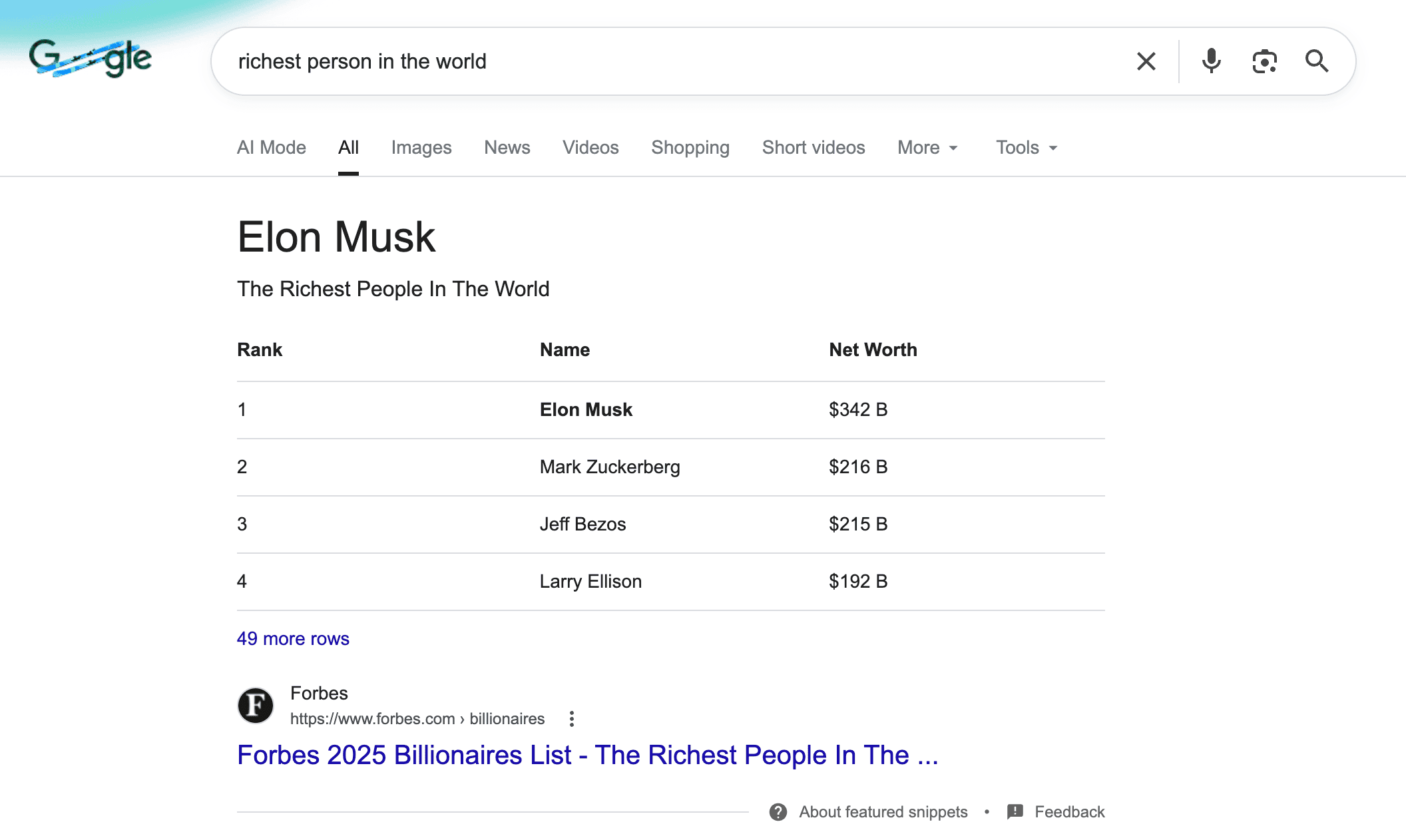
As you can see, the above illustration is a “featured snippet”. When you search for “richest person in the world,” Google displays the answer directly, along with the web page’s title and URL, so you don’t have to browse a ton of links online to get it.
Why Featured Snippets & AI Overviews Matter for Voice SEO?
Optimizing your content for AI overviews and featured snippets is probably the best way to rank for voice searches.
Backlinko’s study shows that 75% of voice search results already rank in the top 3 positions on Google. Also, 40.7% of all voice search results came from a Featured Snippet.
How to Optimize for Featured Snippets & AI Overviews?
Here are a few effective tips to rank for AI overviews and featured snippets.
- Answer questions clearly and quickly. Write a short and direct answer (40–100 words) right below the question heading.
- Use question-style subheadings. Example: What is SEO? How does voice search work?
- Add lists and steps, as numbered lists and bullet points often get picked for snippets.
- Use tables, charts, and visuals, as Google frequently shows snippets with images or structured data.
Here’s a simple guide on everything you need to know about Google AI Overviews.
2. Target Question-Based Keywords
When users search with question-based keywords, Google aims to deliver a direct answer, which is exactly how most voice searches are phrased.
Here’s what it looks like;
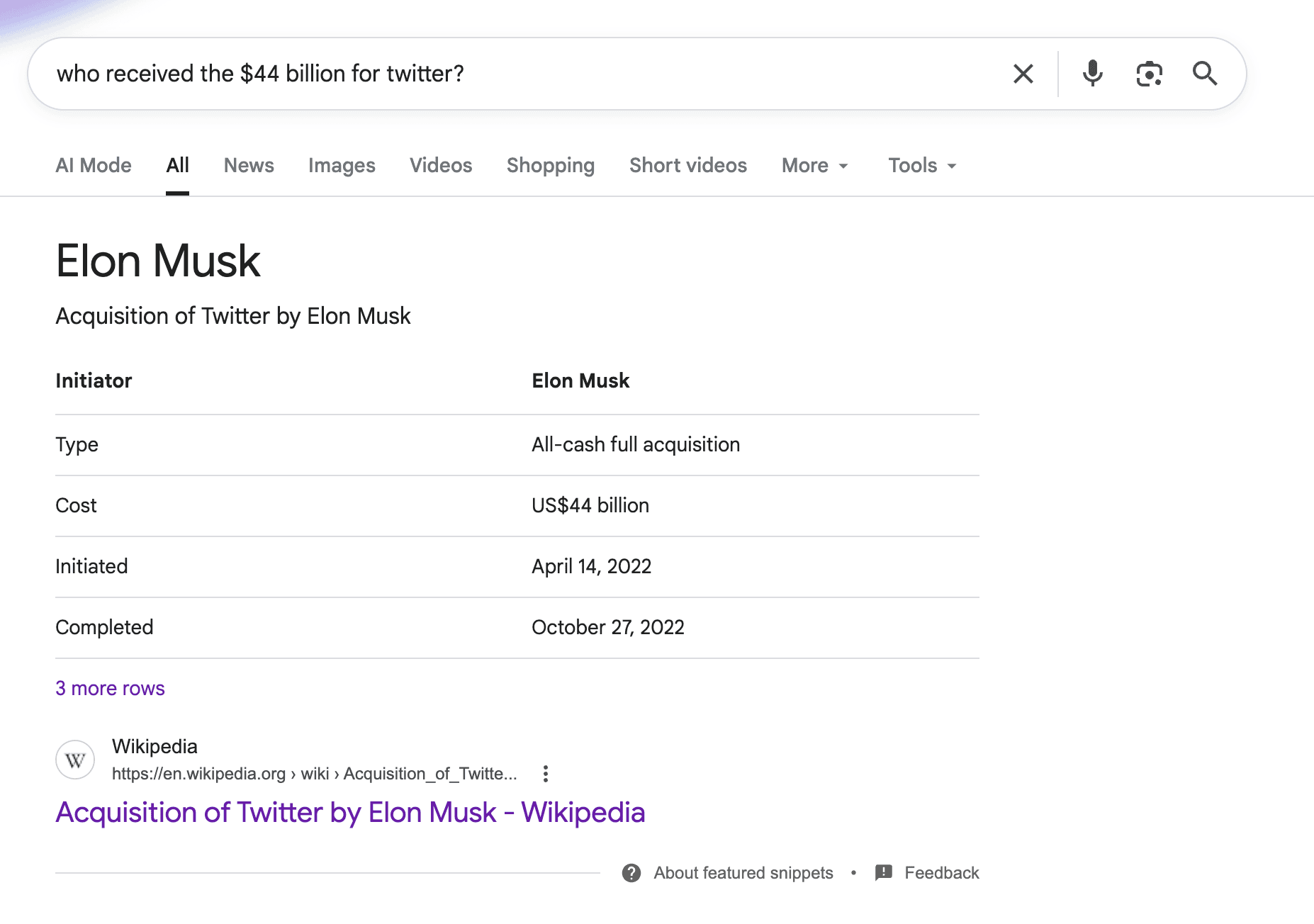
As you can see above, when you search for a question-based phrase, Google instantly gives you a quick answer (which is also known as “answer box” or “featured snippet”).
That’s why targeting question-style queries can improve your chances of appearing in voice results and featured snippets.
Google uses “semantic search technology” to process users’ queries.
Google’s “Searches related to” section also uses the same semantic technology to provide relevant keyword terms at the end of search results.
Semantic search technology takes the following things into consideration.
- Natural language understanding (NLP)
- User context
- Query stream context
- Entity recognition

How to find question-based keywords?
The simplest (and free) way to find question-based keywords is to use Google’s “People also ask” suggestions, as they can help you discover all the keywords your users are searching for.
For instance, if you’re trying to rank for “how to use a MacBook”, you can use the “People also ask” section to discover what questions people are actually asking.
Have a look;
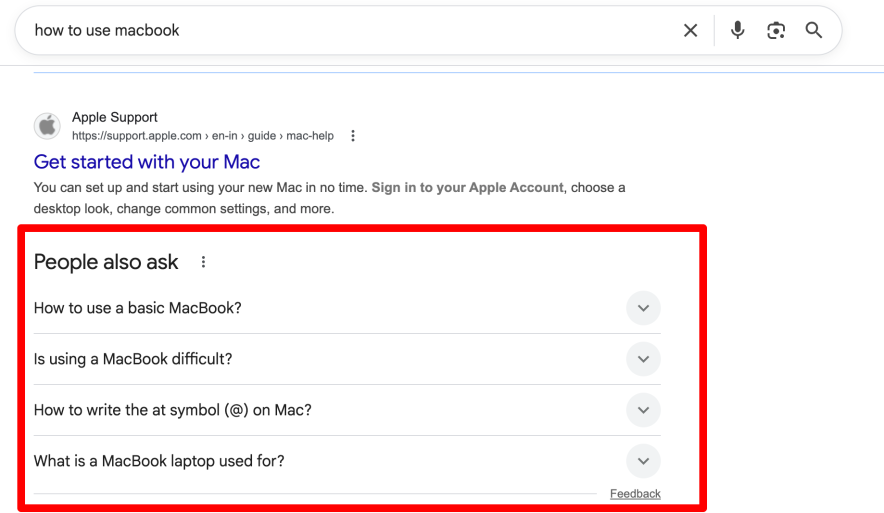
See that? You can find all the relevant question-based keywords for most of the phrases using the “People also ask (PAA)” section.
How to optimize for question-based keywords?
- Target natural questions users ask: Focus on phrases starting with how, what, why, when, where, and the best way to.
- Use conversational long-tail keywords: Voice searches are usually longer and more natural, so optimize for full questions rather than short phrases.
- Answer questions directly: Provide concise answers (1–3 sentences) followed by detailed explanations. If possible, try to answer within the first few lines.
- Add FAQ sections: FAQs help you target multiple question queries and increase your chances of appearing in voice answers.
Did you know that 70% of searches are long-tail keywords? And many of them are conversational or question-based, especially in voice search.
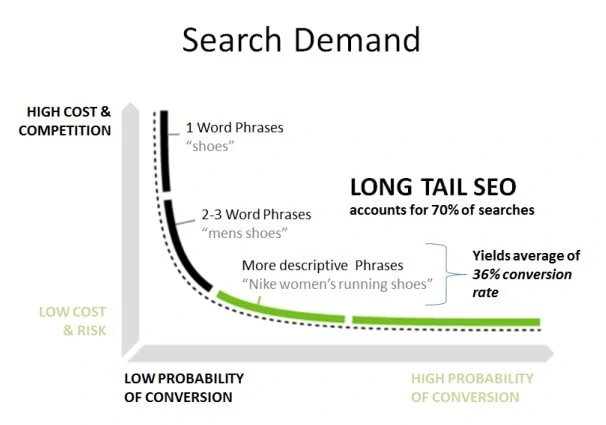
That’s why Google is increasingly rewarding websites with higher rankings that don’t just target single keywords, but cover an entire topic in depth and answer specific user questions.
Building topical authority means creating in-depth content around one specific topic, which also improves your chances of appearing in voice search results.
For example, instead of writing only about “SEO tools,” publish related posts like best SEO tools for beginners, free SEO tools list, how to choose SEO tools, and SEO tools comparison, and then link them together.
Why combine topical authority with long-tail keywords in 2026?
- Higher conversion rates since long-tail searches have clearer user intent
- Easier rankings due to lower competition compared to broad keywords
- Better voice search visibility because people naturally speak in conversational queries
So, how to pick better long tail keywords in your niche?
One of the easiest ways to find long-tail keywords is to start with a broad topic and type it into Google.
You will then see Google autocomplete suggestions like this one;

See that? When you enter a broad keyword phrase like “best website builder” on Google search, you’ll instantly get a ton of long-tail keyword ideas as Google autosuggestions.
For in-depth long-tail keyword research, use tools like Ubersuggest or Semrush, as they offer more keyword metrics.
Have a look at the keywords generated by Semrush tool;
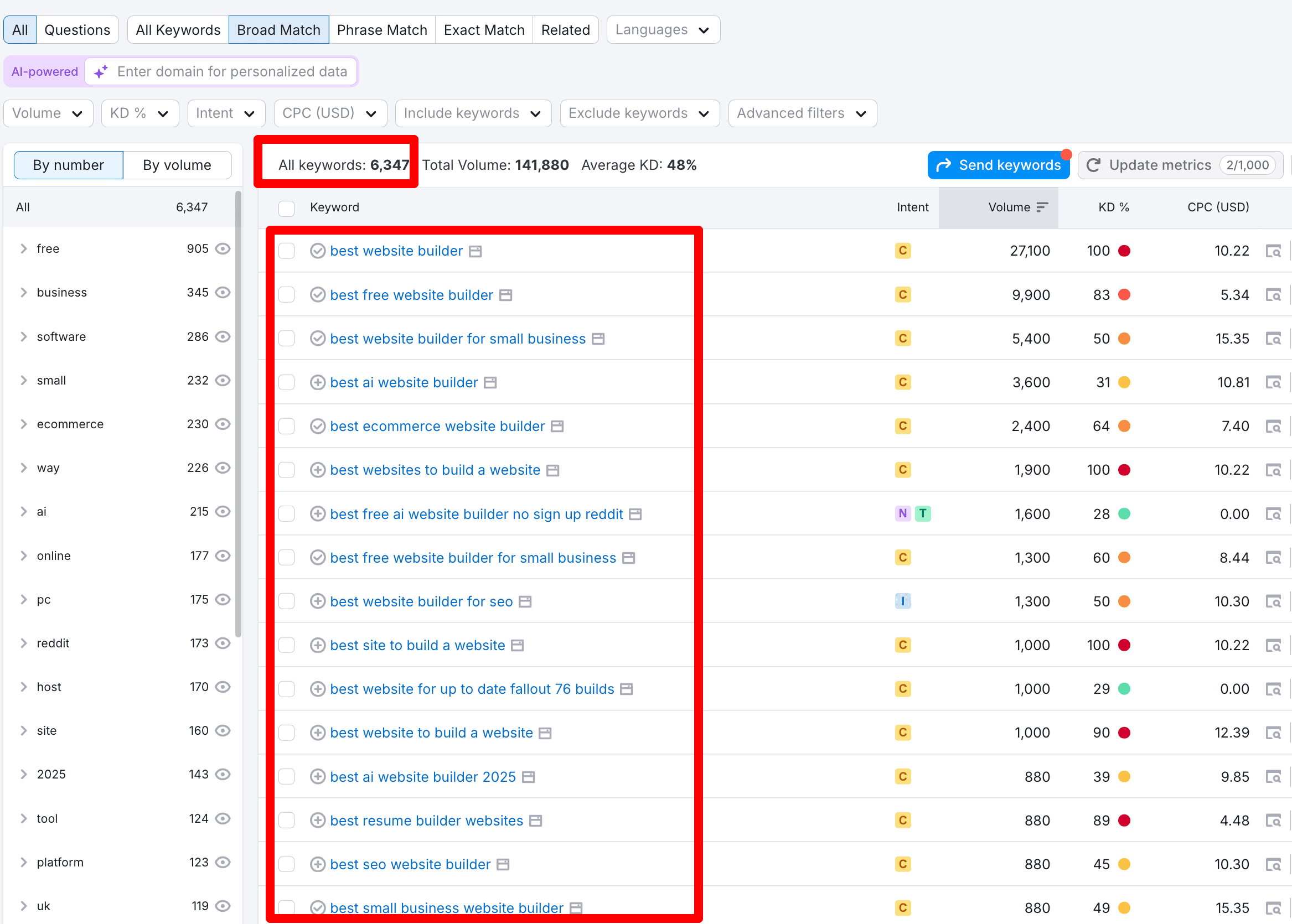
How to optimize your website for topical authority using long-tail keywords?
- Start with a broad pillar topic (Example: Digital marketing)
- Then, create multiple related supporting articles around it (Examples: “SEO Basics for Beginners”, “Email Marketing Step-by-Step Guide”, “Social Media Marketing Strategy for Small Businesses”, etc)
- Target long-tail and conversational keywords that contain real user questions (Example: “How much does digital marketing cost for a small business?”)
- Use Google autocomplete, People Also Ask, or SEO tools like Semrush to find keyword ideas.
- Interlink all related posts to improve topical relevance and authority.
4. Create Conversational Content That Matches Natural Speech
Conversational content means writing as if you’re talking to someone.
Instead of using complex language, you use simple words, easy-to-understand sentences, and a friendly tone that feels personal.
Simple and easy-to-read content may help with voice search optimization.
Don’t use jargon. Don’t write in a corporate tone. Write as you talk. That’s the best way to optimize your content for voice searches.
Here are some effective tips for creating conversational content that helps improve your voice search optimization.

Solve a problem: With every blog post you write, solve a problem. Pick one theme (or topic) for every individual post. Try to cover A to Z information about that topic. Make 10x better than the other top 10 search results.
Make it appealing: Use plenty of graphics, such as pictures, videos, or graphs, in your blog posts. They hook your audience and make your content visually appealing. You can use tools like Canva to create engaging graphics for your content.
Tell a story: Whenever possible, tell a story. Share your experiences. People connect to stories. That’s why we often write about our blogging failures, journeys, earnings reports, and more, as they instantly grab our audience’s attention.
Come up with great topic ideas: No matter how great your content is, if your topic is not engaging, most people will NOT connect to it. That’s why it’s so important to know your audience, find their wants and needs, and brainstorm great ideas that connect with them.
Structure content logically: Use headings, bullets, and short paragraphs for quick understanding. Use a Table of Contents to help readers quickly go to the sections they need and improve overall user experience.
5. Improve Technical SEO for Voice Readability
Since most voice searches happen on mobile, it is a no-brainer to make your website fully optimized for mobile devices.
And… the most important thing is that Google uses mobile-first indexing, meaning it primarily uses the mobile version of your content for indexing and ranking.
Earlier, rankings were largely based on desktop versions, but today only fast, mobile-friendly sites that deliver a smooth user experience tend to perform well in mobile and voice search results.
What should you do?
- Make your site fully mobile-responsive: Your design should automatically adapt to different screen sizes without breaking the layout or readability.
- Use a mobile-friendly theme or plugin: If your site isn’t responsive yet, switch to a responsive theme or use tools like WP Touch to improve mobile usability quickly.
- Improve mobile speed and UX: Ensure text is readable, buttons are easy to read and click, and pages load fast to reduce bounce rates.
- Consider a custom responsive design: If your budget allows, hiring a developer to create a unique mobile experience can significantly improve performance and rankings.

Improve Page Loading Times
Slow websites hurt rankings, especially for voice search, where users expect instant answers.
Google considers page speed (including TTFB — Time To First Byte, the time your server takes to respond) as a ranking factor.

Here are proven ways to speed up your site to increase your chances of ranking for voice searches.
- Choose a fast web host: Hosting quality directly impacts loading time. A slow server can drive users away within seconds, so invest in performance-focused hosting.
- Use a CDN (Content Delivery Network): A CDN stores copies of your site across global servers, delivering content from the nearest location to users for faster loading worldwide.
- Enable caching: Caching plugins create lightweight static versions of your pages, reducing server processing time and improving speed.
- Compress and optimize images: Large images slow down pages. Use modern formats (such as WebP) and compression tools to reduce file size without losing quality.
- Minify and clean up code: Reduce unnecessary CSS, JavaScript, and plugins to make your pages lighter and faster. We use and highly recommend WP Rocket, which offers advanced caching features to improve page load times.
That said, if you’re looking for more ways to increase your site’s speed, read this guide.
6. Use Structured Data & Schema Markup
If you want to rank for voice search in 2026, structured data is a must.
Structured data (also called schema markup) helps search engines like Google better understand your content.
Instead of guessing what your page is about, Google clearly sees:
- This is a question
- This is an article
- This is a how-to guide
And when Google understands your content better, you increase your chances of appearing in:
- Featured snippets
- Voice search answers
- AI summaries
You can test everything using Google’s Rich Results Test tool to make sure your schema markup is implemented correctly and eligible for rich snippets in search results.
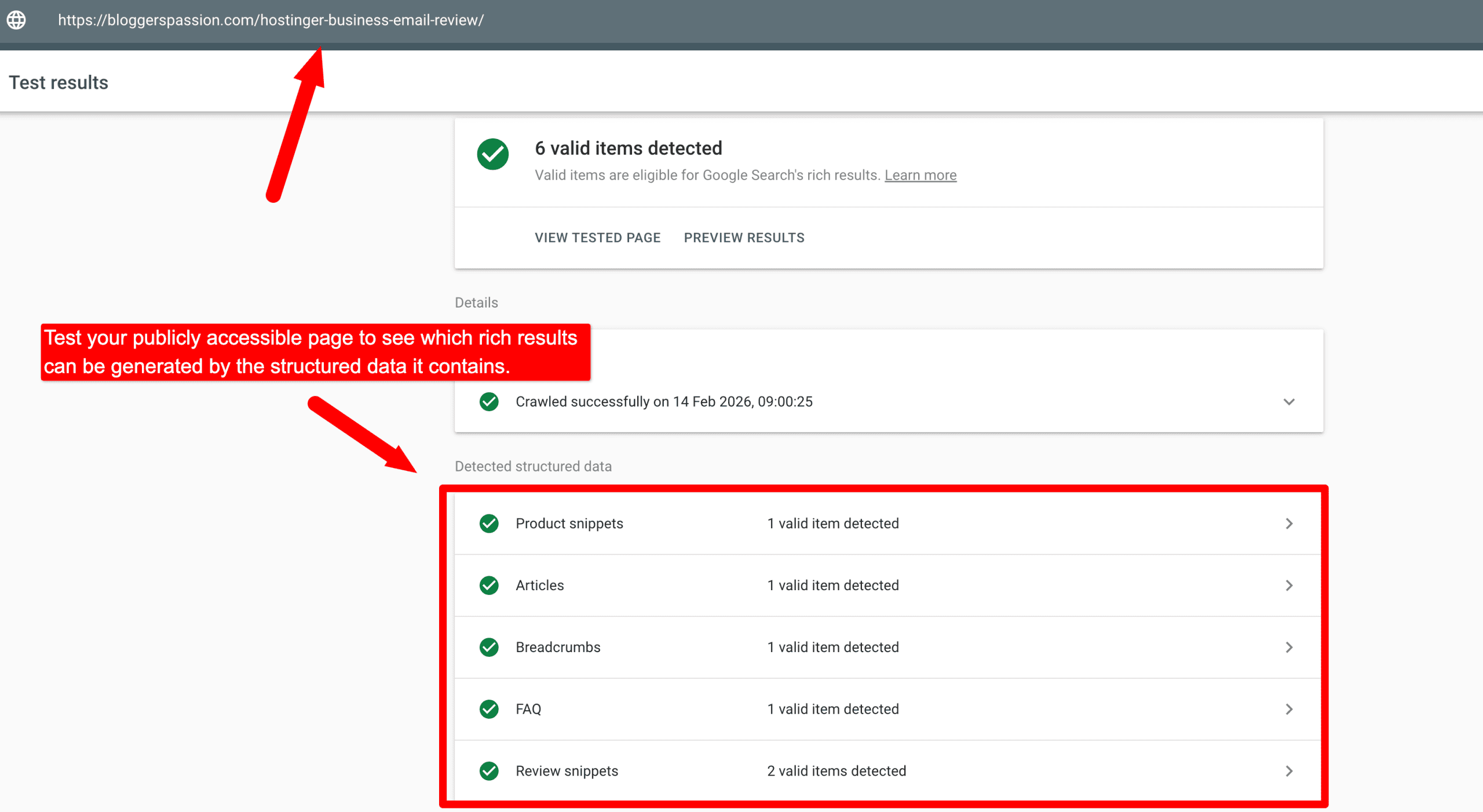
To optimize your website for voice search using schema:
- Add the FAQ schema to your important blog posts. You can easily implement it with Rank Math, which lets you add structured FAQ markup without touching any code.
- Add HowTo schema to step-based guides (RankMath helps you with this)
- Add LocalBusiness schema (if you run a local business)
7. Dominate Local & “Near Me” Searches
Did you know that 58% of voice search users are looking for business information? And 27% visit a business they found through voice search.

So you can’t ignore your local SEO, as you need to optimize for local SEO rankings, as people search for local businesses using voice searches.
Have a look at the following example.
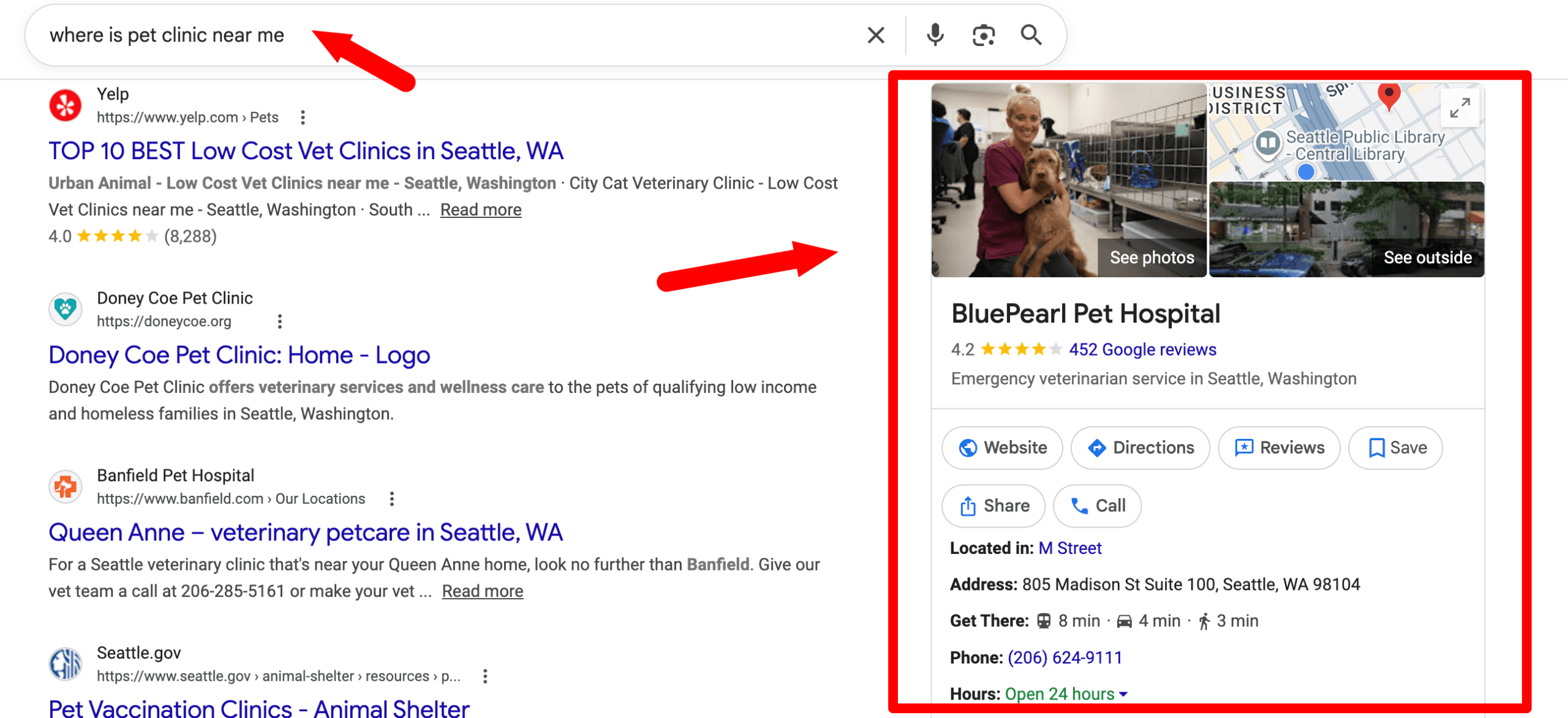
As you can see above, local businesses can get better organic rankings if they’ve perfected their local SEO optimization.
You can’t ignore local business directories such as Yelp, Yell, and Google Business Profile, as they can help you display customer ratings and business information.
Here are some local search ranking factors that you can’t ignore.
- Google Assistant returns the longest answers at 41 words. The typical voice search result is only 29 words in length.
- Businesses can implement local SEO techniques when optimizing for Google Assistant
- You can get better rankings in Apple’s Siri by generating a high Yelp rating and positive customer reviews
Here are a few amazing tips to improve your local SEO for voice searches.
- Create a Google Business Profile account, as it’s essential for anyone who wants to appear in Google search results. Make sure to provide accurate business information, such as Name, Address, and Phone number (NAP).
- Use natural, conversational keywords that match how people speak (e.g., “best dentist near me open now”), since voice searches are typically longer and question-based.
- Get listed in local online business directories such as Yelp, Google Business, Yellow Book, Apple Maps, and more, and aim to earn as many customer reviews as possible to stay ahead of your competitors.
- Optimize URL, title tags, headers, blog description, and content. Whether you’re running a normal website or a local business website, they are essential to boost your search rankings.
Above all, make sure to implement these essential local SEO tips to get #1 rankings on Google.
How to Optimize for Voice Search in 2026: A Quick Checklist
Here’s a quick checklist that helps you easily optimize your website for voice search.
- Use natural language with direct answers to provide answers to users’ questions
- Target long-tail and question-based keywords
- Answer queries clearly in the first 1–2 sentences
- Add FAQ sections with short and clear answers
- Optimize for featured snippets and AI overviews
- Improve page speed and mobile friendliness
- Use structured data (FAQ, HowTo, Local schema)
- Focus on local SEO and “near me” searches
- Create content around user intent, not just keywords
- Build topical authority
- Keep content easy to scan with short paragraphs and headings
Read: For SEO strategies focusing on voice search, consider these Answer the Public alternatives for better results.
FAQs | Voice Search Optimization
Here are some frequently asked questions about voice search optimization.
Voice search is a speech-recognition technology that allows users to search by speaking terms aloud rather than typing them into a search field.
20% of searches in the Google App are now by voice. Over 58% of users turn to voice search to find nearby businesses.
Optimize for conversational keywords, use structured data, load pages quickly, and provide direct answers that match user intent. Make sure to provide accurate information and use question-based keywords whenever possible.
Semrush, Ahrefs, AnswerThePublic, Google Search Console, and Ubersuggest help you find conversational keywords and optimize for voice queries.
Voice search optimization helps capture more mobile and voice assistant-based searches, increasing visibility and traffic.
Yes, faster-loading pages are more likely to be ranked for voice search results.
Yes, voice assistants often pull answers directly from featured snippets.
Read: People Also Search For (PASF): How to Rank for These Queries?
Final Thoughts
According to the PwC report, 71% of search users would rather use their voice assistant to search than type their queries. It’s quite evident that voice searches are increasing rapidly.
Now is the perfect time to build a voice search SEO strategy for your website or business if you want to boost search traffic and conversions.
What’s your take on voice search optimization? Are you already optimizing your site for it, or planning to start soon? Share your thoughts or questions in the comments below.



Hi Anil
Your all article giving some information and new ideas for SEO. In this article you have given that voice search option that will help to increase our websites. Some like higher ranking, increase traffic, and so on. In future this types of ideas will use and best benefit for websites.
Thanks Anil for sharing again nice article.
A complete guide to get done voice SEO. Thank you for sharing with us.
Voice Search is the future of online information search, This article sheds some light on voice search seo. Thankyou
Hello, Anil,
Voice Search definitely taking a quick pace in SEO. People tend more to use voice search. You have shared some detailed and in-depth posts to know more about voice search and how it works. It will definitely help bloggers a lot. Thanks again for sharing this awesome post.
Regards,
Vishwajeet Kumar
Wow!!! It was a great blog that specifies the value of Voice search in SEO. We know that coming time is totally dependant on AI so we have to see the future and according to this we need to upgrade ourself also.